
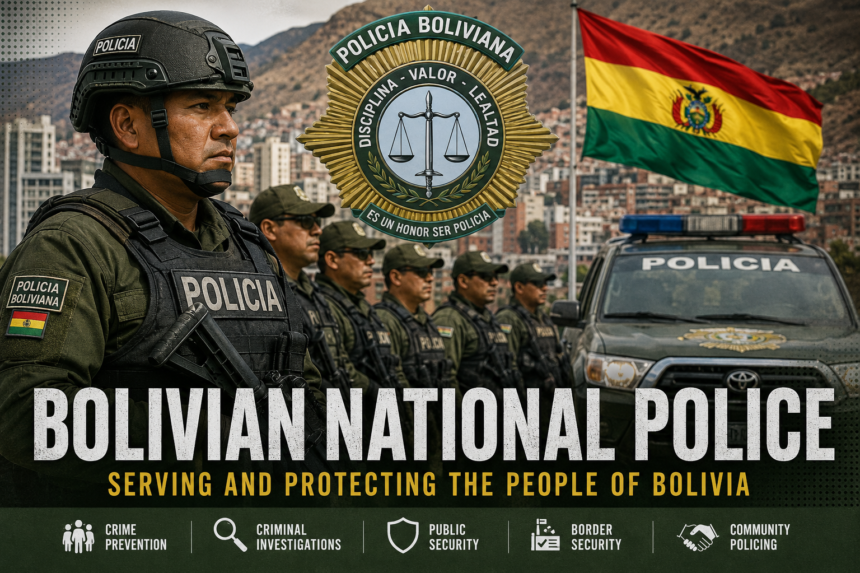
The Bolivian National Police (Policía Boliviana) is the principal law enforcement agency responsible for maintaining public order, enforcing national laws, preventing crime, and protecting citizens across the Plurinational State of Bolivia. Operating under the authority of the Ministry of Government, the institution plays a central role in safeguarding public security while supporting criminal investigations, border security, traffic management, and emergency response.
As Bolivia continues to address complex security issues such as organised crime, drug trafficking, cybercrime, and civil unrest, the Bolivia law enforcement system, led by the Bolivian National Police, remains one of the country’s most visible public institutions. The agency plays a central role in maintaining public safety, enforcing national laws, and supporting criminal investigations across the country. Although it has achieved notable successes in combating criminal networks and strengthening international cooperation, Bolivia law enforcement authorities continue to face ongoing challenges related to public confidence, modernisation, and institutional reform.
History of the Bolivian National Police
The origins of Bolivia’s national police date back to the early years following the country’s independence in 1825. Over nearly two centuries, the institution has undergone multiple reorganisations to adapt to changing political systems, constitutional reforms, and evolving security threats.
The modern legal framework governing the Bolivian National Police is established by Bolivia’s Constitution, which defines the police as a unified public force responsible for defending society, preserving public order, and enforcing the law throughout the national territory. The Constitution also specifies that the institution must remain politically neutral while operating under civilian authority.
Throughout its history, the police have participated in major national events, including responses to political demonstrations, natural disasters, organised crime investigations, and public safety operations. As Bolivia has urbanised and its security landscape has evolved, the institution has expanded both its operational capabilities and specialised units.
Organisational Structure
The Bolivian National Police operates under a central command led by the Commander General, who reports through the Ministry of Government.
Its organisational structure includes several specialised divisions, including:
- Criminal Investigation units
- Traffic Police
- Border Security Police
- Anti-Narcotics Forces
- Special Operations Units
- Cybercrime Investigation Teams
- Tourist Police
- Community Policing Divisions
Each regional department maintains local commands that coordinate policing efforts across Bolivia’s nine departments, ensuring law enforcement services are available from major cities such as La Paz, Santa Cruz, and Cochabamba to remote rural communities.
The institution also maintains specialised academies responsible for officer training, leadership development, and professional education.
Core Responsibilities
The National Police performs a broad range of law enforcement functions that extend beyond traditional policing.
Crime Prevention
Preventing crime remains one of the institution’s primary objectives. Officers conduct patrols in urban neighbourhoods, commercial districts, transportation hubs, and rural communities to deter criminal activity and respond rapidly to incidents.
Community policing initiatives also encourage cooperation between residents and local police officers to identify emerging security concerns before they escalate.
Criminal Investigations
Specialised investigators handle serious criminal cases involving homicide, robbery, kidnapping, financial crimes, organised crime, cybercrime, and corruption.
Investigators collect forensic evidence, interview witnesses, coordinate with prosecutors, and prepare cases for judicial proceedings.
Public Order
The Bolivian National Police is responsible for maintaining order during public demonstrations, sporting events, festivals, elections, and other large gatherings.
Balancing public safety with constitutional rights to peaceful assembly remains an important aspect of these operations.
Traffic Enforcement
Traffic police regulate road safety throughout Bolivia by enforcing traffic laws, investigating collisions, managing congestion, and conducting road safety awareness campaigns.
Growing vehicle ownership has increased demand for improved traffic management across Bolivia’s rapidly expanding urban centres.
Counter-Narcotics Operations
Bolivia remains one of South America’s traditional coca-producing nations, making anti-drug operations a significant responsibility for law enforcement.
Specialised anti-narcotics units work to combat:
- Cocaine trafficking
- Illegal drug laboratories
- Smuggling networks
- Cross-border organised crime
- Money laundering linked to narcotics
These operations frequently involve coordination with customs authorities, prosecutors, neighbouring countries, and international law enforcement organisations.
Border Security
Bolivia shares borders with:
- Brazil
- Argentina
- Chile
- Peru
- Paraguay
These extensive frontiers create significant security challenges due to their length and diverse geography.
Police officers stationed at border crossings help combat:
- Human trafficking
- Migrant smuggling
- Drug trafficking
- Arms smuggling
- Vehicle theft
- Illegal trade
Border security has become increasingly important as organised criminal groups operate across multiple countries in South America.
International Cooperation
The Bolivian National Police actively cooperates with international law enforcement agencies.
Bolivia has been a member of INTERPOL since 1963, and its National Central Bureau in La Paz facilitates cross-border investigations, fugitive tracking, intelligence sharing, and cooperation against organised crime. International collaboration focuses particularly on drug trafficking, human trafficking, cybercrime, and economic crime.
These partnerships enable Bolivian authorities to participate in multinational investigations that extend beyond national borders.
Modernisation Efforts
Like many police agencies worldwide, the Bolivian National Police has invested in modernising its operational capabilities.
Recent improvements include:
- Digital criminal databases
- Improved forensic laboratories
- Electronic communication systems
- Cybercrime investigation capabilities
- Expanded surveillance technology
- Enhanced officer training programmes
Technology now plays an increasingly important role in intelligence gathering, evidence collection, and emergency response coordination.
Community Policing
Building stronger relationships with local communities has become an important priority.
Community policing initiatives seek to:
- Increase public trust
- Improve crime reporting
- Encourage neighbourhood cooperation
- Support youth crime prevention programmes
- Strengthen partnerships with schools and local organisations
These programmes recognise that effective policing depends not only on enforcement but also on collaboration between law enforcement and citizens.
Humanitarian and Emergency Response
Beyond criminal investigations, the National Police also assists during emergencies.
Police personnel frequently support:
- Flood response
- Landslide evacuations
- Earthquake assistance
- Missing persons searches
- Disaster relief coordination
- Crowd management during emergencies
Bolivia’s varied geography—including mountainous regions, forests, and flood-prone areas—requires officers to operate under challenging environmental conditions.
Current Challenges
Bolivian National Police, Despite ongoing reforms, the institution faces several significant challenges.
Organised Crime
Transnational criminal organisations continue to exploit regional smuggling routes.
Authorities regularly investigate networks involved in:
- Drug trafficking
- Human trafficking
- Illegal mining
- Wildlife trafficking
- Financial crimes
International cooperation remains essential for disrupting these networks.
Public Trust
As with many law enforcement agencies around the world, maintaining public confidence requires continuous improvements in transparency, accountability, and professional standards.
Government agencies and police leadership have implemented disciplinary regulations and integrity measures intended to strengthen institutional credibility.
Resource Constraints
Policing a geographically diverse country presents logistical challenges.
Remote communities may require additional personnel, specialised equipment, improved communications infrastructure, and transportation resources to ensure effective law enforcement coverage.
Cybercrime
The growth of internet usage has introduced new threats, including:
- Online fraud
- Identity theft
- Financial cybercrime
- Digital extortion
- Computer system intrusions
Specialised cybercrime investigators continue expanding their expertise to address these evolving risks.
Recent Operational Successes
The Bolivian National Police has participated in several notable international investigations targeting organised crime. Joint operations with foreign law enforcement agencies and INTERPOL have led to the arrest of high-profile fugitives and disrupted transnational criminal organisations involved in narcotics trafficking and money laundering. These operations demonstrate the increasing importance of international intelligence sharing in combating cross-border crime.
Looking Ahead
Future priorities for the Bolivian National Police are expected to include greater technological integration, expanded cybercrime capabilities, improved officer training, enhanced community engagement, and stronger international partnerships. As criminal methods evolve, continued investment in modern investigative tools and professional development will be critical to maintaining public safety.
Institutional reform efforts are also likely to focus on transparency, operational efficiency, and public accountability, ensuring the police can respond effectively to both traditional and emerging security challenges.
Read More: Confederation Bridge Canada: History, Facts, Length & Visitor Guide
Conclusion
The Bolivian National Police remains one of the country’s most important public institutions, carrying responsibility for law enforcement, crime prevention, public safety, and national security. From combating organised crime and drug trafficking to managing emergencies and supporting local communities, its responsibilities extend across nearly every aspect of public life.
While challenges such as organised crime, cyber threats, and resource limitations persist, ongoing modernisation and international cooperation continue to strengthen the institution’s capabilities. Through reforms, technological advancement, and collaboration with global law enforcement partners, the Bolivian National Police continues adapting to the changing security needs of Bolivia and its citizens.