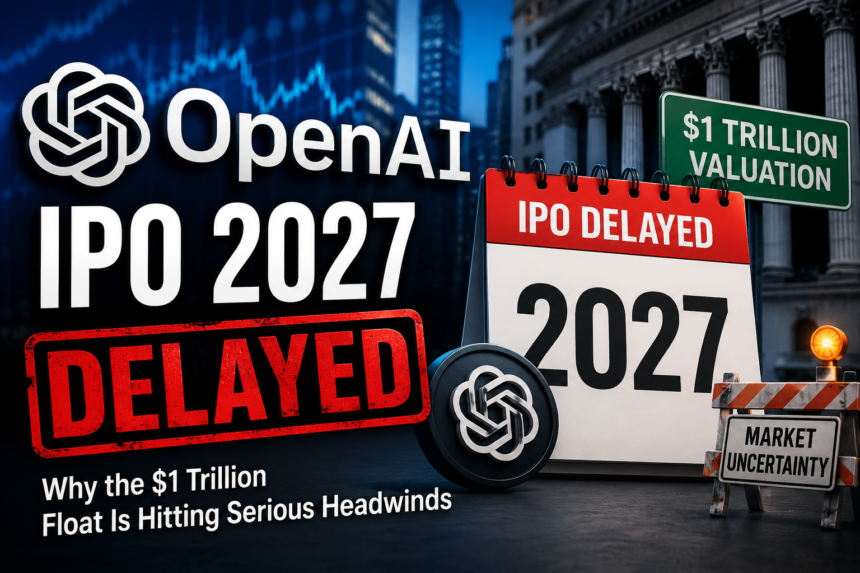
OpenAI IPO 2027, You’ve been keeping an eye on OpenAI and wondering when you’ll finally be able to buy shares? Well, you might want to settle in—because the wait just got a whole lot longer. Fresh reports indicate that OpenAI’s much-anticipated initial public offering has been quietly pushed back, possibly all the way to 2027. The delay comes as the company reportedly aims to protect its ambitious OpenAI IPO valuation target of $1 trillion, giving itself extra runway to navigate regulatory hurdles, shaky capital markets, and the enormous pressure of debuting at such a historic valuation. OpenAI has also reportedly made a confidential filing this month, allowing it to advance the IPO process while keeping its financial details private until market conditions improve.
Let’s dig into everything you need to know about this delay, what’s driving it, and what it means for investors, rivals, and the broader AI landscape.
What Exactly Happened With OpenAI’s IPO Plans?
Here’s the short version: OpenAI hasn’t scrapped its IPO — it’s just pumping the brakes. According to multiple reports, the company filed confidentially with regulators this month. That’s a strategic move, not a retreat. A confidential filing means OpenAI can begin the regulatory process without publicly revealing its financial details to the world just yet. Think of it like rehearsing for a massive concert backstage before the curtains go up. Nobody in the audience sees a thing until the company is good and ready.
This type of filing gives OpenAI breathing room. It can respond to SEC feedback, fine-tune its financial disclosures, and — crucially — wait for the right moment to step onto the public stage. And right now? That moment clearly hasn’t arrived.
Why Is the IPO Being Pushed to 2027?
OpenAI IPO 2027, You might be wondering: why not just go public now and ride the AI hype? That’s a fair question, but the reality is far more complicated. People close to the company’s advisory team reportedly believe the tech market is still too volatile for a listing of this magnitude. We’re not talking about a modest mid-cap offering here — this would be one of the largest IPOs in history.
OpenAI’s leadership, spearheaded by CEO Sam Altman, reportedly has a firm floor in mind: $1 trillion. Anything below that figure, and the company would rather stay private. When you’re swinging for that kind of valuation, you need everything — sentiment, timing, investor appetite — to align perfectly. And right now, those stars simply aren’t lined up.
The Market Isn’t Playing Along
Let’s be honest — the public markets have been a rollercoaster lately. Tech stocks, in particular, have faced headwinds ranging from rising interest rates to geopolitical uncertainty. One example that’s reportedly weighing on OpenAI’s decision is SpaceX’s weak aftermarket trading. When even a company like SpaceX struggles to sustain momentum after its secondary market activity, it sends a chilling signal to other megacap hopefuls waiting in the wings.
For OpenAI, launching into a lukewarm or bearish market would be like setting sail in a storm. Sure, the ship might survive, but why risk it when you can wait for calmer seas?
OpenAI’s Financial Reality: Growth vs. Losses
Now, let’s talk numbers — because this is where things get really interesting. OpenAI reportedly pulled in around $13 billion in revenue last year. That’s an astronomical figure for a company that didn’t even have a consumer product a few years ago. ChatGPT and its suite of AI tools have turned the company into a revenue-generating machine practically overnight.
But here’s the catch: OpenAI is still bleeding money. Despite that impressive top-line number, the company’s expenses — think compute costs, talent wars, research budgets, and infrastructure — are eating through cash at a staggering pace. For public market investors, that’s a tough pill to swallow. Growth is great, but profitability matters, especially when you’re asking people to value your company at a trillion dollars.
Sam Altman’s $1 Trillion Line in the Sand
OpenAI IPO 2027, Sam Altman isn’t just any tech CEO — he’s arguably the most prominent figure in the AI revolution right now. And by all accounts, he’s not interested in letting OpenAI go public at a discount. Reports suggest he’s drawn a clear line: the IPO happens at $1 trillion or it doesn’t happen at all.
That’s a bold stance, but it makes sense when you think about it. OpenAI was last valued at roughly $852 billion in its most recent private funding round. Going public below that figure — or even at a modest premium — would send all the wrong signals. It would suggest the AI boom is cooling, that investors aren’t willing to pay up, and that OpenAI’s best days might already be priced in. None of those narratives serve the company well.
How Does the Confidential Filing Work?
If you’re not familiar with the process, a confidential IPO filing is actually quite common among major tech companies. Under SEC rules, companies can submit their registration documents without making them public right away. The filings only need to be disclosed at least 15 days before the company begins its investor roadshow.
This gives OpenAI several key advantages. First, it can engage with regulators privately, addressing any concerns or required changes without the media circus that comes with a public filing. Second, it keeps competitors and the broader market in the dark about its exact financial position. And third, it provides maximum flexibility — if the market tanks or conditions worsen, the company can simply delay without the embarrassment of pulling a publicly announced offering.
SoftBank Feels the Ripple Effects
OpenAI IPO 2027, OpenAI’s delay isn’t happening in a vacuum. When reports of the postponement started circulating, SoftBank’s shares reportedly tumbled around 13%. That’s a significant hit, and it highlights just how intertwined the fortunes of major tech investors are with OpenAI’s trajectory.
SoftBank has been one of the most aggressive backers of AI, and a blockbuster OpenAI IPO would have been a massive win for the conglomerate’s portfolio. A delay to 2027 means SoftBank — and other major stakeholders — will have to wait longer to see a public market return on their investment. For shareholders of these investment firms, patience is going to be the name of the game.
Anthropic Enters the Chat: A Rival’s Confidential Filing
Here’s where the plot thickens. OpenAI isn’t the only AI giant tiptoeing toward public markets. Anthropic, its most formidable rival, has also reportedly filed confidentially. And Anthropic’s private valuation? A staggering $965 billion — putting it in roughly the same weight class as OpenAI.
This creates a fascinating dynamic. Neither company wants to go first and potentially stumble, giving the other a strategic advantage. It’s like two heavyweight boxers circling each other in the ring, each waiting for the other to throw the first punch. The timing of their respective IPOs could have enormous implications for AI valuations across the board.
What Does This Mean for AI Investors?
OpenAI IPO 2027, If you’re an everyday investor excited about getting a piece of the AI pie through an OpenAI IPO, this delay is a dose of cold reality. The public markets may not be ready to embrace a company that’s growing explosively but still posting heavy losses. We’ve seen this movie before with companies like Uber and WeWork — massive hype, sky-high valuations, and then a public market reckoning when investors demand a clearer path to profitability.
That said, a delay isn’t necessarily bad news. It gives OpenAI more time to tighten its operations, move closer to profitability, and build an even stronger case for that $1 trillion valuation. When the IPO finally happens, it could be on much firmer footing.
No Public Prospectus — Yet
One important thing to keep in mind: because OpenAI’s filing is confidential, there’s no public prospectus available for you to read right now. That means we don’t have access to the detailed financial breakdowns, risk factors, and business strategies that would normally accompany a public filing. All we have are the reported figures and the strategic signals coming from people close to the process.
Until the SEC eventually releases those documents — which won’t happen until OpenAI is ready to move forward with a roadshow — much of what we know remains based on leaks and informed speculation.
The Bigger Picture: Is the AI Bubble Showing Cracks?
Let’s zoom out for a moment. OpenAI delaying its IPO, Anthropic filing confidentially, SoftBank‘s stock taking a hit — does all of this point to cracks forming in the AI investment thesis? Not necessarily, but it does suggest that the market is entering a more mature, discerning phase. The days of slapping “AI” on a company and watching its valuation skyrocket may be fading. Investors want to see real revenue, sustainable margins, and a genuine path to long-term profitability.
That’s actually a healthy development. It separates the truly transformative companies from the pretenders and forces even the best players — like OpenAI — to prove their worth before demanding trillion-dollar valuations.
Read More: SpaceX Stock Crash: How Elon Musk’s Space Giant Lost $600 Billion in Just 3 Days
Conclusion
OpenAI IPO 2027, OpenAI’s IPO delay to 2027 is more than just a scheduling change — it’s a signal that even the most dominant player in artificial intelligence isn’t immune to market realities. Between volatile tech markets, massive operational losses, regulatory complexities, and the towering expectation of a $1 trillion debut, there are simply too many moving parts to rush this process. Sam Altman and his team are clearly playing the long game, and the confidential filing gives them the flexibility to pick their moment wisely. For investors, the takeaway is simple: the AI revolution isn’t slowing down, but getting a seat at the table through OpenAI’s public offering is going to take more patience than anyone originally expected. When this IPO eventually lands, it could redefine what a tech debut looks like — but only if the timing is right.