Medical Tourism India 2026 Affordable Treatment, India has always been recognised for its ancient healing traditions such as Ayurveda, Yoga, Naturopathy, Siddha, and Unani. However, in 2026, the country is gaining global attention for something far more comprehensive. India is now simultaneously one of the world’s most advanced destinations for modern clinical medicine and a global leader in preventive and holistic wellness.
This unique combination of advanced surgical expertise, internationally accredited hospitals, affordable treatment costs, and thousands of years of traditional healing knowledge has made India the undisputed global leader in medical tourism.
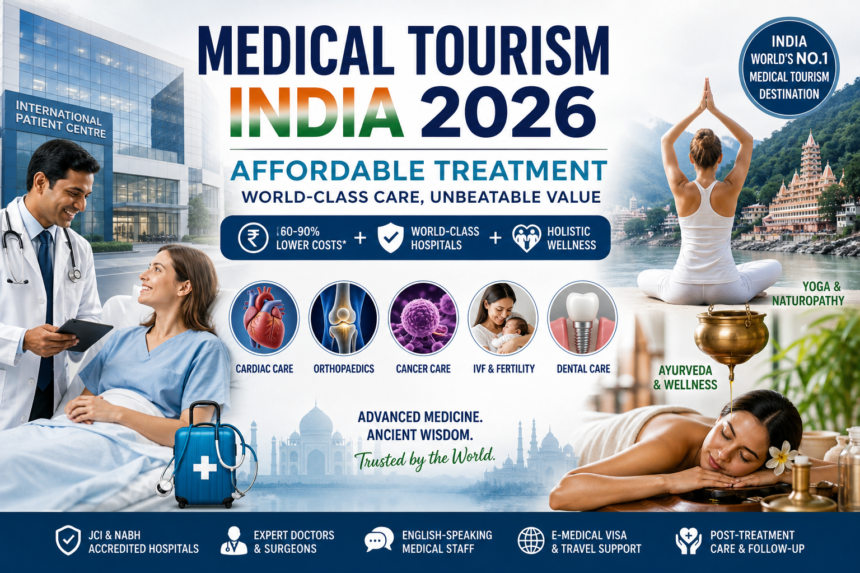
More than 2 million international patients are expected to travel to India for medical treatment in 2026. The sector is projected to contribute over USD 9 billion to the Indian economy. From cardiac surgeries and cancer treatment to fertility care, dental procedures, orthopaedics, and luxury wellness retreats, India offers world-class healthcare outcomes at prices that are 60% to 90% lower than equivalent treatment costs in countries like the United States, the United Kingdom, and Australia.
This comprehensive guide explains why India dominates the medical tourism industry in 2026 and how both international and domestic patients can access the best healthcare and wellness services in the country.
Why India Is the World’s Top Medical Tourism Destination in 2026
Unmatched Cost Advantage
Medical Tourism India 2026 Affordable Treatment, Affordability remains the biggest reason why patients choose India for medical treatment. Procedures that cost lakhs or even crores abroad are available in India at a fraction of the price without compromising quality.
Here is a comparison of average treatment costs in India versus the United States:
- Heart bypass surgery: India Rs 3-5 lakh vs USA USD 130,000+ (Rs 1.23 crore+)
- Hip replacement: India Rs 4-6 lakh vs USA USD 40,000+ (Rs 38 lakh+)
- IVF treatment (one cycle): India Rs 1-2 lakh vs USA USD 15,000+ (Rs 14 lakh+)
- Dental implant (per tooth): India Rs 20,000-40,000 vs USA USD 3,000-5,000 (Rs 2.8-4.7 lakh+)
- Cancer treatment (chemotherapy course): India Rs 5-15 lakh vs USA USD 100,000+ (Rs 95 lakh+)
Even after including airfare, accommodation, recovery, and local travel expenses, treatment in India is often significantly cheaper than undergoing the same procedure in Western countries.
World-Class Medical Infrastructure
India’s top hospitals are equipped with cutting-edge medical technology, internationally trained specialists, robotic surgery systems, advanced diagnostic equipment, and globally recognised quality certifications.
Leading healthcare groups such as Apollo Hospitals, Fortis Healthcare, Narayana Health, Kokilaben Dhirubhai Ambani Hospital, AIIMS, Max Healthcare, and Manipal Hospitals routinely perform highly complex procedures with success rates comparable to the best hospitals in the United States and Europe.
Many Indian hospitals are accredited by Joint Commission International (JCI) and the National Accreditation Board for Hospitals (NABH), ensuring international-quality standards in patient care and safety.
English-Speaking Medical Professionals
Another major advantage India offers is the widespread use of English in healthcare settings. Doctors, surgeons, nurses, and hospital administrators across major Indian hospitals communicate fluently in English.
As a result, international patients face fewer communication difficulties compared to several other medical tourism destinations where language barriers can complicate treatment planning and recovery.
Most Popular Medical Treatments in India for International Patients
Cardiac Care
Medical Tourism India 2026 Affordable Treatment, India has become one of the world’s leading destinations for cardiac treatment. International patients regularly travel to India for bypass surgeries, angioplasties, valve replacements, minimally invasive cardiac procedures, and paediatric heart surgeries.
Narayana Health, founded by renowned cardiac surgeon Dr Devi Shetty, revolutionised affordable heart care through large-scale operational efficiency. Today, the institution’s healthcare model is studied by global business schools and healthcare experts.
Indian cardiac surgeons are known for their extensive experience due to the high volume of procedures performed every year.
Orthopaedics and Joint Replacement
Orthopaedic treatment is another major strength of India’s healthcare sector. Thousands of patients from the UK, USA, Middle East, and Africa visit India annually for knee replacements, hip replacements, spinal surgeries, and sports injury treatment.
Because Indian orthopaedic surgeons perform these procedures at exceptionally high volumes, they possess substantial surgical expertise. Additionally, the overall cost of surgery, rehabilitation, physiotherapy, and hospital stay remains dramatically lower than equivalent procedures abroad.
Cancer Treatment
Oncology has emerged as one of India’s strongest medical tourism specialties. Top Indian cancer hospitals now offer advanced services including:
- Proton therapy
- Robotic surgery
- Immunotherapy
- Precision oncology
- Advanced chemotherapy
- Bone marrow transplantation
Compared to countries with overloaded public healthcare systems such as the UK, India offers much shorter waiting periods for cancer treatment. Moreover, treatment costs remain a fraction of private healthcare expenses in the United States.
Fertility Treatments and IVF
India has become one of the world’s most sought-after destinations for fertility treatment and assisted reproductive technologies (ART).
Several factors contribute to India’s popularity in this sector:
- High-quality fertility clinics
- Experienced IVF specialists
- Competitive pricing
- Advanced reproductive technologies
- Strong success rates
Depending on the evolving legal framework, India also remains an important destination for certain surrogacy and donor-assisted reproductive services.
Dental Tourism
Dental tourism in India is expanding rapidly, especially among patients from the UK, USA, and Middle Eastern countries.
Popular dental procedures include:
- Dental implants
- Veneers
- Crowns and bridges
- Root canal treatment
- Full mouth rehabilitation
- Cosmetic dentistry
In many cases, the combined cost of treatment, flights, and accommodation in India is still lower than the standalone dental treatment cost in Western nations.
AYUSH and Wellness Tourism: India’s Unique Global Advantage
Medical Tourism India 2026 Affordable Treatment, While India excels in modern medicine, its greatest differentiator is the integration of traditional healing systems with preventive wellness.
No other medical tourism destination combines advanced hospital infrastructure with ancient systems such as Ayurveda, Yoga, Siddha, Unani, and Naturopathy on the same scale.
Ayurveda Retreats
Kerala is widely regarded as the global capital of authentic Ayurvedic treatment.
One of the most popular Ayurvedic therapies is Panchakarma, a detoxification and rejuvenation program designed to address chronic illnesses, stress, metabolic disorders, and lifestyle-related conditions.
Authentic Panchakarma treatment generally requires a residential stay of 14 to 21 days in a certified Ayurvedic centre. Depending on the institution and program depth, treatment costs typically range between Rs 1.5 lakh and Rs 5 lakh.
International wellness tourists increasingly choose India not only for disease treatment but also for preventive healthcare and long-term lifestyle transformation.
Yoga and Naturopathy
India also remains the global headquarters of yoga-based wellness tourism.
Cities such as Rishikesh in Uttarakhand and Mysuru in Karnataka attract thousands of international visitors every year for:
- Yoga teacher training
- Therapeutic yoga programs
- Meditation retreats
- Stress management
- Holistic wellness courses
- Naturopathy treatment
The global wellness industry’s rapid expansion has significantly increased international demand for authentic Indian yoga education and lifestyle programs.
Budget 2026-27: Government’s Push for Medical Tourism
The Union Budget 2026-27 highlighted medical tourism as a major economic opportunity for India.
The government proposed the development of five integrated healthcare hubs combining:
- Modern hospitals
- Research centres
- AYUSH facilities
- Wellness infrastructure
- Medical education institutions
In addition, the Medical Value Travel (MVT) Portal has been upgraded into a comprehensive digital platform where international patients can:
- Search hospitals
- Book consultations
- Access treatment packages
- Make payments
- Arrange travel assistance
- Plan post-operative care
These reforms are expected to simplify the patient journey and further strengthen India’s dominance in global medical tourism.
How to Plan Medical Travel to India
Choosing the Right Hospital
Patients should prioritise hospitals accredited by JCI or NABH. It is equally important to research the qualifications, experience, and treatment outcomes of the specific surgeon handling the procedure.
Most major Indian hospitals now have dedicated international patient departments that assist with:
- Visa support
- Airport transfers
- Accommodation
- Language assistance
- Medical coordination
- Follow-up planning
Applying for an e-Medical Visa
India offers a dedicated e-Medical Visa for international patients.
The visa generally allows:
- A 60-day stay
- Triple entry
- Extension up to six months in certain cases
- Two accompanying attendants under e-Medical Attendant Visas
Applications can be completed online through India’s official e-visa portal, and approval usually takes between 3 to 5 business days.
Obtaining Cost Estimates and Treatment Plans
Before travelling, patients should contact multiple hospitals and share their medical reports, diagnosis details, and previous treatment records.
Most hospitals provide:
- Detailed treatment estimates
- Procedure timelines
- Recovery expectations
- Online video consultations with specialists
Comparing estimates from at least two or three hospitals helps patients make informed decisions.
Post-Treatment Recovery and Follow-Up
Patients undergoing major surgery should plan adequate recovery time before flying home. Most surgeons recommend waiting at least 10 to 14 days after major surgery before long-distance air travel.
Additionally, patients should arrange follow-up care with a doctor in their home country before travelling to India.
Most Indian hospitals now offer teleconsultation support for international patients after discharge.
Challenges Facing India’s Medical Tourism Sector
Despite its rapid growth, India’s medical tourism industry still faces several challenges.
Regional Healthcare Imbalance
High-quality medical infrastructure remains concentrated in cities such as:
- Delhi
- Mumbai
- Bengaluru
- Chennai
- Hyderabad
Meanwhile, several regions including Central India and the North-East remain underserved.
Regulatory Gaps
Quality standards among smaller medical tourism facilitators, wellness retreats, and Ayurvedic centres can vary significantly. Stronger regulation and standardisation are still needed.
Language Barriers for Non-English Speakers
Although English is widely spoken in major hospitals, patients from non-English-speaking regions may face communication challenges in smaller healthcare facilities.
Insurance Limitations
Many international insurance providers still do not fully cover medical treatment in India. Consequently, a large percentage of medical tourists continue to rely on self-funded healthcare.
Read More: Spirit Airlines Shutdown: Why the Budget Carrier Collapsed After 34 Years
Conclusion
Medical Tourism India 2026 Affordable Treatment, India’s medical tourism sector represents a rare combination of advanced technology, medical expertise, affordability, ancient healing wisdom, and compassionate patient care.
As the country continues investing in healthcare infrastructure, research, digital health systems, and wellness tourism, India’s position as the world’s leading medical tourism destination is expected to grow even stronger in the coming years.
Whether you are an international patient seeking affordable world-class treatment or an Indian patient exploring premium private healthcare options, India today offers some of the best healthcare value anywhere in the world.
Taza Newsz continues to cover India’s healthcare sector, hospital developments, wellness trends, and government health policies to help readers stay informed about the future of healthcare in India.
With a finger on the pulse of Bollywood and a keen eye for digital trends, Kiara Sharma captures the vibrant world of entertainment for Taza Newsz. A mass media postgraduate from Delhi University, she started her journey as a lifestyle blogger before moving into mainstream entertainment journalism.Kiara specializes in bridging the gap between cinema and the audience, offering fresh perspectives on everything from box-office titans to hidden gems on Netflix and Amazon Prime. Her writing goes beyond gossip, diving into celebrity fashion, wellness trends, and the cultural impact of Indian cinema. Whether she is breaking news on an upcoming big-budget release or curating the perfect weekend watchlist, Kiara ensures her readers are always the first to know. Off-duty, she is an avid traveler and a classical dancer. | View all posts