
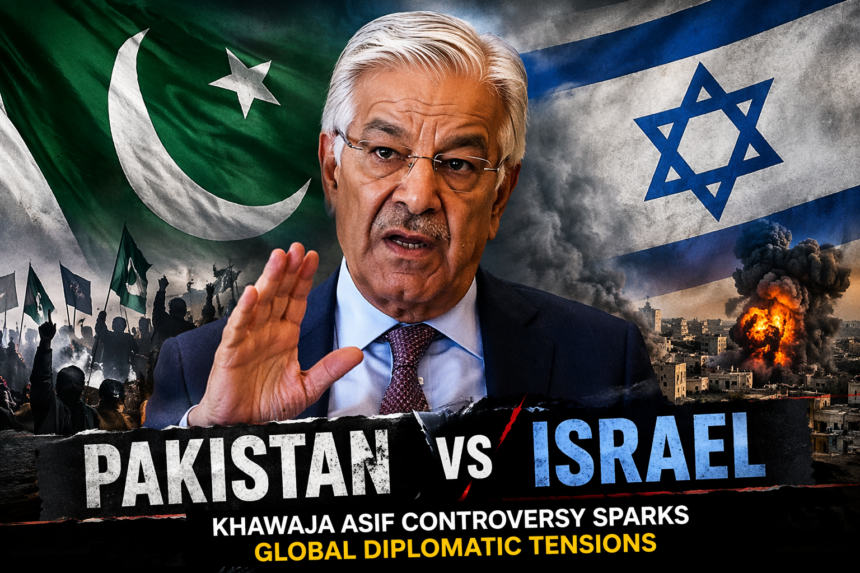
Pakistan vs Israel, In the ever-volatile landscape of Middle Eastern and South Asian geopolitics, words can be as powerful as weapons. And recently, a single social media post sparked a full-blown diplomatic controversy between Pakistan and Israel.
At the center of this storm? Pakistan’s Defence Minister, Khawaja Asif. His now-deleted remarks triggered outrage from Israeli officials and raised serious questions about Pakistan’s role as a neutral mediator in ongoing peace efforts involving United States and Iran.
This rapidly escalating situation has now come to be widely recognized as the Khawaja Asif controversy, drawing global attention and intense diplomatic scrutiny.
Let’s break down what happened—and why it matters more than it might seem at first glance.
What Exactly Did Khawaja Asif Say?
It all started with a series of strongly worded social media posts. Khawaja Asif openly criticized Israel’s military operations, particularly in Lebanon.
He didn’t hold back. In his statements, he labeled Israel as “evil” and even went as far as calling it a “curse on humanity.” That’s not typical diplomatic language—it’s more like throwing gasoline on an already raging fire.
He also connected the dots between ongoing violence in regions like Gaza, Iran, and Lebanon, accusing Israel of sustained aggression and civilian casualties.
But here’s the twist—he deleted the posts shortly after. Why? Because the backlash was swift and intense.
Israel’s Sharp and Immediate Response
Israel didn’t stay silent. Not even close.
The Israeli Prime Minister’s Office issued a strong statement condemning Asif’s remarks as “outrageous.” According to them, such language crosses a line—especially when it comes from a senior government official.
Even more significantly, Israel questioned Pakistan’s credibility as a neutral party in peace negotiations. Think about it: if you’re trying to mediate a conflict, can you really afford to publicly attack one side?
Israel’s message was clear—you can’t play referee while openly criticizing one of the teams.
Foreign Minister Gideon Sa’ar Weighs In
Pakistan vs Israel, The criticism didn’t stop there. Gideon Sa’ar also entered the conversation, calling Asif’s statements “blatant antisemitic blood libels.”
That’s a serious accusation. It signals that Israel viewed the remarks not just as political criticism, but as something deeper and more troubling.
Sa’ar also reiterated a familiar stance—Israel will defend itself against any threats to its existence. In geopolitical terms, that’s a firm line in the sand.
Timing Couldn’t Be Worse for Pakistan
Here’s where things get complicated.
Pakistan is currently playing a delicate role on the global stage. It has been credited with helping broker a temporary two-week ceasefire between the United States and Iran—a significant diplomatic achievement.
On top of that, Islamabad is preparing to host further peace talks. That’s a big deal.
But now, this controversy threatens to undermine those efforts. It’s like trying to build a bridge while simultaneously shaking its foundation.
Can Pakistan Really Be a Neutral Mediator?
This is the million-dollar question.
Pakistan does not officially recognize Israel. That alone already complicates its position as a neutral mediator in regional conflicts involving Israel.
Now add inflammatory statements from a senior minister into the mix—and the neutrality argument becomes even harder to defend.
From Israel’s perspective, the skepticism is understandable. After all, diplomacy requires trust, and trust is fragile.
The Lebanon Factor: A Key Point of Disagreement
Another layer to this issue lies in Pakistan’s stance on Lebanon.
Islamabad has insisted that any ceasefire agreement should include Lebanon. Israel, however, disputes this condition.
This disagreement isn’t just technical—it reflects deeper strategic differences. Pakistan appears to be advocating for a broader regional ceasefire, while Israel is focusing on its immediate security concerns.
It’s like negotiating a deal where both sides are reading from entirely different scripts.
Social Media: A Double-Edged Sword in Diplomacy
Let’s take a step back.
Would this controversy have escalated as quickly without social media? Probably not.
Platforms like X (formerly Twitter) have become powerful tools for politicians—but they’re also risky. One impulsive post can spiral into an international incident.
Khawaja Asif’s deleted remarks are a textbook example. Once something is online, it’s never really gone.
Geopolitical Ripple Effects
Pakistan vs Israel, This isn’t just a bilateral issue between Pakistan and Israel. It has wider implications.
- It affects Middle Eastern stability
- It influences global diplomatic alignments
- It shapes perceptions of Pakistan’s foreign policy
In geopolitics, perception often matters as much as reality. And right now, the perception isn’t entirely in Pakistan’s favor.
Damage Control: Too Little, Too Late?
Deleting the post was a step toward damage control—but was it enough?
In diplomacy, actions speak louder than words—but words still leave a lasting imprint. The incident has already been noted, analyzed, and reacted to by global stakeholders.
It’s like trying to unring a bell. Once the sound is out there, it echoes.
Impact on US-Iran Peace Talks
The bigger picture here is the potential fallout on U.S.-Iran diplomacy.
Pakistan has positioned itself as a facilitator—an intermediary trying to ease tensions between Washington and Tehran.
But controversies like this can erode confidence. If one party perceives bias, the entire negotiation process could stall.
And let’s be honest—peace talks are already fragile. They don’t need additional complications.
Read More: Why the US Iran Ceasefire May Not Hold: Lebanon Could Be the Breaking Point
Conclusion
Pakistan vs Israel, This episode serves as a powerful reminder of how sensitive international relations can be.
A few sentences from a senior official triggered a diplomatic dispute, raised questions about neutrality, and potentially complicated ongoing peace efforts.
For Pakistan, the challenge now is to rebuild trust and reinforce its position as a credible mediator.
For Israel, the incident reinforces its cautious approach toward international actors who criticize its policies.
And for the rest of the world? It’s another example of how quickly things can escalate in today’s hyper-connected age.
In a world where diplomacy often unfolds in real time, every statement carries weight.
Khawaja Asif’s deleted post may be gone—but its impact lingers. The real question now is: will this be a temporary setback or a lasting shift in regional dynamics?
Only time will tell—but one thing is certain—when it comes to global politics, there’s no such thing as “just a tweet.”