
RBI Gold Reserves, Rumors can spread like wildfire in the financial world. One headline sparks panic, another fuels speculation, and before long, investors start asking uncomfortable questions. That’s exactly what happened after reports surfaced claiming that the Reserve Bank of India (RBI) had sold nearly $12 billion worth of gold reserves to defend the Indian rupee and stabilize foreign exchange reserves.
But here’s the twist — the Finance Ministry has firmly denied those reports.
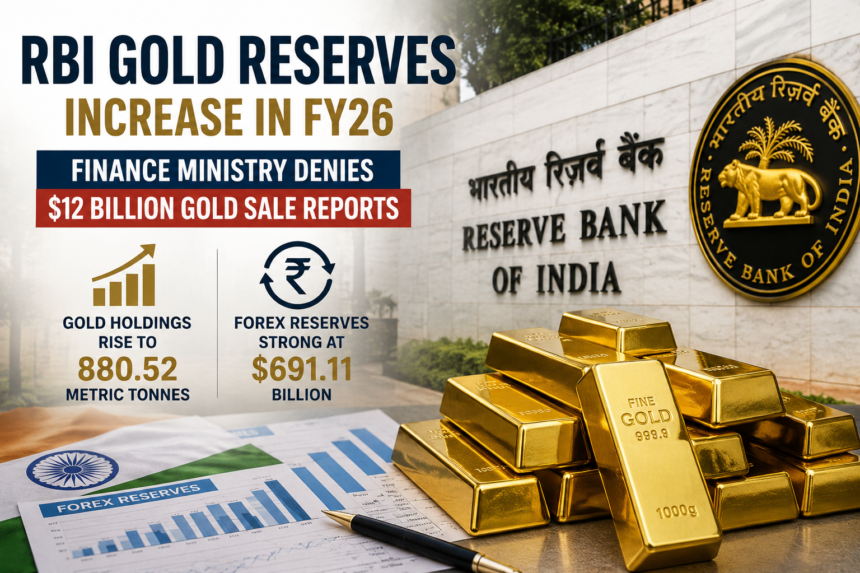
In fact, official figures released in the RBI’s Annual Report for 2025–26 tell a completely different story. Rather than reducing its gold reserves, the central bank actually increased its gold holdings during the financial year, while India forex reserves also remained strong at over $691 billion.
So, what really happened? Let’s break it down in simple terms.
Finance Ministry Dismisses Gold Sale Reports
The Indian Finance Ministry has categorically rejected media reports suggesting that the RBI sold massive quantities of gold reserves worth around $12 billion.
The speculation began after a news agency report claimed that the central bank had sold gold over a two-week period ending May 22. According to the report, the alleged move was aimed at protecting India’s foreign exchange reserves amid pressure on the rupee and rising import costs.
However, Finance Ministry officials quickly clarified that the information was inaccurate. Sources confirmed that the RBI had not undertaken any such large-scale gold sale.
This clarification helped calm concerns in financial markets, where even a whisper about reserve management can trigger uncertainty.
RBI Annual Report Reveals Gold Holdings Increased
RBI Gold Reserves, The strongest contradiction to the rumor comes directly from the RBI’s official Annual Report for 2025–26.
According to the report, the central bank’s total gold holdings stood at 880.52 metric tonnes as of March 31, 2026. In comparison, the RBI held 879.58 metric tonnes on March 31, 2025.
That means the RBI actually added 0.94 metric tonnes of gold during the financial year.
If the central bank had truly sold $12 billion worth of gold, the figures would have shown a sharp decline in reserves. Instead, the data points toward gradual accumulation.
Simply put, the numbers do not support the claims of a massive gold selloff.
Understanding Why Gold Reserves Matter
Gold isn’t just a shiny metal sitting inside vaults. For central banks, gold acts like a financial safety net.
Think of it as a country’s emergency savings account.
When global markets become volatile, gold helps stabilize confidence. Central banks across the world maintain gold reserves because the metal traditionally retains value during economic uncertainty.
India, like many nations, uses gold reserves as part of its broader reserve management strategy. These reserves strengthen financial credibility and provide protection against currency fluctuations.
That’s why reports of a large gold sale immediately attracted attention.
How RBI Stores Its Gold Holdings
The RBI report also provided details about how the gold reserves are distributed.
Out of the total 880.52 metric tonnes, the central bank held:
- 312.32 metric tonnes as assets of the Issue Department
- 568.20 metric tonnes under the Banking Department
This structure helps the RBI manage monetary operations efficiently while maintaining adequate reserve backing.
The detailed breakdown further reinforces transparency in the central bank’s reserve management practices.
Gold Value Jumped Sharply During FY26
RBI Gold Reserves, while the quantity of gold reserves rose only modestly, the value of those holdings surged dramatically.
Why?
Two major reasons played a role:
1. Rising Global Gold Prices
Gold prices climbed significantly in international markets during FY26. Economic uncertainty, geopolitical tensions, and global inflation fears pushed investors toward safe-haven assets like gold.
As prices increased globally, the value of RBI’s existing gold stock also climbed.
2. Depreciation of the Indian Rupee
The Indian rupee weakened against the US dollar during the year. Since gold is globally priced in dollars, a weaker rupee automatically raises the domestic valuation of gold reserves.
Together, these two factors caused the value of gold held under the Banking Department to rise by an impressive 63.6 percent during FY26.
That’s a substantial increase without necessarily adding huge quantities of gold.
India’s Forex Reserves Continue to Remain Strong
Another major takeaway from the RBI report is the strength of India’s foreign exchange reserves.
As of March 31, 2026, India’s forex reserves stood at $691.11 billion, compared with $668.33 billion a year earlier.
That’s a healthy increase.
Forex reserves are crucial because they help a country:
- Manage currency stability
- Handle external debt obligations
- Finance imports
- Maintain investor confidence
A strong reserve position also acts as a buffer during global economic shocks.
The rise in reserves clearly indicates that India’s external financial position remains stable despite global economic challenges.
Gold Reserves Value Crosses $115 Billion
RBI Gold Reserves, The RBI report further highlighted that India’s gold reserves, including gold deposits, surged in value terms.
The total value climbed to $115.40 billion, compared with $78.18 billion in the previous year.
That’s a remarkable jump.
Again, this increase was largely driven by higher global gold prices and exchange rate movements rather than massive fresh purchases.
Still, the sharp rise underscores how valuable gold remains in today’s uncertain global economy.
Why Rumors About Gold Sales Trigger Market Anxiety
Financial markets react strongly to reserve-related news because central bank actions often signal deeper economic concerns.
If a country starts aggressively selling gold reserves, investors may interpret it as a sign of:
- Currency weakness
- Liquidity stress
- External payment pressures
- Economic instability
That’s why the rumors surrounding RBI’s alleged gold sale gained traction so quickly.
But official data now makes it clear that there was no emergency liquidation of gold reserves.
In fact, India’s reserve position appears stronger than before.
RBI’s Reserve Strategy Reflects Stability
The RBI has consistently maintained a balanced reserve management approach over the years.
Instead of making abrupt moves, the central bank typically focuses on:
- Diversification of assets
- Long-term financial stability
- Currency risk management
- Protection against global uncertainty
Gold continues to play an important role in that strategy.
Many global central banks have also increased gold holdings in recent years as geopolitical tensions and inflation concerns reshape the global financial landscape.
India appears to be following a similarly cautious and strategic path.
The Bigger Picture Behind India’s Gold Holdings
India’s growing gold reserves reflect more than just financial strategy — they symbolize economic preparedness.
In an unpredictable global environment marked by inflation fears, geopolitical conflicts, and market volatility, gold continues to act as a financial anchor.
Central banks worldwide are increasingly recognizing this reality.
For India, maintaining strong gold and forex reserves helps strengthen economic resilience while supporting investor confidence at home and abroad.
What This Means for Investors and the Economy
The Finance Ministry’s clarification offers reassurance.
The denial of large-scale gold sales signals that:
- India’s forex reserves remain healthy
- The RBI is not under extraordinary financial pressure
- Reserve management remains stable and transparent
That matters because confidence is everything in financial markets.
When investors trust a country’s economic institutions, markets tend to remain more stable.
The RBI’s audited balance sheet and annual report provide a credible snapshot of the country’s financial strength, helping counter misinformation and speculation.
Read More: Union Budget 2026-27 Highlights: AI Push, Tax Relief, and Major Economic Reforms
Conclusion
RBI Gold Reserves, The controversy surrounding the alleged $12 billion gold sale by the RBI appears to have been firmly debunked by official data.
The Finance Ministry has denied the reports, while the RBI’s Annual Report for 2025–26 clearly shows that India’s gold holdings actually increased during the year.
At the same time, the value of those reserves surged due to rising global gold prices and rupee depreciation. India’s foreign exchange reserves also remained robust at over $691 billion, reinforcing confidence in the country’s financial stability.
In a world where financial rumors can spread faster than facts, official numbers still matter the most. And according to those numbers, India’s reserve position remains solid, stable, and well-managed.