
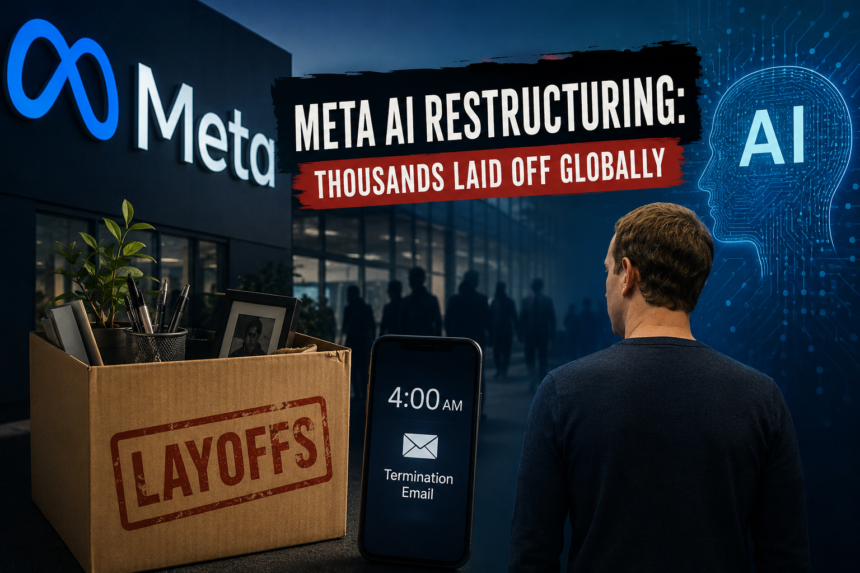
Meta AI Restructuring, Meta Platforms has once again sent shockwaves through the global tech industry after launching another major round of layoffs. This time, the cuts arrived with a chilling twist — employees in Singapore reportedly woke up to termination emails landing in their inboxes as early as 4AM local time.
The move reflects a broader transformation happening across Silicon Valley. Big Tech firms are racing toward an AI-driven future, and employees are increasingly caught in the crossfire.
Meta Begins Global Layoffs Across Offices
Meta’s latest wave of layoffs officially rolled out across its international offices on Wednesday, affecting workers in multiple regions including Asia, Europe, and the United States.
According to reports, employees in Singapore were among the first to receive termination notices. Many reportedly saw emails arrive around 4AM local time — an experience some workers described as deeply unsettling.
The layoffs are part of Meta’s continuing effort to reshape its workforce and prioritize artificial intelligence projects. While the company has not publicly disclosed the exact number of employees affected in this round, reports suggest that thousands globally may be impacted.
It’s another reminder that in today’s tech industry, even employees at some of the world’s most powerful companies are not immune to sudden restructuring.
Why Meta Is Cutting Jobs Again
So, why is Meta reducing staff yet again?
The answer is simple: AI has become the center of everything at the company.
Meta CEO Mark Zuckerberg has made it clear that artificial intelligence is now the company’s top strategic priority. The social media giant is aggressively investing in AI infrastructure, AI-powered products, and advanced digital assistants that can compete with rivals like OpenAI and Google.
To make room for this transformation, Meta is reorganizing internal teams and reducing what it sees as unnecessary layers of management.
In an internal memo, Meta’s Head of People, Janelle Gale, explained that the company wants “flatter structures” and smaller, more agile teams capable of moving faster and taking greater ownership.
Think of it like replacing a massive cruise ship with a fleet of speedboats. Meta believes smaller, leaner teams can innovate more quickly in the AI race.
Employees Were Told to Work From Home
Meta AI Restructuring, Meta reportedly advised many employees to work remotely during the restructuring process.
This strategy has become increasingly common among large tech firms conducting layoffs. Remote notifications help companies avoid uncomfortable office confrontations and reduce operational disruptions.
Still, for workers, receiving life-changing news through an email notification can feel cold and impersonal.
Imagine opening your laptop before sunrise only to discover your access revoked and your role eliminated. That’s the reality many Meta employees faced this week.
Meta Is Reassigning Thousands to AI Teams
While layoffs dominated headlines, Meta is simultaneously expanding its AI workforce.
Reports indicate the company has reassigned roughly 7,000 employees into AI-focused divisions. These teams are working on artificial intelligence products, AI agents, and advanced machine-learning systems designed to strengthen Meta’s competitive position.
This restructuring highlights a major shift happening inside the company. Traditional social media growth is no longer enough. The future, according to Zuckerberg, belongs to AI-powered ecosystems.
Meta wants to become more than just Facebook, Instagram, and WhatsApp. It aims to position itself as one of the world’s leading AI companies.
Engineering and Product Teams Face Biggest Impact
Meta AI Restructuring, The layoffs are expected to hit engineering and product departments particularly hard.
These teams historically formed the backbone of Meta’s innovation engine. However, as priorities shift toward AI development, some roles are being consolidated or eliminated altogether.
This doesn’t necessarily mean Meta is slowing down technologically. In fact, the opposite may be true.
The company appears to be reallocating talent toward areas with higher long-term strategic value. Employees working on projects outside Meta’s immediate AI roadmap may now find themselves vulnerable.
In the tech world, priorities can change almost overnight. One year you’re building a flagship product; the next, your entire division disappears.
Mark Zuckerberg’s Massive AI Bet
Mark Zuckerberg is making one of the boldest bets in tech history.
Meta is expected to spend more than $100 billion this year on AI-related capital expenditures. That figure alone shows how seriously the company views the AI race.
The investment includes:
- Building advanced AI data centers
- Developing large language models
- Expanding AI research infrastructure
- Creating AI-powered assistants and agents
- Improving recommendation systems across Meta platforms
The spending spree is enormous even by Silicon Valley standards.
Zuckerberg believes AI will define the next generation of computing, much like smartphones transformed the internet era. Meta does not want to be left behind while competitors accelerate.
Employee Concerns Over AI Monitoring Grow
Meta AI Restructuring, not everyone inside Meta is comfortable with the company’s AI direction.
Reports suggest growing concern among employees regarding privacy and internal data collection practices linked to AI training.
More than 1,000 workers have reportedly signed a petition asking Meta not to collect detailed device activity information such as keystrokes and screen content for AI-related purposes.
This reveals a growing tension inside the company.
On one side, Meta wants vast amounts of data to improve AI systems. On the other, employees worry about surveillance, privacy, and workplace trust.
It’s a delicate balancing act. AI systems thrive on data, but excessive monitoring can damage morale and create fear within the workforce.
Investors Are Nervous About AI Spending
Employees are not the only ones raising eyebrows.
Investors are also watching Meta’s aggressive AI spending with caution.
Although the layoffs may save Meta around $3 billion, analysts say that amount barely dents the company’s projected AI expenses, which could reportedly climb as high as $145 billion this year.
That’s an eye-watering number.
For comparison, many entire multinational corporations operate on annual budgets far smaller than Meta’s planned AI expenditure alone.
Investors understand AI’s potential, but they also want proof that these enormous investments will eventually generate meaningful returns.
Right now, Meta is essentially pouring fuel into a high-speed AI race where the finish line is still unclear.
The Tech Industry’s AI Arms Race Is Accelerating
Meta AI Restructuring is not happening in isolation.
Across the tech industry, companies are reorganizing operations around artificial intelligence. Google, Microsoft, Amazon, and OpenAI are all rapidly expanding AI initiatives while cutting costs elsewhere.
This creates a paradox in modern tech hiring:
- AI talent is in massive demand
- Traditional tech roles face growing uncertainty
In many ways, the industry resembles a gold rush. Companies are racing to secure the best AI engineers, researchers, and infrastructure before competitors gain an edge.
And just like historic gold rushes, some workers are striking gold while others are left behind.
What This Means for Meta Employees
For Meta workers, the latest layoffs reinforce a difficult reality: no role is guaranteed during periods of technological transformation.
The company that once symbolized limitless tech growth is now constantly reshaping itself in pursuit of the next big innovation wave.
Employees are facing:
- Increased pressure to adapt to AI-focused roles
- Organizational uncertainty
- Rapid team restructuring
- Concerns about long-term job security
Many workers who survive layoffs may still experience anxiety about future rounds of restructuring later this year.
And according to reports, additional layoffs could still happen as Meta continues optimizing its workforce for AI development.
Can Meta’s AI Strategy Actually Pay Off?
That’s the billion-dollar question — or perhaps the $145 billion question.
Meta clearly believes AI will drive the future of social platforms, advertising, digital assistants, and online interaction. If Zuckerberg’s strategy succeeds, Meta could emerge as one of the dominant AI ecosystems globally.
But there are serious risks too.
Massive spending does not automatically guarantee success. Tech history is filled with ambitious bets that failed despite huge investments.
Meta’s challenge is proving that its AI expansion can generate sustainable growth while maintaining employee trust and investor confidence.
Right now, the company is walking a tightrope between innovation and instability.
Read More: Claude Opus 4.7: Features, Improvements, and How It Beats Opus 4.6
Conclusion
Meta AI Restructuring, Meta’s latest layoffs highlight the harsh realities of the modern AI revolution. Thousands of employees across the globe are facing uncertainty as the company restructures around artificial intelligence priorities.
The now-infamous 4AM termination emails in Singapore have become a symbol of how abruptly the tech landscape can change. Behind every restructuring announcement are real people navigating career disruption, workplace anxiety, and an increasingly unpredictable industry.
At the same time, Meta’s aggressive AI investments demonstrate just how fiercely Silicon Valley companies are competing for dominance in the next era of technology.
Whether Zuckerberg’s massive AI gamble ultimately transforms Meta into an industry leader or becomes an expensive misstep remains to be seen. But one thing is certain — the AI race is already reshaping the future of work inside Big Tech.