British Wimbledon Champions, British tennis has experienced plenty of memorable moments over the decades, but few compare to the extraordinary weekend of July 2016. It was a time when the nation was already riding an emotional rollercoaster. Brexit had just dominated headlines, Leicester City had completed one of football’s greatest fairytales, and British sporting success seemed to be everywhere.
Then Wimbledon delivered something truly historic.
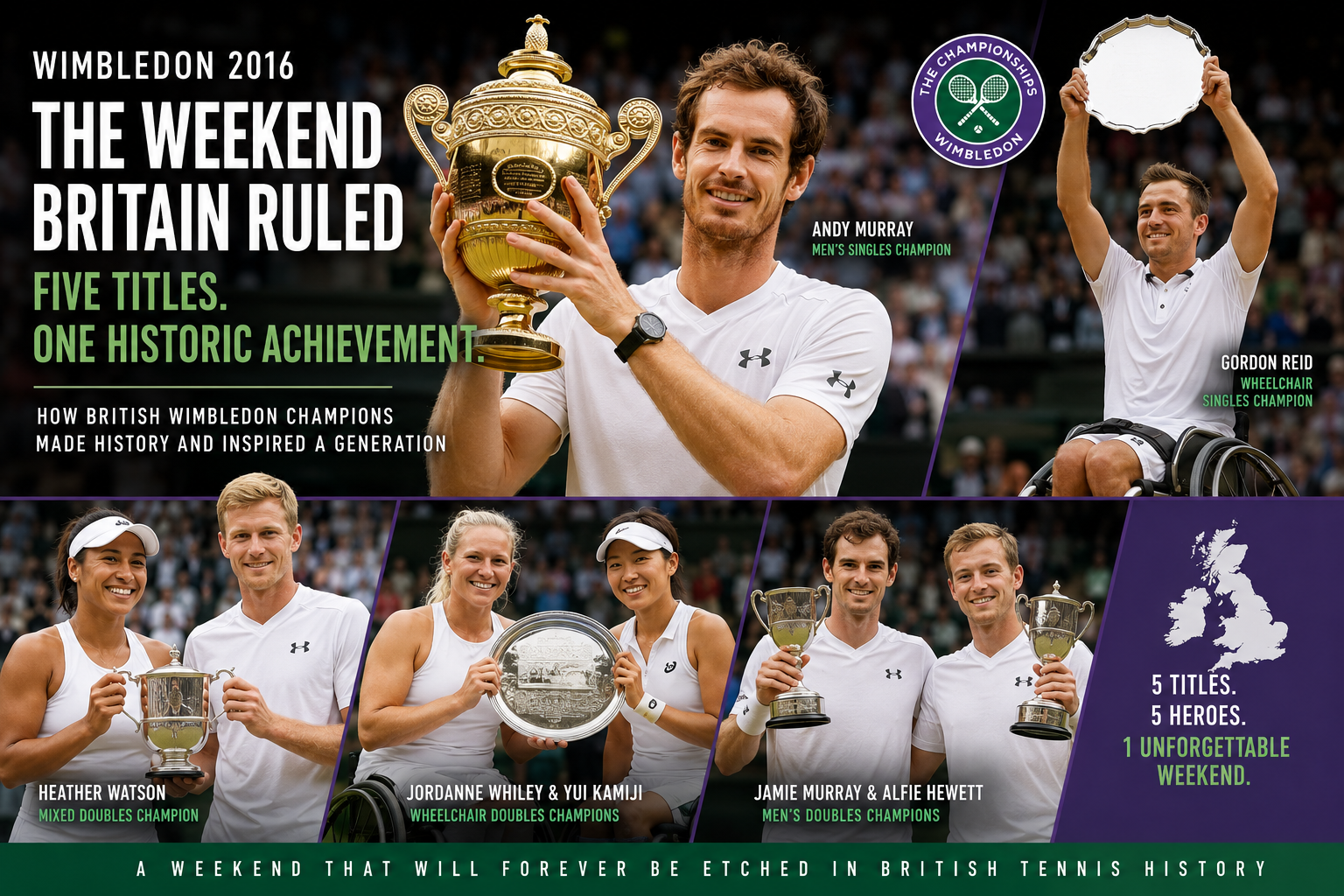
Across one unforgettable weekend, British players captured five Wimbledon titles, creating one of the greatest chapters in British tennis history. At the center of it all stood Andy Murray, who lifted his second Wimbledon men’s singles crown, while fellow Britons Gordon Reid, Heather Watson, Jordanne Whiley, Jamie Murray, and Alfie Hewett added to an unprecedented haul of trophies. Their remarkable achievements not only made Wimbledon 2016 unforgettable but also redefined British tennis history, inspiring a new generation of players and fans alike.
Even ten years later, that magical weekend continues to shape British tennis, inspiring today’s stars and transforming the sport at every level.
A Weekend That Changed British Tennis History
Before 2016, British tennis had enjoyed occasional moments of brilliance, but sustained success at Wimbledon often felt like an impossible dream.
Everything changed during one remarkable weekend at the All England Club.
For the first time in modern history, home players dominated multiple categories, proving Britain could compete with—and beat—the very best in the world.
Instead of celebrating a single champion, the nation celebrated an entire generation of winners.
The achievement wasn’t just about collecting trophies. It became a symbol of what British tennis could become with belief, investment, and world-class talent.
Britain Was Already Riding a Wave of Sporting Momentum
British Wimbledon Champions, The summer of 2016 was unlike any other.
Across the country, sporting headlines were filled with success stories. Leicester City’s unbelievable Premier League triumph had shocked football fans around the world. England had retained the Ashes, while Formula One star Lewis Hamilton continued to dominate motorsport.
Yet Wimbledon became the biggest stage of all.
As thousands packed into the famous grass courts and millions watched from home, British tennis was preparing for one of its finest weekends ever.
No one could have predicted just how historic those two days would become.
Gordon Reid Opened the Celebration in Style
Long before Centre Court filled for Andy Murray’s final, another piece of history was already unfolding.
On the much smaller Court 17, Gordon Reid stepped onto the court for the very first Wimbledon wheelchair singles final.
Although the venue held fewer than 300 spectators, crowds gathered around every available viewing spot to witness history.
Reid had already enjoyed success the previous day after winning the wheelchair doubles title alongside Alfie Hewett. Despite dealing with an unexpected hotel change after a noisy night, Reid remained composed.
His performance against Sweden’s Stefan Olsson was nothing short of dominant.
Winning comfortably in straight sets, Reid secured Britain’s first title of the day and sparked celebrations that perfectly captured the atmosphere surrounding British tennis.
Family, friends, and supporters showered him with champagne as excitement spread across the All England Club.
The momentum had begun.
Wheelchair Tennis Also Enjoyed a Historic Breakthrough
British success didn’t stop there.
Soon after Reid’s victory, Jordanne Whiley and Japanese partner Yui Kamiji claimed the women’s wheelchair doubles title.
The victory marked their third consecutive Wimbledon championship together, highlighting the strength of Britain’s wheelchair tennis program.
Although Andy Murray’s Centre Court final had already started, another British trophy had quietly been added to the growing collection.
Looking back, those victories also represented something much bigger.
Wheelchair tennis, once played before relatively small audiences, began receiving greater attention and respect. Years later, finals would move from smaller courts to larger stadiums packed with thousands of spectators.
The sport had finally begun receiving the recognition it deserved.
Andy Murray Delivered One of the Greatest Wimbledon Performances of His Career
Every Wimbledon champion faces pressure.
Andy Murray, however, entered the 2016 final carrying expectations unlike almost anyone before him.
Having already won Wimbledon in 2013, Murray no longer carried the burden of ending Britain’s 77-year wait for a men’s singles champion.
Instead, he arrived as the favorite.
His path to the final showcased incredible consistency. Murray had lost only two sets throughout the tournament while also reaching the finals of both the Australian Open and French Open earlier that year.
Victories at Queen’s Club and the Italian Open further demonstrated his outstanding form.
Meanwhile, circumstances around him had shifted dramatically.
Roger Federer had suffered a surprise semifinal defeat to Milos Raonic.
Novak Djokovic exited unexpectedly in the third round.
Rafael Nadal missed the tournament through injury.
Everything pointed toward one opportunity Murray simply could not waste.
Milos Raonic Could Not Match Murray’s Excellence
British Wimbledon Champions, Standing across the net was Canada’s Milos Raonic, one of the biggest servers in world tennis.
Yet even his powerful game couldn’t disrupt Murray’s rhythm.
From the opening games, Murray controlled rallies with remarkable confidence.
His movement around Centre Court looked effortless.
His defensive skills frustrated Raonic repeatedly.
Most importantly, Murray remained mentally composed during the pressure-filled tie-breaks.
After winning the opening set 6-4, Murray captured both following sets in tie-breaks to complete a straight-set victory.
The scoreline read:
- 6-4
- 7-6 (7-3)
- 7-6 (7-2)
It was one of the finest performances of his career.
The celebrations that followed became instantly iconic.
Murray embraced the Wimbledon trophy with visible emotion, repeatedly wiping tears from his face before lifting one of sport’s most famous prizes.
A Champion Who Finally Allowed Himself to Celebrate
Unlike his emotional 2013 triumph, Murray approached his second Wimbledon title differently.
This time, relief wasn’t the dominant feeling.
It was pure enjoyment.
During the trophy ceremony, even his famously reserved coach Ivan Lendl couldn’t hide his emotions.
Television presenter Sue Barker asked Murray whether he felt good.
His understated reply—”Yeah”—became another unforgettable Wimbledon moment.
He thanked his family, coaching team, and supporters before joking about the immense pressure of leadership after accidentally acknowledging then-Prime Minister David Cameron, who received boos from parts of the crowd following the Brexit referendum.
Murray quickly eased the tension with humor, earning applause once again.
Moments later, he stepped onto the Wimbledon balcony, proudly displaying the trophy to thousands of cheering fans gathered below.
Heather Watson Completed Britain’s Incredible Weekend
British Wimbledon Champions, The celebrations were far from over.
Heather Watson still had her own Wimbledon final to play.
Partnering Finland’s Henri Kontinen in the mixed doubles competition, Watson entered the match with unusual confidence.
She later admitted that she woke up convinced she would become a Wimbledon champion.
Athletes rarely experience that level of certainty.
Yet her instincts proved correct.
Watson and Kontinen captured the mixed doubles title, making Watson the first British woman in 25 years to win a Grand Slam title.
It also became Britain’s fifth Wimbledon trophy of the weekend.
History had officially been made.
Even today, Watson describes the achievement as one of the greatest moments of her life, proudly displaying her Wimbledon trophy as a daily reminder of that unforgettable success.
An Unforgettable Wimbledon Champions’ Ball
Winning Wimbledon brings another tradition few fans ever witness.
Once media duties finish, champions prepare for the prestigious Wimbledon Champions’ Ball.
For Heather Watson, the evening felt almost surreal.
Players quickly exchanged their tennis outfits for elegant evening gowns and formal suits before walking the famous red carpet.
Andy Murray had joked beforehand that he’d only participate in the traditional champions’ dance after enjoying several glasses of champagne.
As the evening unfolded, that’s exactly what happened.
Watson recalls dancing, celebrating, and partying alongside Murray until sunrise.
Murray himself later admitted the celebrations became so lively that he became sick during the taxi ride home.
For once, Britain’s usually reserved sporting hero simply allowed himself to enjoy every second.
After years of relentless pressure and expectations, nobody could blame him.
The Remarkable Rise of British Tennis After 2016
The impact of that extraordinary weekend stretched far beyond Wimbledon.
Andy Murray continued producing spectacular tennis throughout the remainder of 2016.
He captured five additional ATP titles, won Olympic gold in Rio de Janeiro for a second consecutive time, and eventually became World No. 1.
Although a devastating hip injury later disrupted his career, Murray had already rewritten British tennis history.
Meanwhile, British tennis entered an entirely new era.
Young players suddenly believed Grand Slam success was achievable.
The country’s depth improved dramatically.
In 2016, Britain had only three men ranked inside the ATP Top 200.
A decade later, that number had more than doubled.
The progress reflected growing confidence throughout the entire tennis system.
The Explosion of British Doubles Success
Singles success wasn’t the only story.
British doubles tennis experienced an extraordinary boom following Wimbledon 2016.
Jamie Murray became one of the world’s leading doubles players, eventually reaching World No. 1.
Heather Watson’s mixed doubles title added further momentum.
Even more impressively, British players accumulated around 20 Grand Slam doubles titles during the following decade.
Compared to the ten years before 2016—when only two Grand Slam doubles trophies were won by Britons—the transformation was astonishing.
The message became clear.
Britain was no longer producing occasional stars.
It was consistently developing elite players across multiple disciplines.
The ‘Murray Effect’ Inspired an Entire Generation
British Wimbledon Champions, Sport often changes because one athlete proves something is possible.
Andy Murray became exactly that figure.
Young British players growing up after 2016 viewed Wimbledon differently.
Instead of dreaming about impossible victories, they believed success could become reality.
Current stars, including Jack Draper and several emerging British professionals, frequently credit Murray as a major source of inspiration.
Even after retiring, Murray continues mentoring younger players through formal coaching and informal guidance.
His influence now extends well beyond his own achievements.
He’s helping shape Britain’s future champions.
Investment Helped Turn Inspiration Into Reality
British Wimbledon Champions, Inspiration alone cannot build champions.
Infrastructure matters.
Following the success of Murray and his fellow British winners, the Lawn Tennis Association significantly increased investment across the country.
Hundreds of millions of pounds have been directed toward improving public tennis facilities.
Projects have included:
- Refurbishing public courts
- Installing additional floodlights
- Expanding indoor tennis facilities
- Improving online booking systems
- Supporting grassroots coaching programs
Participation numbers have reached record highs, with millions of adults and children regularly playing tennis across Britain.
The legacy of 2016 now exists far beyond Centre Court.
It’s visible in parks, schools, clubs, and communities nationwide.
Wheelchair Tennis Reached New Heights
One of the most meaningful outcomes involved wheelchair tennis.
Back in 2016, Gordon Reid played his historic singles final before only a few hundred spectators.
Today, wheelchair finals regularly attract thousands of fans on Wimbledon show courts.
Athletes such as Reid and Alfie Hewett have transformed perceptions of the sport through sustained excellence.
Their achievements continue inspiring disabled athletes around the world while strengthening Britain’s reputation as a global leader in wheelchair tennis.
A New Generation Carries the Legacy Forward
Nearly ten years later, British tennis looks stronger than it has in decades.
Young players continue entering Grand Slam tournaments with confidence.
Several have already established themselves on the ATP and WTA Tours, while many more are emerging through Britain’s development pathways.
The influence of Murray remains impossible to ignore.
Whether coaching Jack Draper, mentoring younger professionals, or simply setting standards through his career, his legacy continues growing.
Every Wimbledon now features players who grew up watching that magical weekend in 2016.
For them, those victories weren’t just memories.
They became motivation.
Why Wimbledon 2016 Still Matters Today
Many sporting achievements fade with time.
This one hasn’t.
The five Wimbledon titles won by British players represented far more than medals and trophies.
Most importantly, they proved that sustained British success on tennis’ biggest stage wasn’t an impossible dream.
It could happen.
And because it happened once, future generations now believe it can happen again.
Conclusion
British Wimbledon Champions, The unforgettable Wimbledon weekend of 2016 remains one of the greatest moments in British sporting history. Andy Murray’s second Wimbledon singles title provided the defining image, but it was the collective success of Gordon Reid, Jordanne Whiley, Heather Watson, Jamie Murray, Alfie Hewett, and others that truly transformed British tennis.
Their victories inspired millions, elevated wheelchair tennis, strengthened doubles success, encouraged grassroots participation, and motivated an entirely new generation of players. Nearly a decade later, the effects are still visible across British tennis, proving that one extraordinary weekend can change the future of an entire sport.