
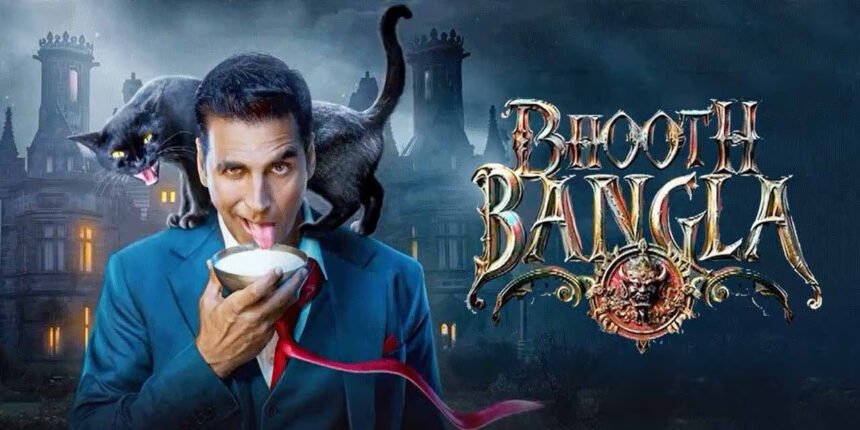
Bhooth Bangla Review, If you walked into Bhooth Bangla expecting the charm, wit, and eerie brilliance of Bhool Bhulaiyaa, you might want to lower your expectations—significantly. This film tries hard to recreate the magic of a cult classic but ends up feeling like a poorly stitched patchwork of old ideas, recycled jokes, and missed opportunities. Let’s break it down in detail.
A Promising Premise That Quickly Falls Apart
At its core, Bhooth Bangla starts with an intriguing folk tale. In the fictional village of Mangalpur, there’s a chilling belief—no one dares to marry because a mysterious creature named Vadhusur kidnaps brides before their wedding night. Sounds eerie, right? That setup alone could have been gold.
But instead of building suspense or curiosity, the film rushes into chaos. The story shifts focus to Arjun, played by Akshay Kumar, a London-based man drowning in debt. He returns to his ancestral village after inheriting a palace and decides to organize his sister Meera’s wedding there.
That’s where things start going downhill.
Characters That Feel More Like Caricatures
Bhooth Bangla Review, Let’s talk about the casting. Akshay Kumar plays Arjun, while Jisshu Sengupta—who looks noticeably younger—plays his father. This mismatch is hard to ignore and constantly breaks immersion.
Mithila Palkar as Meera struggles with a character that feels overly loud and underdeveloped. Tabu, a powerhouse performer, is surprisingly underutilized. Wamiqa Gabbi barely leaves an impression.
The only actor who truly shines? Asrani.
Asrani: The Lone Bright Spot
As Shambhu Babu, the palace caretaker, Asrani delivers moments of genuine humor and sincerity. His performance feels natural, almost like a breath of fresh air in an otherwise suffocating narrative.
Ironically, the film is dedicated to him—and rightfully so. Because without his presence, Bhooth Bangla would feel even more hollow.
A Story That Lacks Direction
Imagine starting a journey with no map, no destination, and no sense of direction—that’s exactly how this film feels.
The plot is scattered. Scenes jump from one moment to another without proper transitions. Emotional beats don’t land, and the horror elements barely create tension. Even the so-called “twist” is so predictable that you’ll likely guess it within the first 20 minutes.
And when the interval hits, instead of excitement, you’re left wondering: “Is this it?”
Heavy Dependence on Bhool Bhulaiyaa Nostalgia
Here’s the biggest issue—Bhooth Bangla leans too heavily on Bhool Bhulaiyaa.
From the haunted haveli setup to the music, character dynamics, and even specific visual frames, everything screams déjà vu. It’s like watching a tribute that forgot to add anything new.
But nostalgia is a double-edged sword. It works only when paired with innovation. Without that, it feels lazy—and that’s exactly the case here.
A Confused Blend of Genres
The film never decides.
The horror lacks intensity. The comedy feels forced. And the emotional moments don’t resonate. It tries to juggle multiple tones but ends up dropping all of them.
Think of it like a dish with too many spices—nothing stands out, and everything tastes off.
Borrowed Ideas From Everywhere
Bhooth Bangla Review, If you pay close attention, you’ll notice familiar elements scattered throughout the film. There are shades of classic Priyadarshan comedies, hints of supernatural thrillers, and even inspirations from international films.
But instead of blending these influences seamlessly, the film stitches them together awkwardly. The result? A narrative that feels unoriginal and disconnected.
Technical Aspects: Style Over Substance
Visually, the film tries to impress with its grand haveli, period setting, and elaborate song sequences. But all that gloss can’t hide the lack of substance.
The cinematography is decent, but the editing feels rushed. Scenes that should build tension are cut short, while unnecessary sequences drag on.
Even the music—clearly inspired by iconic tracks—fails to leave a lasting impact.
Missed Opportunities in Storytelling
Let’s be honest—the concept had potential.
A cursed village, a haunted palace, a mysterious creature—these are elements that could have created a gripping story. But the film never fully explores them.
Instead, it gets lost in unnecessary subplots and forced humor. It’s like having all the ingredients for a great meal but forgetting to cook them properly.
Audience Disconnect: The Biggest Flaw
Here’s the real problem—Bhooth Bangla underestimates its audience.
Today’s viewers are smarter. They’ve seen better storytelling, sharper writing, and more innovative cinema. Simply banking on nostalgia isn’t enough anymore.
If you’re going to revisit a beloved formula, you need to elevate it—not dilute it.
A Title That Carries Legacy, But Not Responsibility
The name Bhooth Bangla itself reminds many of the iconic 1965 horror-comedy Bhoot Bungla. That’s a legacy in itself.
But instead of honoring that legacy, this film feels like it’s borrowing the name without understanding its significance.
A Forgettable Experience
So, should you watch Bhooth Bangla?
If you’re a die-hard Akshay Kumar fan, you might still find moments to enjoy. But for everyone else, this is one cinematic ride you can safely skip.
It’s not scary enough to thrill you, not funny enough to entertain you, and not engaging enough to hold your attention.
Read More: Toaster Movie Review: Rajkummar Rao’s Dark Comedy Delivers Laughs but Falls Short
Conclusion
Bhooth Bangla Review, Film serves as a reminder that nostalgia is not a substitute for good storytelling. You can’t just recreate the past and expect audiences to be satisfied.
Think of it like revisiting your childhood home—it feels special only if it still holds meaning. If it’s crumbling and empty, the magic fades quickly.
This film had the chance to build something memorable on a strong foundation. Instead, it delivers a structure so weak that it collapses under its own weight.
In the end, Bhooth Bangla isn’t just disappointing—it’s a missed opportunity.
And maybe that’s the most frustrating part.
Because somewhere beneath the messy plot, forced humor, and recycled ideas, there was a good film waiting to be made. But it never got the attention, care, or creativity it deserved.
So the next time a film tries to sell you nostalgia, ask yourself—is it offering something new, or just repackaging the old?
Because as Bhooth Bangla proves, the difference matters more than ever.