
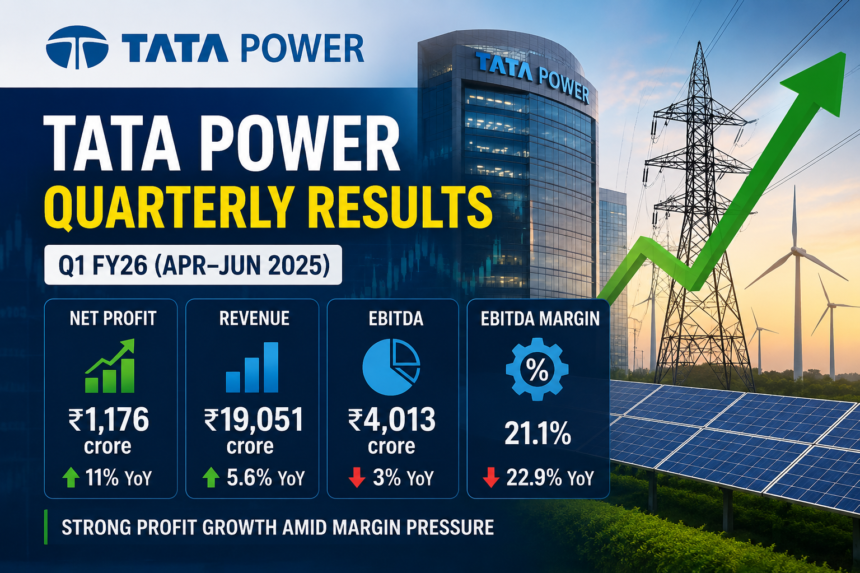
Tata Power Quarterly Results, Tata Power Co. Ltd. has kicked off the new financial quarter with a resilient performance, delivering double-digit profit growth even as operating margins came under pressure. The company’s latest financial results for the quarter ended June 30 highlight its ability to maintain earnings momentum despite rising costs and a challenging business environment.
While revenue registered a healthy increase and Tata Power Net Profit exceeded last year’s figures, the decline in EBITDA and contraction in margins indicate that cost pressures continue to weigh on operations. Even so, investors reacted positively, pushing Tata Power’s shares slightly higher during Monday’s trading session as the strong Tata Power Net Profit growth reflected the company’s overall financial resilience despite operational challenges.
Let’s take a closer look at Tata Power’s Q1 performance, what drove the numbers, how the stock reacted, and what it could mean for investors moving forward.
Tata Power Delivers Strong Profit Growth in Q1
Tata Power reported a consolidated net profit of Rs 1,176 crore for the first quarter, marking an impressive 11% year-on-year increase compared to Rs 1,060 crore recorded during the corresponding quarter of the previous financial year.
The strong bottom-line performance reflects the company’s continued focus on operational efficiency, diversified business portfolio, and sustained contribution from its renewable energy and power distribution businesses.
Although the operating environment remained challenging, Tata Power managed to expand profits, demonstrating its ability to generate value even amid margin pressures.
Revenue Registers Healthy Year-on-Year Growth
Tata Power Quarterly Results, The company’s consolidated revenue rose to Rs 19,051 crore, representing a 5.6% increase over the Rs 18,035 crore reported during the same period last year.
This steady improvement suggests continued demand across Tata Power’s diversified operations, including:
- Power generation
- Renewable energy
- Transmission
- Distribution
- Solar EPC business
- Consumer solutions
While revenue growth wasn’t explosive, it remained consistent and underlined the company’s stable business fundamentals.
In today’s market, where many companies are struggling to maintain growth amid economic uncertainty, even mid-single-digit revenue expansion can be viewed as a positive sign.
EBITDA Declines as Operating Costs Rise
Despite higher revenue and profits, Tata Power experienced pressure at the operating level.
The company’s EBITDA (Earnings Before Interest, Taxes, Depreciation and Amortisation) declined by around 3% year-on-year, falling to approximately Rs 4,013 crore from Rs 4,139 crore.
This decline suggests that rising operating expenses impacted profitability before accounting for financing and non-cash costs.
Lower EBITDA generally indicates that companies are spending more to generate revenue or facing pricing challenges in certain business segments.
EBITDA Margin Contracts to 21.1%
One of the most closely watched metrics in quarterly earnings is the EBITDA margin.
Tata Power’s EBITDA margin fell to 21.1%, compared with 22.9% during the same quarter last year.
Why does this matter?
Margins reveal how efficiently a company converts revenue into operating profit.
Although Tata Power generated higher sales, increased expenses reduced the percentage of revenue translating into operating earnings.
Several factors could have contributed to the margin contraction, including:
- Rising fuel costs
- Higher maintenance expenses
- Increased employee costs
- Greater investment in renewable expansion
- Inflationary pressures across operations
Even so, a margin above 20% continues to reflect a relatively healthy operating business.
Key Financial Highlights at a Glance
Tata Power Quarterly Results, Here’s a quick summary of Tata Power’s first-quarter financial performance:
| Metric | Q1 FY Current Year | Q1 Previous Year | Year-on-Year Change |
|---|---|---|---|
| Revenue | Rs 19,051 crore | Rs 18,035 crore | +5.6% |
| EBITDA | Rs 4,013 crore | Rs 4,139 crore | -3% |
| EBITDA Margin | 21.1% | 22.9% | Lower |
| Net Profit | Rs 1,176 crore | Rs 1,060 crore | +10.9% |
The numbers clearly illustrate an interesting story:
Revenue increased.
Profit increased even faster.
However, operating profitability weakened due to shrinking margins.
Why Did Profit Rise Despite Lower Margins?
At first glance, it may seem contradictory.
If margins declined, how did profits increase?
The answer lies in the broader financial picture.
Several factors may have helped boost Tata Power’s bottom line:
- Better performance from high-margin business segments
- Improved contributions from renewable energy projects
- Lower finance costs in certain operations
- Efficient capital allocation
- Growth in regulated distribution businesses
Think of it like running a restaurant.
Even if ingredient costs rise, increasing customer traffic and improving efficiency elsewhere can still lead to higher overall profits.
Similarly, Tata Power’s diversified operations helped offset operating challenges.
Renewable Energy Continues to Shape Tata Power’s Future
Although the quarterly filing primarily focused on financial figures, Tata Power’s long-term growth strategy continues to revolve around renewable energy.
The company has spent the past several years investing heavily in:
- Solar power generation
- Wind energy
- Rooftop solar installations
- Electric vehicle charging infrastructure
- Energy storage
- Green energy distribution
These investments may temporarily pressure margins due to upfront costs, but they position the company to benefit from India’s accelerating transition toward clean energy.
As renewable capacity expands, investors will closely monitor whether these investments begin contributing more significantly to earnings.
How the Stock Market Reacted
Tata Power Quarterly Results, Investors responded positively following the release of Tata Power’s quarterly performance.
The company’s shares closed 0.79% higher at Rs 377.35.
For comparison, the benchmark NSE Nifty 50 gained 0.96% during the same trading session.
While Tata Power slightly underperformed the broader market, the positive closing suggests investors viewed the earnings report as broadly encouraging.
Intraday Trading Performance
During Monday’s trading session, Tata Power shares remained relatively stable.
Key trading figures included:
- Previous close: Rs 374.40
- Opening price: Rs 376.75
- Intraday low: Rs 374.45
- Intraday high: Rs 379.00
- Closing price: Rs 377.35
The limited trading range reflected balanced investor sentiment, with neither buyers nor sellers dominating the session.
Tata Power’s 52-Week Stock Performance
Looking beyond one trading session provides better perspective.
Over the past 52 weeks:
- 52-week high: Rs 464.90
- 52-week low: Rs 342.50
The current share price remains well below its yearly peak but comfortably above its annual low.
On a year-on-year basis, Tata Power’s stock has declined approximately 4.55%, indicating that investors continue to weigh near-term challenges against the company’s long-term growth prospects.
Market Capitalisation and Valuation
Tata Power currently commands a market capitalisation of approximately Rs 1.26 lakh crore, reinforcing its position among India’s largest integrated power companies.
The stock trades at a Price-to-Earnings (P/E) ratio of 32.53.
A relatively high P/E often suggests that investors expect future earnings growth.
In Tata Power’s case, market participants appear optimistic about:
- Renewable energy expansion
- Rising electricity demand
- Infrastructure investments
- Electric vehicle ecosystem
- India’s clean energy transition
However, premium valuations also mean investors expect consistent execution in the coming quarters.
What Investors Should Watch Going Forward
Tata Power Quarterly Results, While Tata Power’s latest earnings were encouraging, several factors will determine future performance.
Key areas to monitor include:
1. Margin Recovery
Can the company restore EBITDA margins while maintaining revenue growth?
Improved operational efficiency will be critical.
2. Renewable Energy Expansion
New renewable projects could become important earnings drivers over the next few years.
3. Cost Management
Managing input costs will remain essential, particularly if inflationary pressures persist.
4. Distribution Business Performance
Stable cash flows from regulated electricity distribution continue to support overall profitability.
5. Capital Expenditure
Investors will also watch how Tata Power balances aggressive expansion with financial discipline.
What Do These Results Mean for Shareholders?
For shareholders, Tata Power‘s quarterly report sends mixed—but largely positive—signals.
On one hand:
- Revenue is growing.
- Net profit is improving.
- Business diversification remains a major strength.
On the other hand:
- Operating margins are under pressure.
- EBITDA declined.
- Cost inflation continues to impact profitability.
Overall, the company appears to be navigating a challenging environment reasonably well.
The ability to deliver double-digit profit growth despite softer operating margins highlights the resilience of its diversified business model.
Industry Outlook Remains Positive
India’s power sector continues to enjoy favourable long-term fundamentals.
Government initiatives promoting:
- Renewable energy
- Grid modernisation
- Electric mobility
- Energy storage
- Smart distribution networks
are expected to create substantial opportunities for integrated power companies like Tata Power.
As electricity demand continues to rise alongside industrial growth and urbanisation, companies with diversified generation and distribution capabilities are likely to remain well positioned.
Read More: TCS Q1 Results: How to Trade TCS Shares Before the Earnings Announcement
Conclusion
Tata Power Quarterly Results, Tata Power’s first-quarter results present a balanced picture of resilience and caution. The company successfully increased consolidated net profit by nearly 11% while growing revenue by 5.6%, demonstrating the strength of its diversified business model and strategic investments. However, the decline in EBITDA and contraction in operating margins underscore the cost pressures affecting the power sector.
Even with these challenges, Tata Power remains financially solid, supported by its expanding renewable energy portfolio, stable distribution business, and long-term growth strategy. Investors will now be watching closely to see whether the company can improve operating efficiency and restore margins in the coming quarters while continuing to capitalise on India’s accelerating clean energy transition.