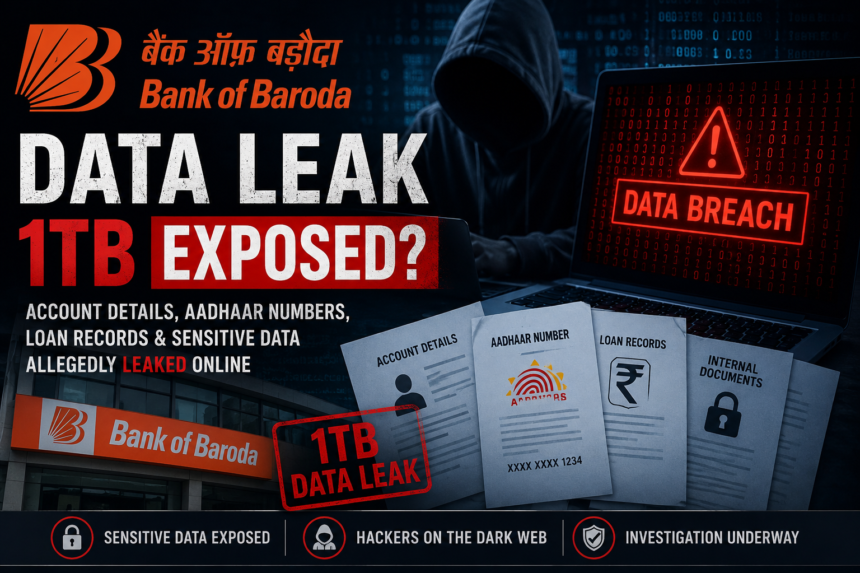
Bank of Baroda Data Leak, The Indian banking sector is once again facing intense scrutiny following reports of a massive alleged cybersecurity breach involving Bank of Baroda (BoB). According to cybersecurity researchers and reports circulating online, a threat actor has claimed responsibility for leaking nearly 1TB of sensitive banking data, including customer records, Aadhaar numbers, account information, loan documents, internal banking files, and other confidential information.
The incident has nevertheless sparked widespread concern among customers, cybersecurity experts, and financial institutions across the country. With cybercriminals becoming increasingly sophisticated, the alleged breach highlights why cybersecurity has become just as important as traditional banking security.
What Is the Alleged Bank of Baroda Data Leak?
Reports suggest that an unidentified threat actor has uploaded approximately 1TB of allegedly stolen Bank of Baroda data onto a dark web platform, making the information freely accessible rather than demanding a ransom.
Unlike many ransomware attacks where hackers encrypt data before demanding payment, this case appears to involve the direct publication of allegedly stolen files. If the claims are accurate, the leaked information could expose both retail and corporate banking customers to significant privacy and security risks.
The leaked dataset reportedly includes documents collected from multiple Bank of Baroda branches across India, affecting various banking services and customer categories.
What Information Was Allegedly Exposed?
Bank of Baroda Data Leak, According to cybersecurity researchers who reviewed portions of the leaked files, the dataset reportedly contains a wide range of confidential banking information.
Some of the allegedly exposed records include:
- Customer names
- Aadhaar numbers
- Savings account details
- Current account information
- Loan application documents
- Loan appraisal reports
- NetBanking user information
- NRI banking records
- Corporate banking documents
- Customer application forms
- Branch audit reports
- Internal communications
- Vigilance investigation files
- ATM and branch-related operational records
- Customer support documentation
If these claims are verified, the breach extends well beyond ordinary customer information and may include sensitive internal operational documents.
Sample Documents Shared Online Raise Concerns
The controversy gained further attention after cybersecurity advocate and CashlessConsumer founder Srikanth Lakshmanan highlighted sample documents that were allegedly uploaded by the threat actor.
According to Lakshmanan, the publicly shared files appeared to contain genuine internal banking records. After reviewing portions of the leaked dataset, he reportedly found documents relating to branch audits, internal investigations, loan processing, and customer application forms from multiple Bank of Baroda branches.
He described the incident as “a cyber disaster”, reflecting the seriousness of the alleged exposure if the documents ultimately prove authentic.
Although cybersecurity experts have conducted preliminary examinations of the leaked samples, complete verification of the entire dataset has not yet been publicly confirmed.
Bank of Baroda Has Not Confirmed the Breach
Bank of Baroda Data Leak, Despite growing speculation online, Bank of Baroda has not officially acknowledged that its systems have been compromised.
Sources familiar with the matter indicate that the bank has initiated an internal investigation to determine whether the leaked data is genuine and whether any of its internal systems were breached.
As of now:
- Bank of Baroda has not confirmed customer data theft.
- CERT-In has not issued an official advisory.
- The Reserve Bank of India has not publicly commented on the incident.
- No official estimate of affected customers has been released.
This means many of the circulating claims remain allegations until independently verified by authorities or the bank itself.
How Was the Alleged Breach Discovered?
According to cybersecurity experts monitoring underground cybercrime forums, the alleged breach first came to light after being detected by the dark web monitoring platform ransomeware.live.
The platform reportedly identified a post advertising a large Bank of Baroda dataset on a Tor-based website.
Instead of attempting to sell the information privately, the threat actor allegedly made the dataset publicly accessible, significantly increasing the potential exposure.
Cybersecurity researchers quickly began analysing portions of the uploaded files to determine whether they appeared authentic.
Who May Be Responsible for the Attack?
No hacking group has officially claimed responsibility through verified public channels.
However, cybersecurity researchers believe the attack could be linked to a relatively new cybercriminal organisation known as TripleX.
According to available reports, the group has previously targeted financial institutions and has demonstrated the capability to steal extremely large datasets.
While attribution in cyberattacks is often difficult, researchers believe similarities between this incident and previous attacks may point towards the same threat actor.
Nevertheless, until law enforcement agencies complete their investigations, responsibility remains unconfirmed.
TripleX’s Previous Attack on an Indonesian Bank
Bank of Baroda Data Leak, The group believed to be behind the alleged Bank of Baroda breach previously attracted international attention after reportedly attacking PT Bank Negara Indonesia, one of Indonesia’s largest state-owned banks.
During that incident, approximately 2TB of sensitive data was reportedly stolen.
The leaked files allegedly included:
- Customer identification documents
- Banking contracts
- Financial transaction records
- Internal communications
- Corporate documentation
- Operational banking files
If the same threat actor is responsible for the Bank of Baroda incident, it would suggest an ongoing campaign targeting major financial institutions across Asia.
Why Banking Data Is So Valuable to Cybercriminals
Banking databases represent some of the most valuable targets for cybercriminal organisations.
Unlike ordinary personal information, banking records often contain multiple forms of sensitive identity data that can be exploited for financial fraud.
Attackers frequently seek information such as:
- Government-issued identity numbers
- Banking credentials
- Loan information
- Personal addresses
- Contact numbers
- Financial histories
- Internal employee communications
Such information may later be used for identity theft, phishing campaigns, social engineering attacks, financial fraud, or sold to other criminal groups operating on underground marketplaces.
Potential Risks for Customers
Bank of Baroda Data Leak, Although the authenticity and scope of the alleged breach remain under investigation, customers should remain vigilant whenever reports of banking data exposure emerge.
Potential risks may include:
Identity Theft
Personal information such as Aadhaar numbers and customer identification documents could potentially be misused by criminals to impersonate individuals.
Targeted Phishing Attacks
Fraudsters often use leaked customer information to create convincing fake emails, SMS messages, or phone calls designed to steal passwords or One-Time Passwords (OTPs).
Financial Fraud
If sensitive banking information falls into the wrong hands, criminals may attempt unauthorised transactions through deception or identity-based attacks.
Loan and Credit Fraud
Identity documents may also be exploit to fraudulently apply for financial services if additional verification safeguards are bypass.
Customers Should Stay Alert but Avoid Panic
At present, there is no official confirmation that customer accounts have be directly compromise or that money has be stolen because of this allege breach.
However, cybersecurity experts recommend taking sensible precautions whenever reports of large-scale banking data leaks emerge.
Customers should consider:
- Monitoring account activity regularly.
- Updating online banking passwords if advised by the bank.
- Never sharing OTPs or PINs.
- Ignoring suspicious calls claiming to represent Bank of Baroda.
- Verifying any banking communication through official customer care channels.
- Reporting suspicious activity immediately.
Remaining cautious is often the best defence against follow-up scams that frequently appear after major cybersecurity incidents.
Growing Cybersecurity Threats Facing Banks
Bank of Baroda Data Leak, The alleged Bank of Baroda breach is part of a wider global trend in which banks have become increasingly attractive targets for organised cybercriminal groups.
Modern financial institutions manage enormous volumes of customer information across interconnected digital platforms, cloud infrastructure, mobile applications, payment systems, and third-party service providers.
As digital banking continues to expand, attackers are investing heavily in sophisticated techniques, including ransomware, credential theft, cloud exploitation, insider attacks, and AI-assisted phishing campaigns.
Financial institutions worldwide are therefore investing billions in cybersecurity infrastructure, threat detection, and incident response capabilities.
Previous Security Concerns Involving Banking Records
While Bank of Baroda has not recently confirmed any internal data breach, cybersecurity incidents involving banking information have occurred in the past.
In September 2025, cybersecurity company UpGuard reported that an exposed third-party cloud database contained more than 273,000 Indian banking records, including approximately 6,000 records associated with Bank of Baroda customers.
Importantly, that incident reportedly involved a third-party system rather than Bank of Baroda’s own internal infrastructure.
Although separate from the current allegations, it underscored how customer information can become exposed through external vendors and cloud services.
The Importance of Stronger Cybersecurity in India’s Banking Sector
Bank of Baroda Data Leak, India’s financial sector continues to undergo rapid digital transformation, with millions of customers relying on online banking, mobile applications, digital payments, and cloud-based financial services.
As digital adoption increases, so too does the need for stronger cybersecurity measures.
Banks are expected to continuously strengthen:
- Network monitoring
- Multi-factor authentication
- Employee cybersecurity training
- Third-party vendor assessments
- Cloud security
- Incident response planning
- Customer awareness programmes
Regulators have also repeatedly encouraged financial institutions to adopt more proactive cybersecurity strategies to counter evolving threats.
Ongoing Investigation May Reveal the Full Picture
The alleged Bank of Baroda data leak remains under active investigation.
Until official forensic examinations are complete, several key questions remain unanswer:
- Was Bank of Baroda’s internal infrastructure actually breach?
- Is the leaked dataset authentic?
- How many customers could potentially be affect?
- Was any financial information misuse?
- Who was ultimately responsible?
The answers will determine the true scale of the incident and whether further regulatory or legal action becomes necessary.
Read More: RBI Digital Fraud Compensation 2027: Victims Can Claim Up to ₹25,000 Under New Rules
Conclusion
The reported Bank of Baroda Data Leak has generated serious concern across India’s banking and cybersecurity communities. Allegations that sensitive customer records, Aadhaar details, loan documents, internal reports, and banking information have been exposed online have raised important questions about digital security within the financial sector.
At present, however, the claims remain under investigation. Bank of Baroda has not confirmed that its systems were breached, and there has been no official verification from CERT-In or the Reserve Bank of India regarding the authenticity of the leaked dataset. Until the investigation concludes, it is important to distinguish between reported allegations and confirmed facts.
Regardless of the outcome, the incident serves as a timely reminder that cybersecurity is now a critical pillar of modern banking. As cyber threats continue to evolve, financial institutions must strengthen their digital defences, while customers should remain vigilant against phishing attempts, identity theft, and other scams that often follow reports of major data breaches.