
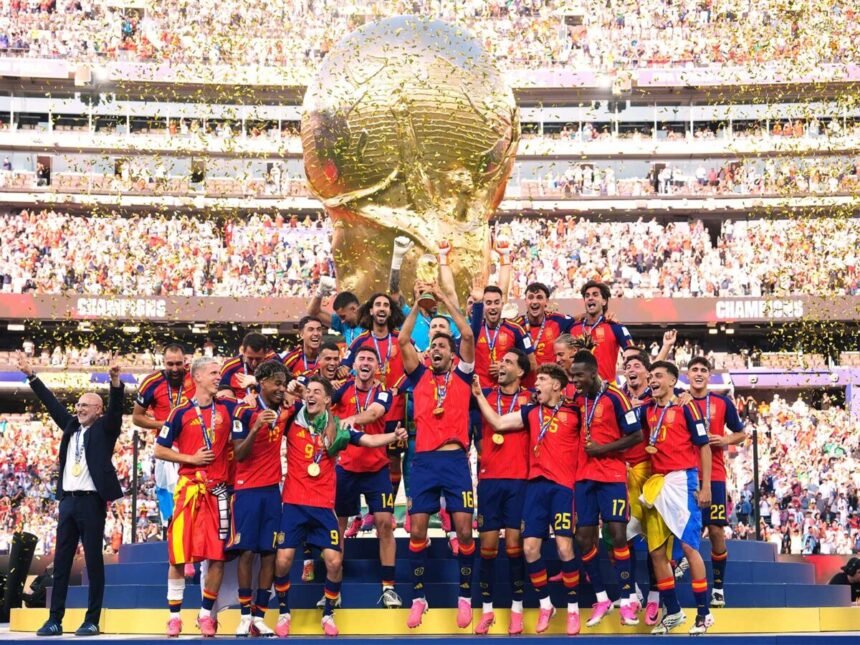
FIFA World Cup 2026 Champions, Football fans around the world witnessed another unforgettable chapter in FIFA World Cup history as Spain defeated Argentina 1-0 after extra time to lift the FIFA World Cup 2026 trophy. In a dramatic final filled with tactical battles, world-class goalkeeping, relentless pressure, and emotional moments, substitute Ferran Torres emerged as Spain’s unlikely hero by scoring the decisive goal in the 106th minute.
The victory ended Argentina’s hopes of defending their world title and denied football legend Lionel Messi the dream of finishing his remarkable international career with consecutive World Cup triumphs. The Spain vs Argentina Final showcased Spain’s tactical dominance, relentless attacking pressure, and Ferran Torres’ unforgettable extra-time winner that ultimately decided the contest. Spain celebrated its second FIFA World Cup title, adding another golden page to the nation’s rich football legacy after its historic triumph in 2010.
The final delivered everything supporters expect from the biggest match in world football—intensity, suspense, tactical discipline, heartbreak, and ultimately, a moment of brilliance that separated the two football giants.
A FIFA World Cup Final Worth Waiting For
The FIFA World Cup final brought together two of football’s biggest powerhouses. On one side stood reigning champions Argentina, determined to retain the crown they captured four years earlier. On the other was a youthful yet highly talented Spanish side that had steadily evolved into one of the world’s strongest teams.
From the opening whistle, both teams understood the magnitude of the occasion. Neither side was willing to take unnecessary risks, resulting in a tightly contested opening phase where every pass, tackle, and movement carried enormous significance.
Spain controlled possession for long spells, patiently searching for openings, while Argentina focused on staying compact and waiting for opportunities to launch dangerous counterattacks.
It was a tactical chess match where every move mattered.
Spain Controlled the Tempo Throughout the Match
FIFA World Cup 2026 Champions, Spain quickly imposed their trademark possession-based style. Their midfield dictated the rhythm, circulating the ball with precision while forcing Argentina to defend for extended periods.
Wave after wave of Spanish attacks tested Argentina’s defensive organization. The European champions consistently created dangerous situations around the penalty area, but finding the decisive breakthrough proved far more difficult.
Argentina’s defenders remained disciplined, blocking crosses, intercepting passes, and denying Spain clear shooting opportunities.
Although Spain enjoyed the majority of possession, football once again proved that dominating the ball doesn’t automatically translate into goals.
Emiliano Martínez Produced Another Goalkeeping Masterclass
If one player kept Argentina alive throughout the contest, it was goalkeeper Emiliano Martínez.
The Argentine shot-stopper delivered one outstanding save after another, frustrating Spain’s attackers with exceptional positioning, quick reflexes, and remarkable composure under pressure.
Time after time, Spanish forwards appeared destined to score, only for Martínez to produce spectacular interventions that kept the score level.
His performance reminded football fans why he has earned a reputation as one of the finest goalkeepers in international football.
Without his heroics, Spain could have wrapped up the match long before extra time.
Argentina Faced a Huge Setback After Enzo Fernández’s Red Card
Argentina’s challenge became significantly more difficult during the second half when midfielder Enzo Fernández received two yellow cards, resulting in a red card and reducing his team to ten players.
Playing with one man fewer against a technically gifted Spanish side was always going to be an enormous task.
The dismissal forced Argentina to become even more defensive. Every player dropped deeper, sacrificing attacking ambitions in favor of protecting their goal.
Despite the numerical disadvantage, Argentina showed incredible determination, discipline, and resilience.
The South American champions continued blocking shots, closing passing lanes, and defending every inch of the pitch with remarkable commitment.
Lionel Messi’s Final World Cup Dream Slips Away
Much of the world’s attention naturally focused on Lionel Messi, who entered the final hoping to achieve another historic milestone.
The Argentine captain worked tirelessly throughout the contest, searching for moments of magic that have defined his legendary career.
However, Spain’s organized defensive structure limited his influence. Every time Messi received possession, multiple Spanish defenders quickly surrounded him, denying him the space needed to create decisive opportunities.
Although he continued fighting until the very end, the fairy-tale ending never arrived.
The defeat also meant Messi narrowly missed the opportunity to surpass Kylian Mbappé in the tournament’s Golden Boot race, adding another layer of disappointment to an already heartbreaking evening.
Even in defeat, Messi’s leadership, commitment, and determination once again demonstrated why he remains one of football’s greatest icons.
Extra Time Finally Produced the Breakthrough
FIFA World Cup 2026 Champions, After ninety tense minutes without a goal, the World Cup final moved into extra time.
Fatigue began affecting both teams, yet Spain continued pressing forward with greater energy and ambition.
Argentina, meanwhile, focused almost entirely on survival.
Every clearance, interception, and tackle became increasingly valuable as both sides sensed that a single mistake could decide the championship.
Just when penalties seemed inevitable, Spain finally found the breakthrough they had been chasing all evening.
Ferran Torres Becomes Spain’s World Cup Hero
Substitute Ferran Torres delivered the defining moment of the tournament.
In the 106th minute, Spain launched another dangerous attack into Argentina’s penalty area. After sustained pressure, the ball fell perfectly for Torres inside the box.
Without hesitation, he unleashed a powerful close-range finish that finally beat Emiliano Martínez and sent the stadium into celebration.
The goal instantly transformed Torres from impact substitute to national hero.
His composure under immense pressure highlighted the value of squad depth at major international tournaments. Fresh legs, sharp instincts, and perfect timing combined to produce the goal that secured Spain’s second FIFA World Cup title.
It was the kind of moment every footballer dreams about—a World Cup final winner that will forever be remembered.
Spain’s Defence Completes the Job
Scoring was only half the battle.
Following Torres’ breakthrough, Spain still had to defend their narrow advantage against an Argentine side desperate for an equalizer.
Despite being reduced to ten men, Argentina pushed forward with renewed urgency during the closing stages.
Spain’s defenders, however, remained calm under pressure.
Every clearance, interception, and challenge reflected the discipline that had characterized their tournament campaign from start to finish.
When the final whistle sounded, Spanish players collapsed to the ground in celebration, knowing they had reached the summit of world football once again.
Luis de la Fuente Praises His Golden Generation
FIFA World Cup 2026 Champions, Following the historic victory, Spain manager Luis de la Fuente expressed enormous pride in his squad.
He praised the players for remaining committed to the team’s philosophy throughout the tournament and described them as more than just teammates—they had become a family united by a shared ambition.
According to the Spanish coach, the players’ dedication, professionalism, and belief in one another ultimately made the difference.
He also acknowledged that winning the final required patience and resilience, especially against an Argentine side that refused to surrender despite playing with ten men.
His emotional celebration reflected years of preparation, development, and trust in a generation of footballers who have now secured their place in Spanish sporting history.
Lionel Scaloni Reflects on Argentina’s Heartbreaking Defeat
Argentina coach Lionel Scaloni accepted defeat with dignity while praising his players for their incredible determination.
He emphasized that his team gave everything throughout the tournament and should be remembered for their fighting spirit rather than the disappointment of losing the final.
Scaloni highlighted that reaching another World Cup final is itself an extraordinary achievement and urged supporters to appreciate everything the squad accomplished during their campaign.
His comments reflected the character that has defined Argentina throughout recent years—a team capable of handling victory with humility and defeat with grace.
Spain’s Tactical Discipline Made the Difference
Although the final scoreline was only 1-0, Spain’s tactical execution played a major role in securing victory.
Several factors contributed to their success:
- Dominated possession for most of the match.
- Applied constant attacking pressure.
- Controlled midfield battles.
- Limited Lionel Messi’s creative influence.
- Maintained defensive organization throughout.
- Successfully capitalized on their numerical advantage.
- Utilized substitutes effectively, with Ferran Torres delivering the winning goal.
Spain combined technical quality with patience, proving that persistence often rewards teams willing to trust their game plan.
Argentina Leave With Pride Despite Defeat
FIFA World Cup 2026 Champions, While the loss undoubtedly hurt, Argentina’s campaign should still be remembered positively.
The reigning champions reached another World Cup final and demonstrated extraordinary resilience throughout the tournament.
Playing over half the match with ten players yet forcing Spain into extra time showcased their remarkable defensive commitment.
Emiliano Martínez’s brilliant goalkeeping performance also reinforced his reputation among the world’s elite.
Although they fell short of defending their title, Argentina once again proved why they remain one of international football’s most respected nations.
What Spain’s Triumph Means for World Football
Spain’s success signals another exciting era for international football.
After years of rebuilding following their golden generation, the national team has once again reached the pinnacle of the sport.
The victory reflects the country’s continued investment in youth development, technical excellence, and tactical intelligence.
With many key players still approaching their peak years, Spain could remain among the favorites in future international tournaments.
Their World Cup triumph also highlights how modern football rewards collective teamwork just as much as individual brilliance.
Legacy of the FIFA World Cup 2026 Final
The FIFA World Cup 2026 final will be remembered as one of the tournament’s most emotionally charged contests.
It featured world-class goalkeeping, relentless Spanish pressure, heroic Argentine defending, dramatic extra-time tension, and a memorable match-winning moment from Ferran Torres.
For Spain, it marked the return to the summit of world football after sixteen years.
For Argentina, it represented the painful end of an inspiring title defense and another emotional chapter in Lionel Messi’s legendary international career.
Years from now, football fans will remember this final not because of a flood of goals but because of its intensity, discipline, and the single decisive strike that changed history.
Read More: Cape Verde World Cup 2026: From 1% Hope to Historic Knockout Stage Glory
Conclusion
FIFA World Cup 2026 Champions, Spain’s 1-0 extra-time victory over Argentina perfectly captured why the FIFA World Cup remains the greatest tournament in football. It was a contest defined by patience, tactical brilliance, defensive resilience, and one unforgettable moment of quality from Ferran Torres. Spain deserved their triumph after controlling much of the match, while Argentina earned widespread respect for refusing to surrender despite playing with ten men for a significant period.
The final also marked another significant milestone in football history. Spain celebrated their second FIFA World Cup title, Ferran Torres etched his name into national folklore, and Lionel Messi’s remarkable World Cup journey concluded with dignity despite falling just short of another championship. Ultimately, the 2026 FIFA World Cup final reminded the world that football’s greatest stories are often written by teamwork, perseverance, and moments of courage when the pressure is at its highest.