
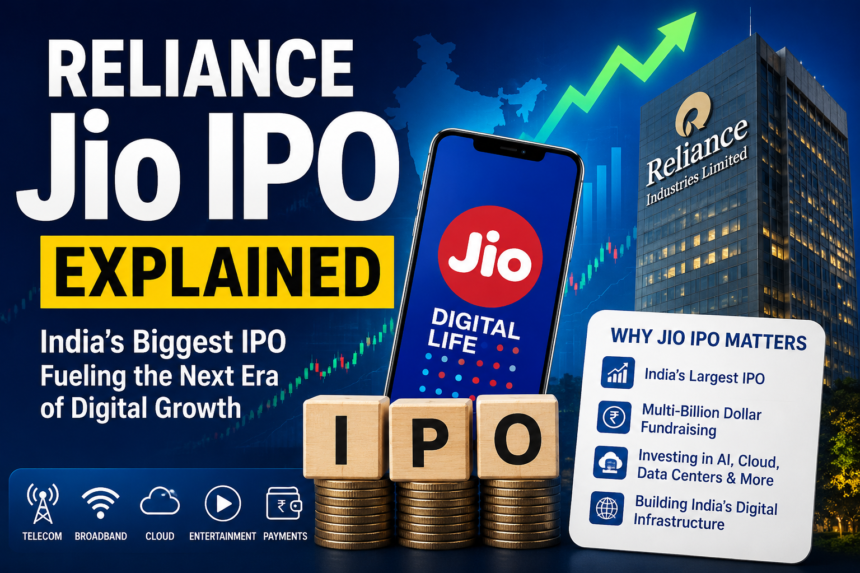
Reliance Jio IPO, There was a time when getting a Jio SIM card felt almost like receiving a free ticket to the digital world. Millions of Indians lined up to grab free SIMs, free data, and free calling services when Jio entered the telecom market in 2016. What seemed like an aggressive customer acquisition strategy at the time has now evolved into one of the most remarkable business transformations in India’s corporate history.
Today, Jio is no longer just a telecom company. It has grown into a vast digital ecosystem spanning broadband services, cloud computing, enterprise solutions, streaming platforms, digital payments, data centers, and increasingly, artificial intelligence (AI).
Now, reports suggest that the upcoming Jio IPO could become one of the biggest Initial Public Offerings ever seen in India, with the company aiming to raise around $4 billion (approximately ₹37,700 crore). As excitement around the Jio IPO continues to build, an important question emerges: Why does a company backed by global giants like Meta, Google, Silver Lake, KKR, and Reliance Industries need to tap public markets for fresh capital?
The answer reveals a fascinating story about Jio’s next chapter.
From Free SIM Cards to a Digital Empire
When Jio entered India’s telecom sector, it didn’t merely compete—it disrupted the entire industry.
At that time, players like Vodafone, Airtel, Aircel, and Idea dominated the market. Instead of gradually winning customers through competitive pricing, Jio practically gave away services for free. The result was unprecedented. Millions switched networks, data consumption exploded, and India experienced a digital revolution.
What began as a telecom venture quickly evolved into something much bigger.
Today, Jio serves hundreds of millions of users and operates across multiple digital segments. The company has become the backbone of India’s internet economy, touching nearly every aspect of consumers’ digital lives.
Why Is Jio Launching an IPO Now?
Reliance Jio IPO, Most companies go public either to raise capital for expansion or provide existing investors with an opportunity to exit.
Interestingly, Jio’s proposed IPO appears to follow a different path.
Unlike many high-profile listings, the offering is expected to be a pure fresh issue. That means there will likely be no Offer for Sale (OFS), where existing shareholders sell their stakes.
Instead, every rupee raised from public investors would flow directly into Jio’s coffers.
This detail is significant because it signals that the company isn’t helping early investors cash out. Rather, it’s raising capital to fuel future growth.
The Revenue Reality: Telecom Still Dominates
Despite all the excitement surrounding Jio’s digital ambitions, the majority of its earnings still come from traditional telecom services.
Mobile subscriptions remain the company’s largest revenue source. Broadband services through JioFiber and enterprise connectivity solutions contribute significantly as well.
Meanwhile, newer businesses such as cloud computing, content platforms, and digital services are growing but still represent a relatively small portion of total revenue.
In fact, telecom-related operations account for nearly 77% of Jio’s consolidated operating revenue.
This creates a challenge.
Investors often value telecom companies differently from technology firms.
The Valuation Problem Facing Telecom Companies
Reliance Jio IPO, Telecom businesses are powerful cash generators, but they are also incredibly capital-intensive.
Building network towers, purchasing spectrum licenses, upgrading infrastructure, and maintaining service quality require enormous investments year after year.
Because of these ongoing expenses, stock markets often view telecom operators similarly to utility companies. They provide essential services but rarely receive the sky-high valuations enjoyed by technology companies.
Think of it like owning a highway. The traffic keeps flowing, but maintaining the road is expensive.
Technology companies, on the other hand, resemble software platforms that can scale rapidly with comparatively lower costs. Investors typically reward such businesses with premium valuations.
This is exactly why Jio wants to reposition itself.
Jio’s Ambition: Becoming a Technology Powerhouse
Jio’s leadership clearly understands that the future lies beyond mobile connectivity.
The company’s vision revolves around building a comprehensive digital infrastructure platform that supports India’s technological growth.
Its investments are increasingly focused on:
Artificial Intelligence Infrastructure
Reliance Jio IPO, AI is becoming the backbone of the next digital revolution. Jio aims to build infrastructure capable of supporting AI applications, machine learning models, and enterprise-level computing requirements.
Cloud Computing Services
Businesses are rapidly shifting to cloud-based operations. Jio wants to become a major player in India’s growing cloud market.
Data Centers
As data consumption continues to soar, demand for secure storage and processing facilities is increasing. Jio is positioning itself to capitalize on this trend.
Enterprise Technology Solutions
The company is also targeting corporate customers with software solutions, connectivity services, and digital transformation tools.
These investments indicate that Jio views telecom services as merely the gateway into a much broader technology ecosystem.
Where Will the IPO Money Go?
Many investors might assume the IPO proceeds will be used entirely for AI and technology projects.
However, the reality is more nuanced.
According to draft filings, a substantial portion of the funds—up to ₹27,500 crore—could be allocated toward repaying existing debt.
At first glance, this may not sound exciting.
But strategically, it makes a great deal of sense.
Debt Reduction: The Hidden Strategy Behind the IPO
Reliance Jio IPO, Over the years, Reliance Jio Infocomm borrowed heavily to finance network expansion across India.
Some of these borrowings include international loans denominated in dollars and Japanese yen.
Currently, the targeted loans represent more than ₹30,000 crore in outstanding principal.
By using IPO proceeds to reduce debt, Jio can strengthen its financial position before embarking on its next growth phase.
Think of it as clearing space in your backpack before starting a long trek. Reducing weight allows you to move faster and more efficiently.
Similarly, a cleaner balance sheet provides Jio with:
- Lower interest expenses
- Improved financial flexibility
- Reduced leverage
- Greater investment capacity
- Enhanced investor confidence
This makes debt repayment a strategic move rather than a defensive one.
Why Existing Investors Are Not Selling
Perhaps one of the strongest signals comes from Jio’s current shareholders.
Global investment giants such as Meta, Google, Silver Lake, KKR, and sovereign wealth funds are reportedly not rushing to sell their stakes.
That decision speaks volumes.
These investors entered when Jio was primarily a telecom company. Today, they have a front-row seat to India’s digital transformation story.
By holding onto their shares, they appear to be betting that Jio’s future value lies far beyond telecom operations.
In simple terms, they believe the most rewarding chapter may still be ahead.
The Biggest Challenge: Airtel
Reliance Jio IPO, Every growth story has competition, and Jio is no exception.
While Vodafone Idea continues to face financial difficulties and BSNL remains in recovery mode, Airtel stands as Jio’s most formidable rival.
Unlike Jio’s scale-first approach, Airtel focused heavily on premium customers, higher average revenue per user (ARPU), enterprise solutions, and disciplined capital management.
The result?
Despite having fewer subscribers, Airtel often delivers stronger profitability metrics.
This creates a fascinating rivalry between two very different business models.
The Question Investors Must Answer
For potential IPO investors, one critical question will shape their investment decision.
Is Jio simply a telecom company competing against Airtel?
Or is it a technology platform using telecom services as a customer acquisition engine?
The answer matters because it directly impacts valuation.
If investors see Jio primarily as a telecom operator, valuation expectations may remain relatively conservative.
If they view it as an emerging digital infrastructure and technology company, the upside could be significantly greater.
Could Jio Become India’s Digital Infrastructure Giant?
The future of Jio depends less on acquiring additional SIM card users and more on monetizing its massive customer base through technology services.
Success will require execution across several areas:
- AI infrastructure development
- Cloud computing expansion
- Enterprise software growth
- Digital ecosystem integration
- Data center investments
If Jio succeeds, it could eventually be compared not only with telecom operators but also with global technology leaders.
That would represent a dramatic shift in how investors value the company.
Why This IPO Could Change Indian Market History
India has witnessed many landmark IPOs over the years, but Jio’s proposed public offering could stand apart.
The listing represents far more than a telecom company raising money.
It symbolizes the evolution of India’s digital economy and the emergence of homegrown technology infrastructure on a massive scale.
For investors, the opportunity isn’t about selling more SIM cards. That chapter is already written.
The real story lies in whether Jio can transform itself into the foundation upon which India’s future digital economy is built.
And if it succeeds, this IPO may eventually be remembered as one of the defining moments in India’s corporate and market history.
Read More: NSE IPO Set to Break Records with ₹30,000 Crore Issue and ₹5 Lakh Crore Valuation
Conclusion
Reliance Jio IPO, Jio’s upcoming IPO is not merely a fundraising event—it is a strategic blueprint for the company’s next decade of growth. By strengthening its balance sheet, reducing debt, and investing heavily in emerging technologies like AI, cloud computing, and data centers, Jio is preparing for a future that extends far beyond telecom services.
The company has already reshaped India’s telecom landscape. Now, it aims to become the digital infrastructure engine powering the country’s technological ambitions. Whether investors view Jio as a telecom operator or a future technology powerhouse will ultimately determine how the market values this historic IPO.