
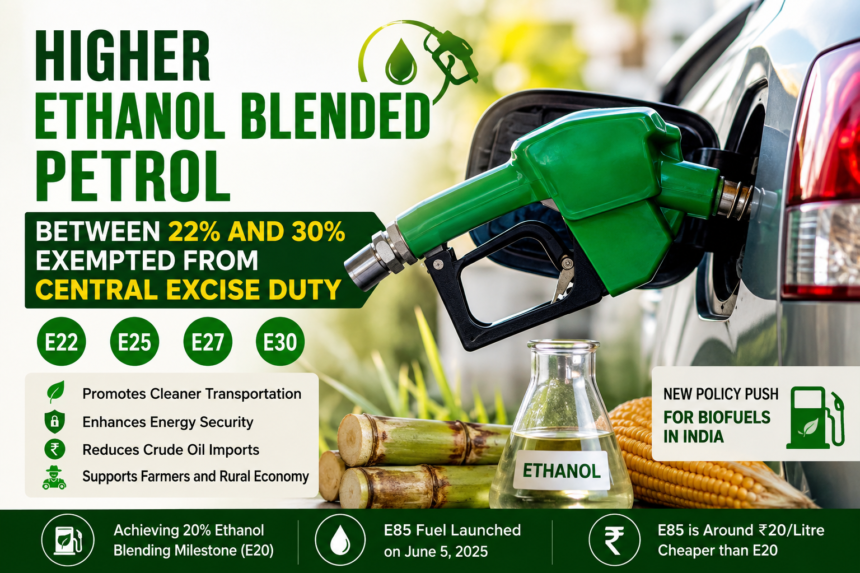
Higher Ethanol Blended Petrol, India has taken another significant stride in its transition toward cleaner and more sustainable energy sources. In a move aimed at accelerating the adoption of biofuels, the Central Government has announced an exemption from central excise duty on petrol blended with higher percentages of ethanol, specifically between 22% and 30%.
What Does the New Excise Duty Exemption Mean?
Under the latest notification issued by the government, petrol containing ethanol blends of 22%, 25%, 27%, and 30% will no longer attract central excise duty.
In simple terms, fuel manufacturers and suppliers producing these higher ethanol-blended petrol variants will benefit from reduced taxation, potentially making these fuels more attractive for commercial distribution and consumer adoption.
This exemption serves as an incentive to encourage oil companies, fuel retailers, and vehicle owners to embrace higher ethanol blends as part of India’s broader clean energy strategy.
Why Is India Promoting Ethanol-Blended Petrol?
Higher Ethanol Blended Petrol, Think of ethanol as a renewable companion to conventional gasoline. While traditional petrol relies heavily on imported crude oil, ethanol is primarily produced from agricultural feedstocks such as sugarcane, maize, and other biomass resources.
By increasing ethanol content in fuel, India aims to achieve several key objectives:
- Reduce dependence on imported crude oil
- Lower greenhouse gas emissions
- Improve energy security
- Support domestic farmers
- Strengthen rural economies
- Promote sustainable transportation
The latest tax exemption aligns perfectly with these long-term goals.
A Milestone Achievement: Reaching 20% Ethanol Blending
India recently achieved a significant milestone under its Ethanol Blended Petrol (EBP) Programme by successfully reaching a 20% ethanol blending level.
This accomplishment marks years of coordinated efforts involving oil marketing companies, farmers, ethanol producers, and policymakers. Having achieved the E20 target, the government is now looking beyond 20% blends and encouraging the next generation of fuel standards.
The exemption for blends ranging from 22% to 30% reflects this forward-looking approach.
BIS Introduces New Fuel Standards
The development follows the introduction of new fuel specifications by the Bureau of Indian Standards (BIS), which officially notified standards for higher ethanol blends on May 19, 2026.
These standards establish quality benchmarks for fuels containing ethanol percentages beyond the current E20 level. Although these fuel variants have not yet entered widespread commercial circulation, the new framework lays the foundation for their future rollout.
Standardization is crucial because it ensures compatibility, safety, and consistency across the fuel supply chain.
The Bigger Goal: Cleaner Transportation
Higher Ethanol Blended Petrol, Transportation remains one of the largest contributors to carbon emissions worldwide. India, with its rapidly growing vehicle population, faces the challenge of balancing economic growth with environmental sustainability.
Higher ethanol blends can play an important role in addressing this challenge.
Ethanol burns cleaner than conventional petrol, resulting in lower emissions of harmful pollutants. As more vehicles begin using ethanol-rich fuels, overall emissions from the transportation sector could decline significantly.
It’s similar to replacing a traditional incandescent bulb with an energy-efficient LED—small changes at scale can create a massive impact.
Reducing India’s Crude Oil Import Bill
One of the biggest economic advantages of ethanol blending is its potential to reduce India’s reliance on imported crude oil.
India imports a substantial portion of its petroleum requirements from international markets. Fluctuating global oil prices often place pressure on the country’s trade balance and foreign exchange reserves.
Every additional percentage of ethanol blended into petrol means less gasoline is required. Over time, this can translate into significant savings on crude oil imports.
The government views ethanol blending as an important tool for achieving greater energy independence.
A Boost for India’s Agriculture Sector
Higher Ethanol Blended Petrol, The benefits of higher ethanol blending extend beyond the energy sector. Farmers are also expected to gain from increased demand for ethanol-producing crops.
Sugarcane growers, maize farmers, and other agricultural producers stand to benefit as ethanol production expands. Increased demand can create new income opportunities, strengthen rural economies, and provide greater market stability for agricultural products.
This creates a win-win situation where environmental objectives and agricultural development move forward together.
Launch of E85 Fuel Marks a New Era
The excise duty exemption comes shortly after the formal launch of E85 fuel in India on June 5.
E85 contains 85% ethanol and 15% gasoline, making it one of the highest ethanol-blended fuels introduced in the Indian market.
The launch represents a major milestone in the country’s biofuel journey and demonstrates the government’s willingness to explore advanced ethanol-blending solutions.
Although widespread adoption will depend on vehicle compatibility and infrastructure readiness, E85 opens the door to a new chapter in India’s clean energy ambitions.
E85 Offers Cost Advantages for Consumers
One of the most attractive features of E85 fuel is its pricing.
According to available information, E85 is approximately ₹20 per litre cheaper than E20 petrol, which currently serves as the standard ethanol-blended fuel option.
For consumers, lower fuel prices can provide meaningful savings over time, particularly for individuals who drive frequently or operate commercial vehicles.
If vehicle compatibility issues are addressed effectively, the cost advantage could become a powerful factor driving adoption.
Challenges Ahead for Higher Ethanol Blends
Higher Ethanol Blended Petrol, While the government’s latest move has been widely welcomed, several challenges remain.
Some vehicles may require modifications or specialized engines to operate efficiently on higher ethanol blends. Fuel distribution infrastructure must also be expanded to accommodate new fuel variants.
In addition, consumer awareness will play a critical role. Many drivers remain unfamiliar with higher ethanol blends and their benefits.
Successful implementation will require cooperation between automakers, fuel retailers, policymakers, and consumers.
What This Means for India’s Energy Future
The excise duty exemption for petrol blended with 22% to 30% ethanol sends a strong signal about India’s long-term energy priorities.
Rather than relying solely on fossil fuels, the country is actively diversifying its energy mix through renewable alternatives. Ethanol blending has emerged as one of the most practical and scalable solutions available today.
With supportive policies, standardized fuel specifications, and growing industry participation, higher ethanol blends could soon become a regular feature of India’s fuel landscape.
The move not only supports environmental sustainability but also strengthens energy security and rural economic development.
Read More: BMW F 450 GS Price in India: Everything You Need to Know
Conclusion
Higher Ethanol Blended Petrol, India’s decision to exempt higher ethanol-blended petrol from central excise duty marks another important milestone in the nation’s clean energy journey. By encouraging the use of fuels containing 22% to 30% ethanol, the government aims to accelerate biofuel adoption, reduce oil import dependence, and support the agricultural sector.
Combined with the recent launch of E85 fuel and newly established fuel standards, the policy highlights India’s commitment to building a more sustainable and energy-secure future. As the country continues expanding its ethanol ecosystem, consumers, farmers, and the environment could all emerge as beneficiaries of this transformative shift.