
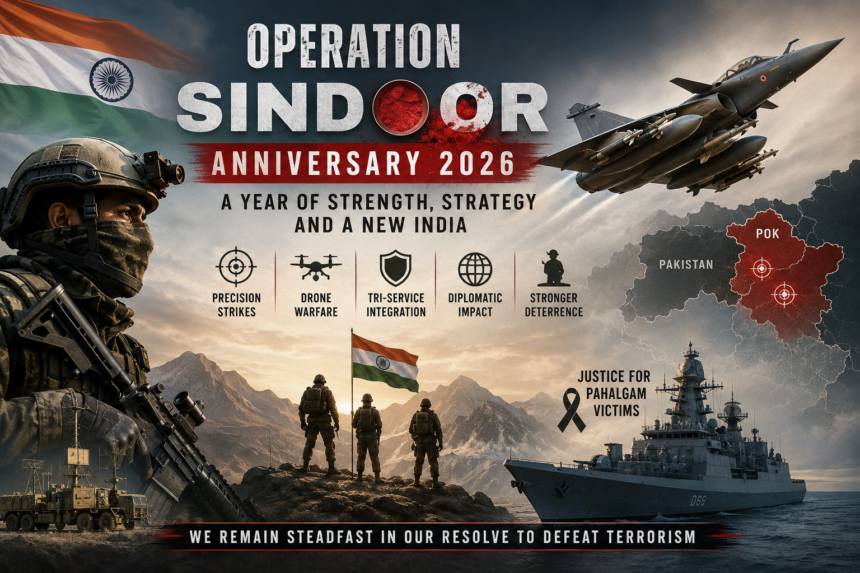
Operation Sindoor Anniversary, India marked the first anniversary of Operation Sindoor — the precision military operation launched against terrorist infrastructure in Pakistan and Pakistan-Occupied Kashmir (PoK) following the devastating Pahalgam terror attack of April 22, 2025, which killed 26 civilians.
To commemorate the anniversary, Defence Minister Rajnath Singh attended a special military briefing and the screening of a documentary on Operation Sindoor at the South Western Command Headquarters in Jaipur. Prime Minister Narendra Modi also changed his social media profile picture in remembrance of the operation and reaffirmed India’s commitment against terrorism by posting: “We remain steadfast in our resolve to defeat terrorism.”
One year later, Operation Sindoor’s impact extends far beyond the battlefield. The operation reshaped India’s strategic doctrine, accelerated defence modernisation, strengthened international diplomatic positioning, and altered the long-standing India-Pakistan deterrence equation.
This comprehensive analysis examines what Operation Sindoor achieved, the military capabilities it showcased, the lessons India’s armed forces learned, and how the country’s security architecture has evolved since the operation.
What Was Operation Sindoor? A Complete Recap
Operation Sindoor was launched in the early hours of May 7, 2025, as India’s direct response to the Pahalgam massacre carried out on April 22, 2025. In that attack, 26 tourists — mostly Hindu civilians — were killed by Pakistan-linked terrorists in Kashmir’s Baisaran Valley.
The military operation involved several coordinated components:
Precision Air Strikes
The Indian Air Force deployed Dassault Rafale fighter jets equipped with SCALP cruise missiles and HAMMER precision-guided munitions. These assets targeted nine terrorist infrastructure facilities located across Pakistan and Pakistan-Occupied Kashmir.
Use of Loitering Munitions
India also deployed domestically developed and imported kamikaze drones. These loitering munitions struck additional high-value targets with exceptional accuracy.
Zero Civilian Casualties
India maintained that the operation was strictly focused on terrorist infrastructure and deliberately avoided Pakistani civilian or military installations. According to official briefings, the operation achieved its objectives without civilian casualties.
Controlled Duration
The kinetic phase of the operation lasted approximately 25 minutes. After completing the designated strikes, India voluntarily paused further military action while assessing Pakistan’s response.
Deep Strike Capability
One of the most significant aspects of Operation Sindoor was the geographical depth of the strikes. Unlike earlier cross-Line of Control operations, India targeted locations deep inside Pakistani territory, not just within PoK.
Military Capabilities Demonstrated by Operation Sindoor
Operation Sindoor Anniversary, Operation Sindoor revealed a major evolution in India’s military capabilities. The operation highlighted improvements in precision warfare, joint-force coordination, drone deployment, and escalation management.
Precision Strike Capability — The Defining Achievement
The defining achievement of Operation Sindoor was India’s demonstrated ability to conduct highly accurate precision strikes.
Indian forces successfully targeted specific buildings within larger compounds, including terrorist training camps, weapons storage facilities, and operational command centres. At the same time, nearby civilian structures remained untouched.
This level of precision became possible through several advanced systems, including:
- TALIOS electro-optical targeting pods used by Rafale jets
- SCALP cruise missile terminal guidance systems
- HAMMER precision-guided munitions
- Detailed intelligence preparation and target mapping
The operation showed that India had developed a significantly improved capability for surgical counter-terror strikes.
Multi-Domain Military Integration
Operation Sindoor also demonstrated unprecedented coordination across multiple branches of India’s armed forces.
The air strikes were synchronised with:
- Ground force readiness along the Line of Control
- Naval deployments in the Arabian Sea and Bay of Bengal
- Cyber operations
- Electronic warfare systems
A major symbolic moment occurred when the three service chiefs — Lt Gen Rajiv Ghai, Air Marshal Awadhesh Kumar Bharti, and Vice Admiral AN Pramod — jointly addressed the media during the operation.
The joint briefing projected a new era of tri-service integration within India’s military establishment.
Drone Warfare Emerged as a New Operational Dimension
Operation Sindoor marked India’s operational debut of large-scale drone warfare.
Both indigenous systems and Israeli-origin loitering munitions were used extensively during the mission. These drones could remain airborne over targets, identify the optimal strike opportunity, and execute precision attacks with minimal collateral damage.
As a result, drones emerged as a force multiplier that complemented India’s manned aircraft operations.
The success of these systems accelerated India’s military focus on unmanned warfare capabilities.
One Year Later: How India’s Security Landscape Has Changed
Operation Sindoor Anniversary, India’s national security framework has undergone visible transformation.
Accelerated Defence Procurement
The operation exposed several capability gaps that the government moved quickly to address.
Consequently, defence procurement timelines that once took years were significantly accelerated.
Additional Rafale Marine Jets
India fast-tracked its order of 26 Rafale Marine fighter aircraft for the Indian Navy. The acquisition strengthened carrier-based strike capabilities and expanded India’s maritime deterrence posture.
Emergency Drone Procurement
The government accelerated emergency procurement of armed drones, surveillance systems, and loitering munitions.
Counter-Drone Systems
Pakistan’s drone responses during the conflict highlighted the growing importance of anti-drone technology. Therefore, India substantially increased investments in counter-drone systems.
Satellite Communication Expansion
Military-grade encrypted satellite communication systems for forward-deployed troops were also expanded to improve battlefield coordination and operational security.
The Emergence of the “Sindoor Doctrine”
Military analysts increasingly describe India’s new strategic posture as the “Sindoor Doctrine.”
The doctrine reflects India’s demonstrated willingness to conduct precision strikes against terrorist infrastructure inside Pakistan proper in response to major attacks on Indian civilians.
This represents a major departure from India’s earlier posture of strategic restraint.
Threshold Clarity
India clearly established the threshold for military retaliation: large-scale terrorist attacks targeting civilians.
Proportionality Principle
India limited its strikes strictly to terrorist infrastructure. This signalled that the operation was not intended to pursue territorial gains or regime change.
Escalation Management
After completing the initial strikes, India voluntarily paused further military action. This showcased India’s ability to control escalation while preserving the option of future retaliation if necessary.
International Response and Diplomatic Legacy
Operation Sindoor also reshaped India’s diplomatic standing on the global stage.
The United States Position
The United States urged both India and Pakistan to exercise restraint. However, Washington simultaneously called on Pakistan to take “verifiable action” against terrorist organisations.
International observers widely interpreted this language as tacit support for India’s position that Operation Sindoor was a counter-terror operation rather than an act of aggression.
The crisis also highlighted the growing strategic partnership between India and the United States.
China’s Difficult Balancing Act
China’s response proved significantly more complicated.
Beijing called for restraint but avoided explicitly condemning the Pahalgam terror attack as terrorism. This position created diplomatic friction and reinforced Indian concerns regarding China’s close strategic relationship with Pakistan.
As a result, Operation Sindoor deepened India’s scepticism about the long-term viability of any comprehensive diplomatic reset with China.
India’s Global South Outreach
India’s diplomatic communication strategy during the crisis was notably effective.
New Delhi framed Operation Sindoor as a limited and defensive counter-terrorism operation with clearly defined objectives. This narrative gained broad acceptance across Global South nations.
Importantly, no major international institution formally condemned India’s actions.
The diplomatic outcome reflected both the legitimacy of India’s response and the effectiveness of its strategic communications strategy.
Pahalgam Victims and the Pursuit of Justice
Operation Sindoor Anniversary, the central question remains whether justice has truly been delivered for the 26 victims of the Pahalgam attack.
Investigators later identified several terrorists linked to the massacre. According to official assessments, multiple individuals involved in the attack were eliminated during Operation Sindoor.
The investigation into the intelligence failures surrounding the attack also triggered structural reforms within Jammu and Kashmir’s security apparatus.
However, for the families of the victims, the anniversary remains deeply emotional.
Many of the tourists had travelled to Pahalgam specifically to experience Kashmir’s natural beauty. For their families, no military response can fully erase the trauma of their loss.
The emotional impact of the tragedy also entered India’s democratic discourse. In West Bengal’s Panihati constituency, Ratna Debnath — the mother of one of the victims — won her election by 28,836 votes, reflecting how public grief transformed into political expression.
Operation Sindoor and India’s Nuclear Doctrine
Operation Sindoor was carefully conducted below the nuclear threshold.
The operation validated India’s doctrine of calibrated conventional deterrence by demonstrating that India could impose substantial military costs on Pakistan without triggering uncontrolled nuclear escalation.
Pakistan engaged in deliberate but ambiguous nuclear signalling during the crisis. Nevertheless, back-channel diplomatic communication ultimately contributed to maintaining stability and supporting the ceasefire environment.
The operation therefore reinforced India’s confidence in managing limited conventional conflict under a nuclear overhang.
Information Warfare and Media Management
India’s information management strategy during Operation Sindoor was notably sophisticated.
The government conducted regular real-time briefings supported by:
- Satellite imagery
- Strike footage
- Intelligence assessments
- Military spokesperson presentations
This proactive communication strategy allowed India to shape the international narrative before counter-narratives could gain traction.
The joint press conference featuring all three service chiefs became one of the defining moments of the operation, symbolising institutional unity and military professionalism.
In addition, rapid fact-checking efforts and coordinated social media communication helped prevent large-scale misinformation campaigns during the conflict.
What Comes Next? India’s Security Agenda After Operation Sindoor
Operation Sindoor Anniversary, Operation has already influenced India’s long-term national security priorities.
Formalising the Sindoor Doctrine
Strategic experts expect India to gradually formalise elements of the Sindoor Doctrine within defence policy papers and future strategic documents.
Strengthening Counter-Terror Infrastructure
India is continuing to strengthen intelligence coordination in Jammu and Kashmir and along border regions to prevent future attacks.
Defence Manufacturing Expansion
The government is accelerating indigenous defence programmes, including:
- HAL Tejas Mk2 development
- Indigenous drone programmes
- Advanced submarine projects
Diplomatic Consolidation
India is also attempting to preserve the international diplomatic consensus achieved during Operation Sindoor for use in future crises.
Border Infrastructure and Forward Deployment
Continued investment in border roads, logistics infrastructure, and rapid deployment capabilities remains central to India’s evolving military strategy.
Conclusion
Operation Sindoor Anniversary, India’s strategic posture appears significantly more assertive, integrated, and confident.
The operation demonstrated that India could respond decisively to terrorism while still preventing uncontrolled escalation. That achievement carried both military and diplomatic significance.
For India’s armed forces, the anniversary represents a moment of institutional pride. For the families of the Pahalgam victims, it remains a solemn reminder of irreversible loss.
Both realities now shape India’s national security outlook.
Operation Sindoor was not merely a military strike. It became a defining moment in the evolution of India’s counter-terror doctrine, defence modernisation, and strategic identity in the 21st century.