
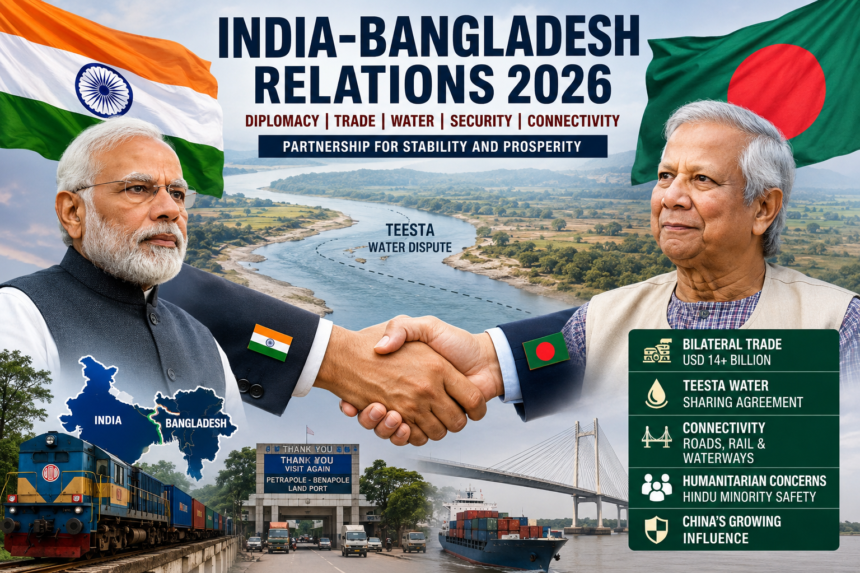
India-Bangladesh Relations 2026 is navigating one of its most delicate phases in decades. The political upheaval of July-August 2024 — which ended Sheikh Hasina’s 15-year government and brought Muhammad Yunus’ interim administration to power — fundamentally changed the bilateral dynamic that India had carefully cultivated over years. While Bangladesh remains India’s largest neighbour and trade partner in South Asia, several contentious issues — Sheikh Hasina’s asylum in India, the Teesta river water sharing dispute, the status of Indian projects in Bangladesh, and Hindu minority concerns — require careful navigation.
Muhammad Yunus and the New Bangladesh: What Changed
The 2024 Political Transition
Sheikh Hasina’s government — which had maintained exceptionally close ties with India — fell in August 2024 following massive student-led protests against a quota system in government jobs. Hasina fled to India and has remained there since. Nobel Peace laureate Muhammad Yunus returned from Paris to lead an interim government tasked with stabilising Bangladesh and organising new elections.
The Yunus government’s composition — including former BNPP-aligned elements and Islamist parties that are openly anti-India — initially alarmed New Delhi. However, the relationship has been managed with pragmatic caution on both sides, recognising that the bilateral partnership is too important to be derailed by political transitions.
India’s Diplomatic Response
India-Bangladesh Relations 2026, India has maintained official channels with the Yunus government while avoiding explicit endorsement. New Delhi’s concerns include:
- Hasina’s safety: India is providing refuge to the former PM — a politically sensitive decision
- Hindu minority safety: Reports of attacks on Hindu minorities in Bangladesh following the political transition have created domestic political pressure in India
- Pakistani and Chinese influence: Any weakening of India-Bangladesh ties creates space for India’s rivals to expand influence
- Treaty obligations: Multiple bilateral agreements — power, water, connectivity — require continuation regardless of political changes
The Teesta River Water Dispute
What Is the Teesta Dispute?
The Teesta River originates in Sikkim, flows through North Bengal, and enters Bangladesh before joining the Brahmaputra. Bangladesh is heavily dependent on the Teesta for dry season irrigation in its northern agricultural districts. A proposed Teesta water-sharing agreement between India and Bangladesh has been negotiated at the central government level multiple times — but successive West Bengal Chief Ministers (first Buddhadeb Bhattacharya, then Mamata Banerjee) have refused to concede to the deal, arguing it would harm West Bengal farmers.
Current Status in 2026
The Teesta dispute remains unresolved in 2026 — and has become a more politically charged issue under the Yunus government, which has cited India’s refusal to share Teesta waters as evidence of an inequitable bilateral relationship. Bangladesh is also exploring China’s offer to fund a Teesta river management project — a development that India views with serious concern, as Chinese infrastructure in sensitive areas of Bangladesh creates strategic vulnerabilities.
Resolution of the Teesta dispute remains one of the most important steps toward normalising India-Bangladesh ties under the new political configuration. Any movement on Teesta would signal genuine Indian commitment to equitable bilateral cooperation.
India-Bangladesh Trade in 2026
Trade Volumes
- Total bilateral trade: USD 14+ billion (FY2025-26)
- India’s exports to Bangladesh: USD 12 billion — cotton yarn, fabric, machinery, power equipment, consumer goods
- Bangladesh’s exports to India: USD 2+ billion — readymade garments, fish, jute products
- Trade imbalance: Bangladesh runs a large trade deficit with India — a persistent source of tension
Connectivity Infrastructure
India and Bangladesh have made significant progress on connectivity infrastructure — roads, rail, inland waterways, and power interconnections. Key links:
- Power: India exports approximately 1,600 MW of electricity to Bangladesh — critical for Bangladesh’s energy security
- Rail: Restored train services on multiple routes; Maitree Express and Bandhan Express connecting Kolkata, Dhaka, and Khulna
- Road: Integrated Check Posts at Petrapole-Benapole and other crossings facilitating trade
- Inland waterways: Protocol on Inland Water Transit and Trade allowing Indian goods to transit through Bangladesh — cost-efficient alternative to sea shipping
Impact of Political Transition on Trade
The 2024 political transition created temporary trade disruption — border crossings were disrupted, projects were delayed, and business confidence fell. In 2026, trade has largely normalised operationally, though several large Indian-funded projects in Bangladesh (connectivity infrastructure, power plants) face uncertainty about continued cooperation.
Hindu Minority Safety: India’s Humanitarian Concern
India-Bangladesh Relations 2026, India has repeatedly raised concerns about the safety of Bangladesh’s Hindu minority — approximately 9% of the population — in the context of post-Hasina political instability. Reports of temple vandalism, property seizures, and violence against Hindu families in the immediate aftermath of the political transition in 2024 generated significant concern in India, particularly in West Bengal.
The Yunus government has publicly committed to protecting all religious minorities. However, actual implementation — including accountability for past violence and prevention of future incidents — remains an area of active diplomatic engagement between the two countries. India’s domestic politics — where West Bengal, with its large Bengali Hindu population, is a significant electoral state — make this issue politically sensitive beyond pure diplomatic calculus.
Path to Normalisation: What India Must Do
Engage the Yunus Government Pragmatically
India must engage with the Yunus government on the basis of bilateral interests, not political preferences. Just as India has managed relationships with governments across the ideological spectrum globally, Bangladesh is too important a neighbour to cede to Chinese influence simply because the current Dhaka government is less India-friendly than Hasina’s.
Resolve the Teesta Dispute
The Teesta water-sharing deal is the most actionable step India can take to demonstrate genuine commitment to equitable partnership. The central government must find a way to address West Bengal’s concerns — through compensatory water allocation or alternative arrangements — and finalise the treaty. Continued delay empowers China’s alternative offer.
Facilitate Sheikh Hasina’s Future
India’s continued sheltering of Sheikh Hasina creates ongoing friction with Dhaka. A negotiated arrangement — whether regarding Hasina’s legal status, her potential return to political life, or her repatriation if charged — would remove one of the most visible bilateral irritants.
China’s Growing Influence in Bangladesh
One of India’s most significant concerns in Bangladesh is the expanding footprint of Chinese investment and diplomatic influence. China is Bangladesh’s largest source of foreign aid and investment, its largest single-country trading partner, and is now positioning itself as a partner in the Teesta river management project that India has failed to conclude.
- BRI (Belt and Road Initiative): Bangladesh joined BRI in 2016 — Chinese-funded infrastructure includes the Padma Bridge Rail Link, port development, and power plants
- Teesta offer: China has offered to fund and execute a comprehensive Teesta river management project — direct competitive positioning against India’s stalled water-sharing agreement
- Defence: Bangladesh uses Chinese military equipment including submarines, frigates, and aircraft
India’s challenge is to offer Bangladesh a sufficiently attractive partnership — equitable trade, water sharing, connectivity investment — to prevent China from emerging as the default development partner for Bangladesh’s next government.
Read More: India-US Trade Deal 2026: Key Negotiations, Opportunities, and Challenges
Conclusion
India-Bangladesh Relations 2026, Bangladesh is India’s most important bilateral relationship in South Asia — in terms of trade, connectivity, shared culture, and strategic positioning. The political transition of 2024 has created challenges, but the fundamental logic of India-Bangladesh partnership — geographic interdependence, economic complementarity, and shared interest in regional stability — remains unchanged. India must invest diplomatically to ensure that political change in Dhaka does not become a strategic setback for India in South Asia. Taza Newsz covers India’s South Asia foreign policy, bilateral relations, and regional security news comprehensively.