
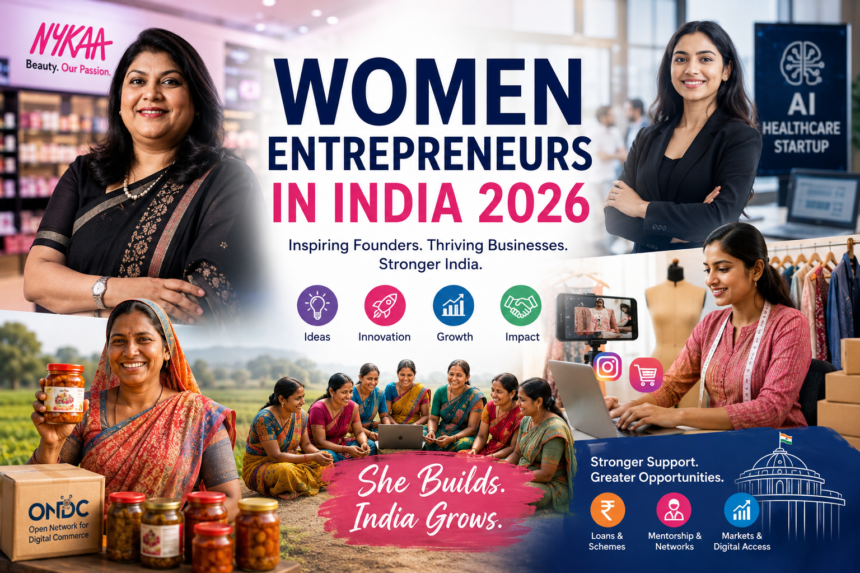
Women Entrepreneurs in India 2026, India’s entrepreneurship story has historically been dominated by men — but 2026 is writing a different chapter. The combination of rising education among women, digital access enabling business from home, government schemes specifically targeting women entrepreneurs, and a growing ecosystem of women-focused investors, mentors, and networks is producing a generation of Indian female founders who are building businesses of genuine scale and impact.
Top Female Founders in India 2026
Falguni Nayar — Nykaa
Falguni Nayar’s story is one of Indian entrepreneurship’s most inspiring. She left her investment banking career at Kotak to found Nykaa in 2012 at the age of 50 — building India’s leading beauty and fashion e-commerce platform. Nykaa’s 2021 IPO made Falguni Nayar the wealthiest self-made female billionaire in India. In 2026, Nykaa continues to grow its physical store network, Nykaa Man, and Nykaa Fashion verticals under her leadership.
Richa Kar — Zivame
Richa Kar founded Zivame — India’s first online lingerie marketplace — in 2011, breaking social taboos around intimate wear retail in India. By making lingerie shopping private, convenient, and size-inclusive online, she created a category where none existed. Zivame was acquired by Reliance Retail, validating the business model and Richa’s original insight.
Vineeta Singh — SUGAR Cosmetics
Vineeta Singh, co-founder and CEO of SUGAR Cosmetics, turned down a placement offer from IIM Ahmedabad to start a business. SUGAR Cosmetics — built specifically for Indian skin tones with long-lasting, affordable formulations — has become one of India’s most loved beauty brands, successfully competing with international brands across price points. Vineeta’s visibility on Shark Tank India has also made her one of India’s most prominent entrepreneurship role models.
Bhavish Aggarwal (Honourable mention — Ola’s EVs created women employment)
While not a woman founder, Ola Electric has notably created employment for thousands of women in its Futurefactory in Tamil Nadu — India’s largest all-women-operated manufacturing plant. This model of inclusive manufacturing is increasingly relevant to the women entrepreneurship narrative.
Government Schemes for Women Entrepreneurs in India 2026
PM MUDRA Yojana — Women’s Advantage
Women Entrepreneurs in India 2026, Under PM MUDRA Yojana, women entrepreneurs receive priority consideration and in many states receive lower interest rates — typically 0.25-0.50% lower than the standard rate. All three MUDRA categories (Shishu, Kishore, Tarun) are available to women. In 2026, the MUDRA loan limit was raised to Rs 20 lakh — significantly expanding the potential scale of women-led micro businesses.
Startup India — Women Founders Benefits
DPIIT-recognised startups led by women founders receive all standard Startup India benefits — tax holidays, self-certification of compliance, priority government procurement. Additionally, several state governments (Tamil Nadu, Kerala, Telangana, Karnataka) have women-specific startup schemes with additional grants, subsidies, and incubation support.
Stree Shakti Package (State Bank of India)
SBI’s Stree Shakti Package offers business loans at concessional interest rates (0.50% lower than standard) to women entrepreneurs who hold majority ownership stake (at least 51%) in their business. The package is available for a wide range of businesses — from manufacturing to trade to services. No collateral required for loans up to Rs 25 lakh under CGTMSE guarantee.
Annapurna Scheme
For women in the food processing and catering sector, the Annapurna Scheme provides loans up to Rs 50,000 for working capital — purchasing kitchen equipment, ingredients, and supplies. Administered through scheduled banks with government guarantee support.
Udyogini Scheme (Karnataka)
Karnataka’s Udyogini scheme provides subsidised loans and grants to women entrepreneurs in the state — particularly those from SC, ST, and OBC communities, and widows. Multiple states have similar schemes with different names — check your state government’s MSME or women development department website for locally relevant schemes.
How Women Can Start a Business in India 2026: Step-by-Step
Step 1: Validate Your Business Idea
Start with a problem you understand — ideally one you have personally experienced. Women entrepreneurs in India have had enormous success in areas like:
- Health and wellness — period care, prenatal nutrition, postpartum support
- Education — tutoring, edtech, skill development for women
- Fashion and beauty — sustainable fashion, clean beauty, ethnic wear
- Food — home-based cloud kitchens, artisan food brands, nutrition products
- Social enterprise — handicraft, rural producer connecting, environmental services
Step 2: Register Your Business
Choose between Sole Proprietorship (simplest, no registration needed), Private Limited Company (most formal, limited liability), or OPC (One Person Company). Register on the Udyam Portal for MSME status — this unlocks government scheme access, priority lending, and market linkages. Register on Startup India if your business is tech-driven, scalable, and innovation-based.
Step 3: Access Capital
Options for women entrepreneurs accessing capital in India:
- MUDRA loan: Rs 50,000 to Rs 20 lakh — most accessible starting point
- SBI Stree Shakti: Concessional rate business loan
- SIDBI’s Udyam Shakti: Specific MSME loans for women-led businesses
- Women-focused angel investors: Startups led by women increasingly attract investor interest — India Angel Network, She Capital, Saha Fund
- WEP (Women Entrepreneurship Platform): NITI Aayog’s platform connecting women entrepreneurs to mentors, capital, and market access
Step 4: Build Your Digital Presence
Every women’s business in India in 2026 needs a digital presence. At minimum:
- WhatsApp Business account for customer communication
- Instagram business account with consistent content (product photos, testimonials, behind-the-scenes)
- Google My Business listing for local discoverability
- ONDC or Meesho listing for online sales reach
Digital marketing skills are learnable and affordable — Meta Blueprint, Google Digital Garage, and YouTube tutorials provide free learning. Many successful women entrepreneurs in India have built significant businesses with zero advertising budget, purely through consistent, authentic social media content.
Challenges Women Entrepreneurs in India Face
- Access to credit: Women-owned businesses receive disproportionately less formal credit than male-owned businesses — even with similar creditworthiness
- Social and family pressure: Many Indian women face family resistance to entrepreneurship — particularly in conservative social contexts
- Time poverty: Women’s disproportionate domestic burden limits time available for business development
- Safety: Women’s mobility and physical safety concerns limit ability to travel for business, market visits, or client meetings
- Networking: Informal business networks in India are still predominantly male — women have less access to the ‘old boys network’ that facilitates deals and opportunities
Women SHGs: India’s Grassroots Entrepreneurship Engine
India’s 120+ million Self Help Group (SHG) members — predominantly women — represent the world’s largest grassroots financial inclusion programme. SHGs pool savings, provide micro-loans to members, and collectively invest in income-generating activities. The government’s Namo Drone Didi programme — providing agricultural drones to women SHG clusters — is one example of how SHGs are being given higher-value economic roles. The Lakhpati Didi initiative aims to create 3 crore women earning Rs 1 lakh or more annually through SHG-linked enterprise activities.
Read More: India Startup Ecosystem 2026: Funding Boom, Deep Tech Rise & Startup Trends
Conclusion
Women Entrepreneurs in India 2026, From Falguni Nayar building Nykaa at 50 to an SHG member in Bihar selling pickles on ONDC — women entrepreneurship in India in 2026 is a story of rising confidence, expanding access, and genuine business creation at every scale. The government schemes, digital tools, and investor interest are all moving in the right direction. What is needed most is social permission — families, communities, and institutions giving women the freedom to try, fail, learn, and succeed. Taza Newsz covers women entrepreneurship, female founder news, business scheme updates, and inspiring business stories from across India.