As India approaches its centenary of Independence in 2047, the nation has set itself the most ambitious goal in its post-colonial history: to become a fully developed nation — Viksit Bharat — with a USD 30 trillion economy, world-class infrastructure, poverty eliminated, and every citizen equipped with education, healthcare, and the opportunity for a dignified life. This vision — articulated by PM Modi and embraced as a national goal across government departments, industry bodies, research institutions, and civil society — is both inspiring and demanding.
What Does Viksit Bharat Mean?
The Core Targets
Viksit Bharat 2047 has several interconnected targets that collectively define ‘developed’ status:
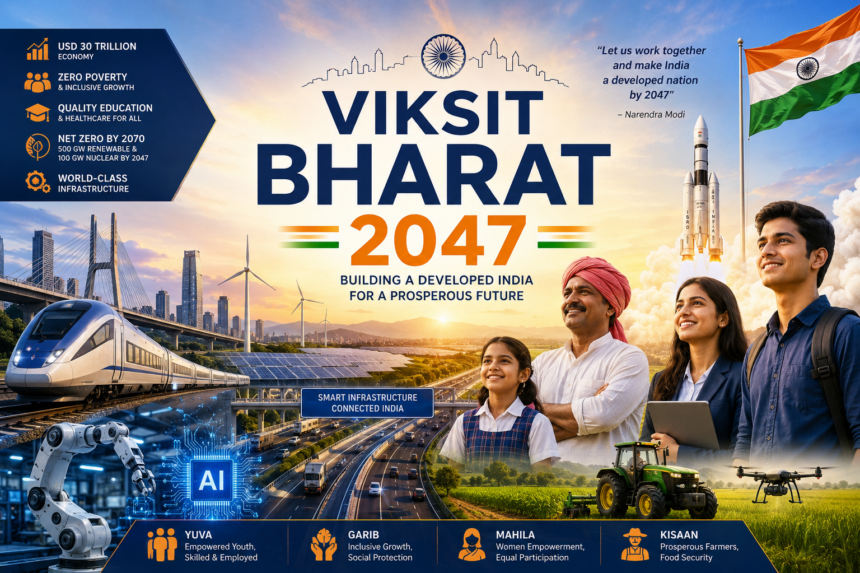
- GDP: USD 30 trillion by 2047 — up from approximately USD 3.5 trillion today. Requires sustained 8-9% annual real growth.
- Per capita income: USD 18,000+ by 2047 — bringing India near World Bank’s high-income threshold
- Poverty elimination: Zero multidimensional poverty — clean water, food security, education, healthcare for all
- Infrastructure: World-class roads, railways, ports, airports, digital connectivity
- Energy: Net-zero trajectory by 2070 with 500 GW renewable and 100 GW nuclear by 2047
- Human development: Top quartile globally in education and health outcomes
The Four Pillars of Viksit Bharat
- Yuva (Youth): Leveraging India’s demographic dividend through education, skills, and employment
- Garib (Poor): Inclusive development ensuring poverty elimination and social protection
- Mahila (Women): Gender equality in economic participation, safety, and political representation
- Kisaan (Farmer): Agricultural transformation ensuring farmer prosperity and food security
India’s Starting Position in 2026: The Honest Assessment
Strengths India Is Building On
- GDP growth: Consistently among the world’s fastest-growing major economies at 6.8-7.0% in 2026
- Digital infrastructure: UPI, Aadhaar, and India Stack are world-leading digital public infrastructure
- Renewable energy: India is the world’s third-largest renewable energy producer, surpassing 200 GW in renewable capacity
- Space: ISRO’s Chandrayaan-3 South Pole lunar landing demonstrates world-class technological capability
- Financial inclusion: Jan Dhan accounts have brought 500+ million Indians into formal banking
- FDI: Record USD 81 billion FDI inflows in 2024-25 signal international confidence
The Gaps India Must Close
- Per capita income: India’s USD 2,400 per capita income must grow 7.5x to reach USD 18,000 by 2047
- Human capital: Learning outcomes in schools, healthcare access, and nutrition remain below ambition
- Manufacturing: India’s manufacturing share of GDP (13-14%) is far below China’s 27% — reaching 25% is critical
- Infrastructure: Despite record investment, infrastructure gap relative to peers remains large
- Employment quality: 90% of India’s workers are in the informal sector without social security, formal wages, or career development
Key Sectors in the Viksit Bharat Strategy
Infrastructure — The Foundation
No economy can sustain 8-9% growth without world-class infrastructure. India’s infrastructure investment has reached record levels — Rs 11 lakh crore in capex in Budget 2026. The PM Gatishakti National Master Plan coordinates infrastructure planning across 16 ministries. Key projects:
- National Highway development: 50,000 km of new highways by 2025 (largely achieved); expressways connecting all major cities
- Railway: 100% electrification (achieved), high-speed rail on key corridors, dedicated freight corridors (operational)
- Ports and logistics: Sagarmala programme transforming port capacity and efficiency
- Urban metro: 50+ cities with metro rail by 2047 — connecting India’s urban centres
Manufacturing — The Employment Imperative
India needs to create 90 million non-farm jobs by 2030 to absorb its working-age population growth. Manufacturing — labour-intensive, scalable, and export-oriented — is the only sector that can create these jobs at the required pace. The PLI (Production Linked Incentive) scheme for 14 sectors, semiconductor manufacturing, defence production, and textiles are all aimed at building India’s manufacturing base.
Education and Skill Development
The National Education Policy (NEP) 2020 is India’s framework for transforming education from rote learning to critical thinking, from regional language barriers to mother-tongue instruction in early years, from academic silos to multidisciplinary learning. Full implementation of NEP by 2047 would fundamentally change India’s human capital quality. Skills development through PM Kaushal Vikas Yojana, IIT expansion, and medical and engineering college growth are parallel initiatives.
Agriculture — The Kisaan at the Centre
With 600+ million Indians dependent on agriculture, agricultural transformation is central to Viksit Bharat. Key targets: doubling farmer income, reducing farmer distress, expanding irrigation, promoting FPOs (Farmer Producer Organisations), and connecting farmers to markets through digital platforms. AgriTech, AI-powered precision agriculture, and food processing industry growth are enabling strategies.
The Biggest Challenges on the Path to Viksit Bharat
Employment Creation
India’s most existential challenge is creating enough good-quality jobs for its working-age population — which will peak at 950 million+ in the 2030s-2040s. Every year, approximately 7-8 million young Indians enter the job market. Despite economic growth, formal job creation has not kept pace. Unless manufacturing scales dramatically and services formalise, the demographic dividend could become a demographic challenge.
Climate and Resource Constraints
Growing at 8-9% for 20 years while managing water scarcity, air pollution, deforestation, and climate change is an unprecedented challenge. India’s development path cannot replicate the resource-intensive model of China’s industrial growth — it must be cleaner, more efficient, and more resilient from the start.
Social Cohesion
Development requires political stability and social cohesion. India’s remarkable diversity — linguistic, religious, caste, regional — is a source of cultural richness but also potential fragmentation. Inclusive development that reduces rather than increases inequality, that brings every region and community into the growth story, is essential to sustaining the political will for long-term transformation.
Viksit Bharat and India’s Global Positioning
Viksit Bharat 2047 is not just about domestic development — it is about India’s position in the world. A USD 30 trillion India would be the world’s second or third-largest economy, with commensurate influence in global governance, trade, and technology. India’s leadership of the Global South — demonstrated through its G20 presidency, BRICS engagement, and Solar Alliance leadership — is being built now to serve the geopolitical requirements of a developed India.
India’s 2047 Geopolitical Vision
- Permanent UNSC membership: India’s campaign for Security Council reform as a reflection of its global weight
- Technology leadership: AI, semiconductor, space, green energy — India as a technology shaping nation
- Trade: Global top 5 merchandise exporter by 2047
- Military: Fully modernised, indigenously equipped armed forces with blue-water naval capability
- Soft power: Indian culture, cinema, cuisine, and yoga as global cultural exports
Read More: Green Hydrogen India 2026: Mission, Projects, Investment and Future Growth
Conclusion
Viksit Bharat 2047 is not guaranteed — it requires 20+ years of consistent policy direction, institutional reform, and inclusive growth. But India’s trajectory in 2026 — strong economic growth, world-class digital infrastructure, rising global influence, and a young, ambitious population — makes the dream genuinely achievable. Taza Newsz tracks every major Viksit Bharat initiative, from nuclear energy to semiconductor manufacturing to agricultural transformation. Follow us for the most comprehensive coverage of India’s development story.