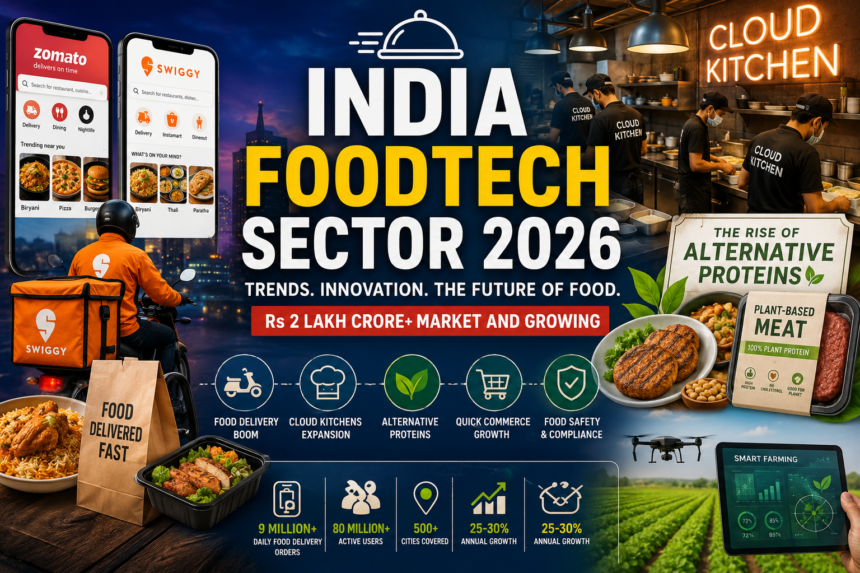
India FoodTech Sector 2026, India’s relationship with food is changing fundamentally. The country that invented dal tadka, biryani, and masala dosa is now also the country where 9 million food delivery orders are placed every day — where ghost kitchens operate out of converted garages in Gurugram, where lab-grown meat startups are raising crores from venture capital, and where a teenager in Patna can have restaurant-quality food delivered from a kitchen that has no physical dining room in 35 minutes.
India’s Food Delivery Market 2026: The Numbers
- Daily food delivery orders: 9 million+ across Zomato and Swiggy
- Market size: Rs 1.4 lakh crore (food delivery alone) in 2026
- Users: 80 million+ active food delivery app users
- Growth rate: 25-30% annually — one of the fastest growing food delivery markets globally
- Average order value: Rs 380-420 per order
- Cities covered: 500+ cities across India — Tier 2 and 3 city expansion driving growth
Zomato vs Swiggy: The Eternal Duopoly
Zomato (Eternal) — The Market Leader
Now operating under the parent brand Eternal — leads India’s food delivery market with approximately 55-58% market share. The acquisition of Blinkit (quick commerce) has transformed Eternal from a food delivery company to a comprehensive urban convenience platform. Zomato achieved consolidated profitability in 2024 — a landmark moment in Indian food delivery history. In 2026, Zomato is pushing into new cities, expanding its restaurant partner base, and growing Blinkit’s dark store network simultaneously.
- Market share: 55-58% of food delivery orders
- Key differentiator: Blinkit integration — food and grocery from one app
- Gold subscription: Zomato Gold members order significantly more frequently — loyalty programme critical
- Stock performance: Listed on NSE/BSE — a proxy for Indian food delivery sector sentiment
Swiggy — The Challenger
Swiggy, which listed on Indian stock exchanges in late 2024, has invested heavily in its Instamart quick commerce business and is pushing aggressively into Tier 2 cities where Zomato’s lead is smaller. Swiggy’s integrated app — combining food, grocery, and dining out discovery — is a genuine alternative to Zomato’s ecosystem. The company’s focus on profitability has increased in 2026 as post-IPO investors demand a path to sustainable earnings.
Cloud Kitchens: The New Restaurant Reality
What Is a Cloud Kitchen?
A cloud kitchen (also called dark kitchen, ghost kitchen, or virtual kitchen) is a food preparation facility that produces food exclusively for delivery — with no dine-in service, no customer-facing space, and often no brand signage. It is a kitchen optimised purely for delivery economics — lower rent (no premium high-street location needed), lower staff requirements (no front-of-house), and ability to run multiple virtual restaurant brands from a single kitchen.
India’s Cloud Kitchen Market
India has one of the world’s largest and fastest-growing cloud kitchen markets. Key players:
- Rebel Foods: India’s largest cloud kitchen company — operates 45+ brands across 450+ cloud kitchens in 10 countries. Brands include Faasos, Behrouz Biryani, Oven Story, and The Good Bowl.
- Box8: Focused on office lunch delivery — compact meals with consistent quality across its cloud kitchen network
- Biryani by Kilo: Premium biryani delivery brand operating entirely through cloud kitchens — serving corporate and premium residential customers
- Zomato Kitchen and Swiggy Access: Both delivery platforms operate their own cloud kitchen infrastructure programmes that provide space and food prep support to restaurant partners
Economics of Cloud Kitchens
A cloud kitchen in a non-prime urban location in a metro city costs Rs 3-8 lakh per month in all-in costs (rent, staff, electricity, packaging) versus Rs 15-30 lakh for a comparable dine-in restaurant. The delivery model — though platform commission of 20-30% reduces margins — eliminates the dine-in experience cost. For the right business with strong delivery demand, cloud kitchens can be highly profitable.
Alternative Proteins: India’s Food Revolution in Waiting
India FoodTech Sector 2026, — plant-based, fermentation-derived, or lab-grown substitutes for animal protein — are a global food trend with particular relevance for India:
Why Alternative Proteins Matter for India
- India’s protein deficit: NFHS data shows widespread protein undernutrition — affordable protein alternatives could address this
- Environmental pressure: Animal agriculture is a major source of greenhouse gas emissions — India’s growing meat consumption increases this
- Cost advantage: Plant-based proteins can be significantly cheaper than meat at scale — relevant for India’s price-sensitive mass market
- Cultural fit: India’s large vegetarian population creates ready acceptance for high-quality plant protein products
Indian Alternative Protein Startups 2026
- GoodDot: India’s largest plant-based meat company — products available in supermarkets nationally; targets India’s vast vegetarian and flexitarian market
- Imagine Meats: Celebrity-backed (Kapil Dev, Shilpa Shetty) plant protein brand — positioned premium
- Blue Tribe Foods: Plant-based chicken and seafood — growing retail distribution
- Wakao Foods: Jackfruit-based meat alternatives — leveraging India’s abundant jackfruit as raw material
- Luyef Biotechnologies: Developing fermentation-derived proteins — B2B ingredient supplier
Lab-Grown Meat: Still Early Days in India
Cultivated meat (lab-grown from animal cells) remains at pre-commercial stage globally in 2026. India has potential as both a market and a production hub — its biotechnology capabilities, cost-conscious research culture, and large animal protein demand make it relevant. However, regulatory frameworks, production costs, and consumer acceptance are all barriers to near-term commercialisation.
Food Trends Shaping India in 2026
Hyperlocal Regional Cuisines
Delivery platforms have enabled cuisines that were once only available in their home region to reach national audiences. Chettinad food from Tamil Nadu is now available in Delhi. Assamese thali can be ordered in Mumbai. This democratisation of regional cuisine — facilitated by cloud kitchen entrepreneurs building regional specialty brands — is one of the most exciting cultural developments in Indian food.
Health-Focused Eating
India’s growing health consciousness is driving demand for low-carb, high-protein, sugar-free, and organic food options. Delivery platforms are seeing fastest growth in ‘healthy’ and ‘diet’ food categories. Nutritionist-designed meal plans delivered daily are growing rapidly in urban markets.
Premium and Experience Dining
At the other end of the spectrum, premium dining experiences — tasting menus, chef’s table experiences, luxury home dining events — are growing among India’s expanding HNI population. Luxury restaurants with celebrity chefs, immersive dining experiences, and farm-to-table concepts are proliferating in Delhi, Mumbai, and Bengaluru.
Food Safety in India 2026: FSSAI and What Consumers Need to Know
FSSAI (Food Safety and Standards Authority of India) regulates all food businesses in India. Key developments in 2026:
- FoSCoS licensing: All food businesses must be registered on Food Safety Compliance System — cloud kitchens, home bakers, and food delivery operators included
- Hygiene ratings: FSSAI’s Clean and Fresh certification for restaurants visible on Zomato and Swiggy — look for this before ordering
- Labelling requirements: Packaged food must display nutritional information including sugar, salt, and fat prominently
- E-commerce food safety: FSSAI actively regulates food sold through Zomato, Swiggy, Amazon, Flipkart — periodic raids on dark stores and cloud kitchens
Read More: India Startup Ecosystem 2026: Funding Boom, Deep Tech Rise & Startup Trends
Conclusion
India FoodTech Sector 2026 sits at the intersection of technology, culture, health, and sustainability. From the daily food delivery order placed by a software engineer in Hyderabad to the lab-grown protein being developed in Bangalore to the cloud kitchen entrepreneur in Lucknow building a biryani brand from a converted garage — the way India eats is transforming at extraordinary speed. Taza Newsz covers food tech news, restaurant industry developments, food safety updates, and Indian food culture.