
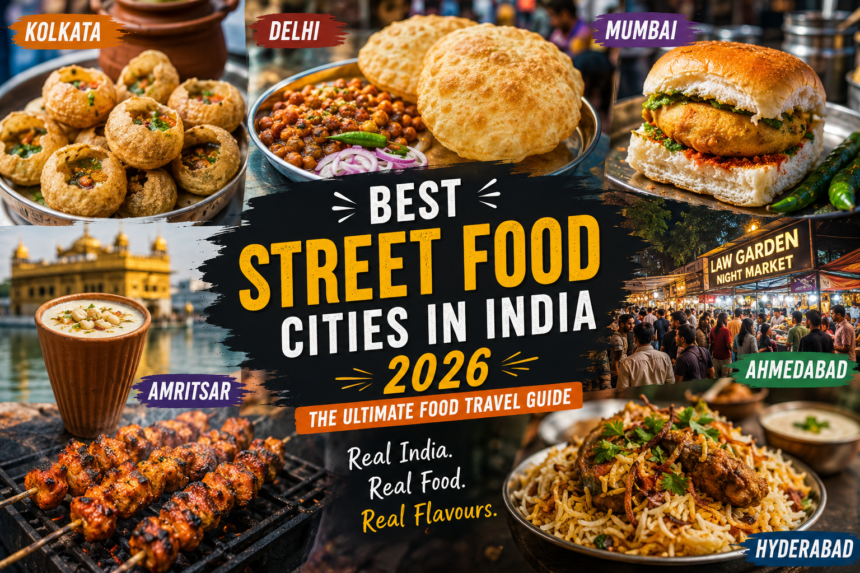
Best Street Food Cities in India— truly understand it at the level of daily life, cultural pride, regional identity, and the extraordinary creativity of its people — do not begin in a five-star restaurant. Instead, stand at a crowded street corner. Watch a pani puri vendor work with the precision of a master craftsman, filling, seasoning, and serving six perfect bites in less than a minute. Smell ghee browning on a giant tawa as fresh chole bhature sizzle beside it. Taste the sharp, electric flavour of a Kolkata phuchka during a monsoon evening.
Indian street food is not simply food. It is history, migration, economics, memory, and community condensed into a single bite.
In 2026, India’s street food culture is experiencing a remarkable renaissance. A new generation of food creators, travel vloggers, culinary historians, and curious young Indians are rediscovering the country’s regional food traditions with fresh enthusiasm. Instagram reels, YouTube food trails, and regional food documentaries have pushed local dishes into national conversations. As a result, travellers are now exploring not just monuments and landscapes, but also the streets, markets, and hidden food lanes that define India’s culinary identity.
This guide explores the best street food cities in India, the iconic dishes you must try in each destination, and the lesser-known culinary gems that even experienced travellers sometimes overlook.
Kolkata: India’s Undisputed Street Food Capital
If Indian street food were an Olympic sport, Kolkata would take the gold medal every single time.
The city’s street food culture is unmatched in flavour complexity, emotional attachment, culinary technique, and sheer diversity. In Kolkata, street food is not merely convenient eating. It is an act of cultural participation. Residents passionately debate which puchka stall is superior with the same seriousness that other cities reserve for politics or cricket.
Moreover, Kolkata’s food scene reflects centuries of cultural exchange — Bengali traditions mixing with Mughal influences, Chinese migration, British colonial history, and Tibetan food culture.
Must-Try Street Foods in Kolkata
Phuchka (Puchka)
Kolkata’s phuchka is dramatically different from Delhi’s pani puri. The puris are thinner and more fragile, the filling uses heavily spiced mashed potato with chickpeas, and the tamarind water delivers a sharper, tangier punch instead of a mint-heavy flavour.
Some of the best phuchkas can be found around College Street, Dakshinapan, and the Victoria Memorial area.
Kathi Roll
Invented in Kolkata at the legendary Nizam’s restaurant, the kathi roll is one of India’s greatest street food inventions. Egg-coated parathas are wrapped around spicy fillings such as chicken, mutton, paneer, or kebabs.
Nizam’s on Hogg Street remains iconic, while Hot Kati Rolls near Park Street continues to attract loyal crowds.
Jhalmuri
Jhalmuri is Kolkata’s answer to bhel puri, but it carries a personality entirely of its own. Puffed rice is tossed with mustard oil, peanuts, onions, green chilli, coriander, raw mango, and spice blends that create an unmistakably Bengali flavour profile.
Momos
Kolkata’s Tibetan and Nepali food influence has created one of India’s best momo cultures. Around Tangra and several northern neighbourhoods, steaming dumplings filled with chicken, vegetables, or pork are served with intensely spicy chutneys.
Jhal Moog
Simple yet deeply satisfying, jhal moog combines boiled moong dal with onion, chilli, lime juice, and masala. It is the ideal evening snack during long walks through Kolkata’s historic streets.
Delhi: The Nation’s Chaat Capital
Best Street Food Cities in India, Delhi’s street food scene spans centuries of culinary history and every social layer imaginable. On one side, you have generations-old kebab stalls in Old Delhi. On the other, modern Korean fusion carts serving Gen Z food lovers in Hauz Khas Village.
However, the soul of Delhi street food still lives in its oldest neighbourhoods. Chandni Chowk, Jama Masjid, and Paharganj remain culinary institutions where recipes have been perfected across multiple generations.
Must-Try Street Foods in Delhi
Paranthe Wali Gali
Located in Chandni Chowk, this legendary lane has served stuffed parathas since the 19th century. Giant tawas sizzle continuously as vendors cook parathas stuffed with potato, paneer, lentils, chillies, and even sweet fillings.
The generous use of desi ghee defines the experience.
Chole Bhature
Delhi’s contribution to Indian breakfast culture is unmatched. Fluffy bhature paired with deeply spiced chole, pickles, onions, and green chillies create one of North India’s most satisfying meals.
Sitaram Diwan Chand near Paharganj remains the benchmark destination.
Gol Gappe
Delhi-style gol gappe differ significantly from Kolkata phuchkas. The puris are larger, the water relies heavily on mint and coriander, and fillings often include ragda or mashed potato.
The result is fresher, cooler, and more herbaceous in flavour.
Daulat Ki Chaat
Available only during winter mornings in Old Delhi, Daulat Ki Chaat is among India’s most delicate desserts. It resembles edible clouds — whipped milk foam flavoured with saffron, sugar, and dry fruits that dissolve instantly on the tongue.
Old Delhi Kebabs
The kebab culture around Jama Masjid represents some of India’s finest meat cookery. Shammi kebabs, seekh kebabs, and grilled meats cooked over charcoal showcase culinary traditions that date back to the Mughal era.
Mumbai: A City That Eats While Moving
Best Street Food Cities in India, Mumbai’s street food perfectly reflects the city itself — fast, practical, democratic, and endlessly energetic.
This is a city where office workers, film stars, students, and labourers all stand side by side at the same food stall. Street food in Mumbai is available at almost every hour of the day, making it deeply woven into the rhythm of urban life.
Most importantly, Mumbai transformed affordable snacks into cultural icons.
Must-Try Street Foods in Mumbai
Vada Pav
Vada pav is Mumbai’s defining street food. A spicy potato fritter is tucked into a soft pav with dry garlic chutney and fried green chilli.
The snack is simple, cheap, and incredibly addictive.
Ashok Vada Pav near Dadar station and the famous stall outside Kirti College are considered legendary.
Bhel Puri
Mumbai’s bhel puri is lighter and sweeter than Kolkata’s jhalmuri. Puffed rice is mixed with chutneys, onions, coriander, sev, and crunchy snacks to create a balance of sweet, spicy, and tangy flavours.
Chowpatty Beach and Juhu Beach remain classic destinations.
Pav Bhaji
Originally developed as a quick meal for textile mill workers, pav bhaji evolved into one of India’s most beloved dishes. Vegetables are mashed and cooked with butter-heavy masala before being served alongside toasted pav.
Sardar’s at Tardeo remains the city’s reference standard.
Sev Puri
Crispy puris topped with potato, onion, coriander, sev, and multiple chutneys create an extraordinary contrast of textures and flavours.
Every bite combines crunch, sweetness, spice, and acidity simultaneously.
Misal Pav
This spicy Maharashtrian curry made from sprouted lentils is among western India’s most complex street foods. Topped with sev and onion, misal pav delivers intense spice balanced by the softness of fresh pav bread.
Ahmedabad: Gujarat’s Vegetarian Street Food Paradise
Best Street Food Cities in India, Ahmedabad proves conclusively that vegetarian food can be every bit as complex, layered, and satisfying as meat-based cuisine.
Gujarati street food is built around a sophisticated flavour philosophy that balances sweetness, spice, saltiness, and acidity in nearly every dish. Furthermore, the city’s night food culture is among the most vibrant in India.
Must-Try Street Foods in Ahmedabad
Dhokla and Khaman
These fermented gram flour snacks are soft, airy, and deeply flavourful despite their simplicity. Tempered mustard seeds, curry leaves, green chillies, and chutneys elevate them into something extraordinary.
Manek Chowk and Law Garden vendors are consistently excellent.
Fafda and Jalebi
Ahmedabad’s famous Sunday breakfast tradition combines crunchy chickpea-flour fafda with hot sugar-soaked jalebi.
Although the combination sounds unusual to outsiders, the contrast between salty crunch and syrupy sweetness feels perfectly balanced once tasted.
Locho
Originally from Surat but now popular across Gujarat, locho is a soft steamed gram flour preparation topped with butter, spices, sev, and chutneys.
Its texture is intentionally messy, which is precisely what makes it memorable.
Sev Tameta nu Shaak with Bhakri
This comforting Gujarati staple combines tangy tomato curry with sev and thick millet bread. It represents the warmth and practicality of Gujarati home-style cooking.
Law Garden Night Market Chaat
Law Garden transforms every evening into one of India’s great open-air food experiences. Dozens of stalls serve chaat, sandwiches, local Gujarati snacks, and Indo-Chinese dishes to massive crowds late into the night.
Amritsar: Where Food and Faith Meet
In Amritsar, food is inseparable from spirituality, generosity, and community.
The Golden Temple’s langar serves free meals to more than 100,000 people daily regardless of religion, wealth, caste, or nationality. It is the world’s largest community kitchen and one of humanity’s most extraordinary examples of collective service.
Beyond the langar, Amritsar’s street food celebrates the richness and boldness of Punjabi cooking.
Must-Try Street Foods in Amritsar
Amritsari Kulcha
Stuffed kulchas baked inside blazing tandoors are served with spicy chole, onions, chutneys, and thick slabs of butter.
Kulcha Land and Bharawan Da Dhaba are widely considered benchmark destinations.
Lassi
Amritsar’s lassi culture is legendary. Thick, creamy, and served in large clay glasses, the drink is almost a meal in itself.
Ahuja Milk Bhandar remains one of the city’s most iconic stops.
Amritsari Fish
This crispy fried fish preparation uses gram flour batter and Punjabi spices to create one of India’s finest seafood snacks.
The stalls near Jallianwala Bagh are especially famous.
Pinni
Made from wheat flour, dry fruits, and ghee, pinni is Punjab’s traditional winter sweet. However, visitors can now find it throughout the year in Amritsar’s sweet shops and markets.
Hyderabad: The Deccan’s Culinary Jewel
Hyderabad’s identity is inseparable from biryani. The city transformed a royal Mughal-influenced rice dish into a global culinary symbol of India.
Yet Hyderabad’s food culture extends far beyond biryani alone. Its street food reflects centuries of Persian, Turkish, Telugu, and Deccani influences that shaped the region’s royal kitchens.
Must-Try Street Foods in Hyderabad
Hyderabadi Biryani
Best Street Food Cities in India, Authentic Hyderabadi biryani depends on precision. The rice must remain separate and fragrant, the meat tender, and the saffron subtle rather than overpowering.
Paradise Restaurant remains globally famous, while Shah Ghouse is often prefer by local food enthusiasts.
Haleem
Especially popular during Ramadan, haleem is a slow-cooked mixture of wheat, lentils, spices, and meat that develops extraordinary richness over hours of cooking.
It is one of Hyderabad’s most culturally significant dishes.
Irani Chai and Osmania Biscuit
Hyderabad’s Irani café culture is unique in India. Sweet milky tea paired with buttery Osmania biscuits creates a simple but unforgettable combination.
These cafés also function as social spaces where conversations stretch for hours.
Mirchi Ka Salan
This iconic curry made with green chillies, peanuts, sesame, and spices is traditionally serve alongside biryani. It perfectly demonstrates the balanced complexity of Deccani cuisine.
Read More: Hidden Hill Stations in India 2026: Best Peaceful Alternatives to Shimla and Manali
Conclusion
Best Street Food Cities in India. It crosses class boundaries, survives economic changes, adapts to modern trends, and preserves regional identity more effectively than almost anything else.
Moreover, social media has transformed Indian street food into a global phenomenon. Food creators now document forgotten recipes, local vendors gain international fame overnight, and younger Indians are rediscovering culinary traditions that once seemed ordinary.
However, the real magic of Indian street food still happens offline — on crowded sidewalks, under flickering lights, beside railway stations, and in noisy market lanes filled with smoke, spice, and conversation.
You can visit monuments to learn India’s history. Yet if you want to understand how India truly lives, thinks, celebrates, and connects, eat from a cart at a busy street corner.
That is where the country reveals itself most honestly.