
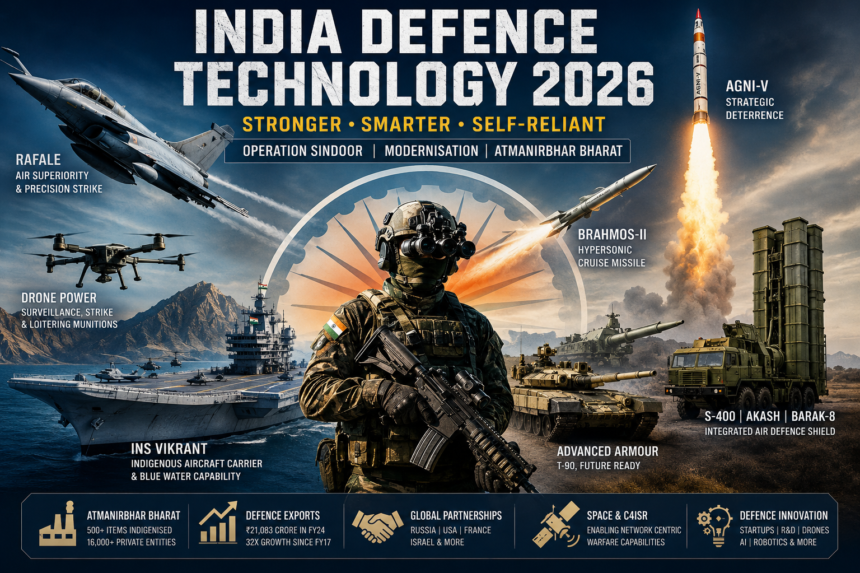
India Defence Technology 2026, India’s defence and military technology landscape in 2026 has been dramatically reshaped by the events of April-May 2026 — the Pahalgam terror attack and the subsequent Operation Sindoor. Although the conflict was brief, it became a real-world operational test of India’s military technology, doctrine, preparedness, and strategic coordination. As a result, the lessons learned from Operation Sindoor are already accelerating defence procurement, indigenous weapons development, and long-term military investments across all three armed forces.
At the same time, India is undergoing the most ambitious military modernisation programme in its independent history. From the INS Vikrant aircraft carrier to the Tejas MkII fighter programme, and from advanced missile systems to rapidly expanding drone capabilities, India is steadily transforming into a technologically advanced military power. This guide explores the complete picture of India’s defence technology ecosystem in 2026.
Operation Sindoor: What India’s Military Demonstrated
Operation Sindoor — India’s targeted military response following the Pahalgam terror attack — offered the world a clear glimpse into the country’s evolving military capabilities. More importantly, it demonstrated how India is integrating modern warfare technologies into real operational environments.
Precision Strike Capability
One of the most significant aspects of Operation Sindoor was India’s ability to conduct precise strikes against identified targets while minimising collateral damage. The operation relied heavily on air-launched precision-guided munitions, which allowed Indian forces to target specific infrastructure with high accuracy.
This capability reflects years of investment in advanced targeting systems, intelligence integration, and stand-off weaponry. Consequently, India now possesses more flexible response options in limited-conflict scenarios.
Loitering Munitions and Kamikaze Drones
The operation also highlighted the growing role of loitering munitions, often referred to as kamikaze drones. Both indigenous and imported systems were reportedly deployed for precision engagement missions.
These drones can hover over target areas before striking at the optimal moment, making them highly effective against mobile or time-sensitive targets. Therefore, India’s expanding investment in drone warfare has become a major priority after Operation Sindoor.
Layered Air Defence Systems
India’s layered air defence architecture also demonstrated considerable maturity during the operation. Systems such as the Russian S-400, Israeli Barak-8, and indigenous Akash missile systems collectively formed a defensive shield capable of intercepting incoming aerial threats.
The successful integration of multiple systems from different countries showed that India has significantly improved its air defence coordination and response capability.
C4ISR Integration
Operation Sindoor further showcased India’s growing proficiency in C4ISR — Command, Control, Communications, Computers, Intelligence, Surveillance, and Reconnaissance.
The Indian military demonstrated that it can coordinate complex multi-domain operations involving air assets, surveillance systems, missile platforms, and real-time intelligence networks. As modern warfare increasingly depends on data and coordination, this capability represents a major strategic advantage.
Information Warfare and Media Coordination
Another important lesson from Operation Sindoor was India’s improved handling of information warfare. Real-time communication management and coordinated public messaging helped shape the information environment during the operation.
Compared to earlier conflicts, India’s military-media coordination appeared more structured and disciplined, reflecting a modern understanding of strategic communication.
India’s Missile Systems: Strategic Deterrence in 2026
India Defence Technology 2026, India’s missile programme continues to form the backbone of its strategic deterrence posture. In 2026, the country possesses one of the most diverse missile arsenals in Asia.
Agni-V: India’s ICBM-Class Deterrent
The Agni-V is India’s most powerful ballistic missile, with a range exceeding 5,000 kilometres and the capability to carry nuclear warheads.
India has also been testing the MIRV (Multiple Independently targetable Reentry Vehicle) version of Agni-V under the codename Mission Divyastra. This advanced technology allows a single missile to carry multiple warheads capable of striking different targets simultaneously.
As a result, India has entered a very small group of nations possessing operational MIRV capability, significantly strengthening its nuclear deterrence posture.
BrahMos Hypersonic Programme
The BrahMos cruise missile — developed jointly by India and Russia — is already among the fastest operational cruise missiles in the world, travelling at speeds of Mach 2.8 to 3.
However, the hypersonic BrahMos-II programme represents the next major leap. The upcoming missile is expected to achieve speeds exceeding Mach 8, making interception extremely difficult.
In addition, BrahMos has become one of India’s biggest defence export successes. Countries such as the Philippines have already acquired the system, while several others are exploring procurement agreements.
Pralay and Prahar Missile Systems
India’s Pralay quasi-ballistic missile provides precise theatre-level strike capability with a range between 150 and 500 kilometres.
These systems are designed to target military infrastructure, logistics hubs, command centres, and hardened enemy positions. Importantly, they also provide India with graduated escalation options in limited conflicts, bridging the gap between conventional artillery and strategic nuclear systems.
Indian Air Force: Rafale and Tejas in 2026
India Defence Technology 2026, The Indian Air Force is currently balancing advanced foreign platforms with rapidly improving indigenous aircraft programmes.
Rafale: Transforming India’s Air Combat Capability
India currently operates 36 Rafale multirole fighter aircraft, while an additional 26 Rafale Marine jets for the Indian Navy are in the procurement pipeline.
The Rafale has significantly enhanced India’s Beyond Visual Range (BVR) combat capability. Equipped with Meteor air-to-air missiles, Indian pilots now possess one of the world’s longest-range aerial engagement advantages.
During Operation Sindoor, Rafale aircraft reportedly played a critical role in precision strike missions using HAMMER precision-guided bombs and SCALP cruise missiles.
Additionally, the aircraft’s advanced electronic warfare suite and SPECTRA self-protection system improve survivability in contested airspace.
Tejas MkII: India’s Indigenous Fighter Programme
The Tejas Light Combat Aircraft remains India’s most important indigenous aerospace achievement.
While the Tejas MkI and MkIA variants are already entering operational service, the Tejas MkII programme represents a substantial upgrade. The new aircraft will feature improved avionics, a more powerful GE-414 engine, greater payload capacity, and enhanced combat capability.
The Indian government’s order for 83 Tejas MkIA aircraft is the largest indigenous fighter aircraft order in Indian history. Consequently, increasing production at HAL’s Bengaluru facilities is gradually reducing India’s dependence on foreign fighter imports.
Indian Navy: INS Vikrant and Maritime Ambitions
India Defence Technology 2026, India’s maritime strategy is increasingly focused on securing dominance in the Indian Ocean Region.
INS Vikrant: India’s First Indigenous Aircraft Carrier
INS Vikrant, commissioned in 2022 and fully operational in 2026, is one of the most complex engineering projects ever completed in India.
Built at Cochin Shipyard, the carrier is 262 metres long, displaces approximately 45,000 tonnes, and operates MiG-29K fighter aircraft alongside various helicopters.
Its operational deployment in the Arabian Sea has provided India with genuine carrier strike capability and significantly enhanced power projection across the Indian Ocean Region.
India’s Three-Carrier Vision
Alongside INS Vikrant, India also operates INS Vikramaditya, while plans for a third carrier — INS Vishal — continue to be discussed.
INS Vishal is expected to be substantially larger and could potentially feature nuclear propulsion. Therefore, India’s long-term three-carrier ambition reflects its broader goal of becoming the dominant naval power in the region.
Submarines and the P-75I Programme
India’s submarine fleet remains central to both deterrence and maritime security. However, several conventional submarines are ageing and require replacement.
The P-75I programme aims to build six advanced submarines equipped with Air Independent Propulsion (AIP) systems. These submarines can remain underwater for extended periods without surfacing, dramatically improving survivability and operational endurance.
At the same time, India’s Arihant-class nuclear submarines continue to provide the country’s sea-based nuclear deterrent capability.
India’s Drone Revolution After Operation Sindoor
Operation Sindoor dramatically accelerated India’s interest in drones and counter-drone warfare technologies.
The conflict demonstrated the effectiveness of loitering munitions and also exposed the growing importance of defending against hostile drone systems. Consequently, India has increased defence budget allocations for drone procurement and indigenous UAV development.
Key Indian Drone Companies in 2026
IdeaForge
IdeaForge is currently India’s leading drone manufacturer and supplies surveillance drones to both the armed forces and police agencies.
Garuda Aerospace
Garuda Aerospace has rapidly expanded its production capability across agricultural and defence drone categories. The company has also received significant backing from industrialist Anand Mahindra.
Apollyon Dynamics
Apollyon Dynamics is an emerging defence-tech startup supported by Skyroot Aerospace and Dhruva Space. The company focuses on advanced UAV and autonomous warfare systems.
Sagar Defence Engineering
Sagar Defence Engineering specialises in naval drones and autonomous underwater systems, making it an important player in India’s maritime technology ecosystem.
Atmanirbhar Bharat in Defence: The Numbers
India’s Atmanirbhar Bharat initiative in defence manufacturing is now producing measurable results across multiple sectors.
Defence Export Growth
India exported defence equipment worth ₹21,083 crore in FY24, representing a massive increase compared to FY17 levels. This growth reflects India’s expanding manufacturing capability and rising global credibility.
Expanding Private Sector Participation
More than 16,000 private entities are now part of India’s defence supply chain. This shift has significantly diversified the country’s defence industrial base.
Foreign Direct Investment Reforms
India now permits 100% Foreign Direct Investment through the automatic route for defence items not included in the reserved category list. This policy has encouraged greater international collaboration and technology transfer.
Positive Indigenisation Lists
The government’s positive indigenisation lists now cover over 500 defence items that can no longer be imported and must instead be manufactured domestically.
Defence Industrial Corridors
The Uttar Pradesh Defence Industrial Corridor and Tamil Nadu Defence Corridor continue to attract investment and rapidly expand manufacturing capacity.
India’s Defence Partnerships: Balancing Global Powers
India’s defence procurement strategy continues to balance relationships with multiple global powers.
Russia remains a major defence partner through platforms such as the S-400 air defence system, T-90 tanks, Sukhoi fighter aircraft, and nuclear submarine cooperation.
Meanwhile, India’s partnership with the United States has expanded through GE engines for Tejas aircraft, MQ-9B Predator drones, C-17 and C-130 transport aircraft, and P-8I maritime surveillance platforms.
India also maintains strong defence relationships with France for Rafale fighters and submarines, as well as Israel for drones, missiles, and air defence systems.
This strategy of strategic autonomy allows India to avoid overdependence on any single supplier. However, it also creates logistical and interoperability challenges that the armed forces must continuously manage.
Read More: India Successfully Tests Agni-5 Ballistic Missile: A Game-Changer in Strategic Defence
Conclusion
India Defence Technology 2026 is more advanced, more indigenous, and more globally competitive than at any point in the country’s independent history.
The combination of Agni-V strategic deterrence, Rafale combat capability, indigenous Tejas fighter development, INS Vikrant carrier operations, advanced missile systems, and rapidly growing drone and space technologies is creating a genuinely modern, multi-dimensional military force.
Operation Sindoor acted as both a military response and a real-world stress test of India’s evolving defence ecosystem. Most importantly, it accelerated political and military urgency around indigenous manufacturing, rapid procurement, and technological self-reliance.
As India continues its military modernisation journey, the country is steadily positioning itself as one of the world’s most significant emerging defence powers.
Taza Newsz continues to cover India’s defence and security developments with detailed and factual analysis. Follow us for the latest updates on military procurement, defence policy, strategic affairs, and emerging military technologies.