
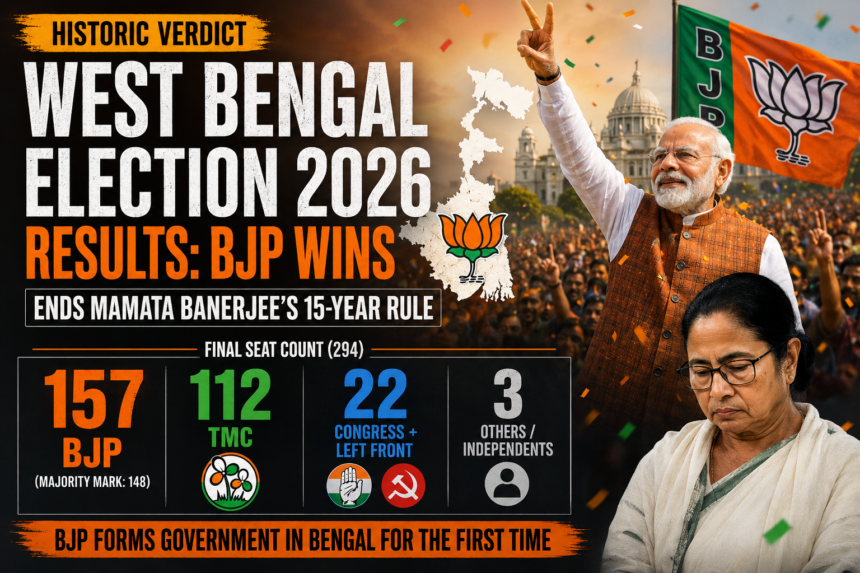
West Bengal Election 2026 Results BJP, History was made in India’s political landscape on May 4, 2026, when the Bharatiya Janata Party secured victory in the West Bengal Assembly elections for the very first time. By crossing the majority mark comfortably, the BJP ended Mamata Banerjee’s 15-year rule and fundamentally altered the political balance of eastern India.
For years, West Bengal had been viewed as one of the most difficult states for the BJP to conquer. The All India Trinamool Congress (TMC), led by Mamata Banerjee, had dominated the state with decisive victories in both 2016 and 2021. Political analysts consistently described Bengal as a TMC stronghold. However, the 2026 election result shattered that assumption and produced one of the most dramatic verdicts in recent Indian political history.
In this detailed analysis, we examine the final seat tally, the major factors behind the BJP’s breakthrough, and the wider implications for national politics.
West Bengal Election 2026: Final Seat Count
- BJP — 157 seats
- All India Trinamool Congress (TMC) — 112 seats
- Congress + Left Front — 22 seats combined
- Others / Independents — 3 seats
The majority mark in the 294-member assembly was 148 seats, and the BJP crossed it with a cushion of nine seats. As a result, government formation is expected to proceed smoothly.
Meanwhile, Mamata Banerjee retained her Bhabanipur seat, ensuring that she remains the central face of the opposition in Bengal politics.
Why BJP Won West Bengal in 2026
Anti-Incumbency After 15 Years in Power
One of the biggest factors behind the TMC’s defeat was growing anti-incumbency after fifteen consecutive years in government.
Over time, public frustration began building around governance issues, allegations of corruption, and concerns regarding law and order. Voters who once strongly supported the TMC appeared increasingly willing to consider political change.
Additionally, the RG Kar Medical College incident became a defining issue during the campaign. The death of a trainee doctor triggered widespread protests across Bengal and generated enormous public anger. The BJP successfully framed the election around women’s safety, institutional accountability, and law and order failures.
As the campaign intensified, these issues resonated strongly with urban and semi-urban voters.
Mamata Banerjee’s Centralised Leadership Structure
Another major challenge for the TMC was its heavy dependence on Mamata Banerjee herself.
Throughout the campaign, she remained the party’s primary strategist, speaker, and decision-maker. While this centralised leadership model had worked effectively in previous elections, it also created vulnerabilities.
Because Mamata Banerjee became the face of every government response, criticism surrounding the RG Kar controversy directly affected her personal political image. Furthermore, the absence of a strong second line of leadership made it difficult for the TMC to distribute political pressure during the campaign.
As a result, voter dissatisfaction increasingly became linked with the leadership itself rather than only the government.
The RG Kar Effect and Women Voters
The RG Kar Medical College tragedy ultimately became the emotional centre of the election.
Doctors’ protests, public demonstrations, and continuous media coverage kept the issue alive for months. Importantly, the controversy affected voter sentiment beyond traditional political lines.
Women voters, who had historically formed one of the TMC’s most loyal support bases, appeared deeply impacted by the incident. The BJP aggressively highlighted women’s safety during rallies and campaign speeches, turning the issue into a statewide political narrative.
Consequently, the party gained traction in constituencies where it had previously struggled.
BJP’s Expanded Ground Campaign
West Bengal Election 2026 Results BJP, the BJP ran a significantly more organised and disciplined campaign in 2026.
The party reportedly began booth-level preparation nearly eighteen months before voting day. It focused heavily on data-driven outreach and constituency-level targeting.
Special attention was given to:
- OBC communities
- Matua voters
- Young first-time voters
- Migrant workers settled in Bengal
At the same time, Prime Minister Narendra Modi held multiple high-energy rallies in constituencies considered electorally critical. BJP leaders also maintained a more coordinated campaign message focused on governance, safety, and political change.
This combination of organisational depth and targeted outreach helped the BJP convert support into seats.
Migrant Worker Vote Shift
A less discussed but highly important factor was the shift among migrant worker families.
Stories such as that of Seema Das, widely covered during the election period, reflected a broader political transition. Many migrant workers from Bengal who had lived and worked in cities like Delhi, Surat, and Bengaluru reportedly compared governance conditions between states.
For some voters, those comparisons influenced their political choices back home.
Traditionally, many of these communities had supported the TMC. However, in 2026, a noticeable section appeared to move toward the BJP, especially in closely contested constituencies.
Mamata Banerjee’s Response and the Future of TMC
Following the results, Mamata Banerjee conceded defeat gracefully and congratulated the BJP on its victory.
Despite losing power, the TMC remains a major political force in West Bengal. Winning more than 110 seats ensures that the party will continue as a strong opposition presence inside the assembly.
Moreover, the TMC still retains substantial influence in Kolkata and several urban regions. Mamata Banerjee’s personal popularity also remains significant, meaning it would be politically premature to write off either her or the party.
In opposition, her aggressive political style is expected to become even more prominent.
Impact on National Politics
Opposition Bloc Faces Major Setback
West Bengal Election 2026 Results, The Bengal result represents a major blow to the broader opposition alliance in India.
West Bengal had long been one of the few large states governed by a strong regional party outside the BJP-led NDA ecosystem. With this victory, the BJP and its allies now govern a massive share of India’s population.
This development could significantly affect opposition unity ahead of the 2029 Lok Sabha elections.
Furthermore, regional parties may now reassess their own electoral strategies after witnessing the BJP’s breakthrough in Bengal.
Congress Continues to Struggle
The election also highlighted the continued decline of the Indian National Congress in state politics.
Despite contesting as part of an alliance with the Left Front, Congress failed to emerge as a serious challenger. Its limited seat tally reinforced the perception that the party continues to struggle in converting national narratives into strong regional performances.
As a result, Congress increasingly appears dependent on alliances rather than independent electoral strength in many states.
Who Will Become the Next Chief Minister of West Bengal?
Following the BJP’s victory, attention has quickly shifted toward the Chief Ministerial decision.
Several names are currently being discussed within political circles:
- Suvendu Adhikari, who led much of the BJP’s Bengal campaign
- A woman candidate, which would align symbolically with the campaign’s emphasis on women’s safety
- A technocrat or administrator focused on governance and development
The final decision is expected to be taken by the BJP’s central leadership in consultation with the RSS and the Bengal state unit.
An official announcement is likely within days of the election result.
Panihati: The Election’s Most Emotional Victory
Among all the constituency results, Panihati emerged as one of the most emotionally significant contests.
Ratna Debnath, the mother of the RG Kar victim, contested the election as an independent candidate supported by the BJP. She ultimately won the seat by more than 28,000 votes.
Her victory became a powerful symbolic moment during the election aftermath and reflected the emotional intensity surrounding the RG Kar issue across the state.
Read More: West Bengal Election Results 2026: Full Seat Tally, Winners List & Latest Updates
Conclusion
West Bengal Election 2026 Results BJP, The BJP’s victory in West Bengal is far more than a routine electoral win. It marks a major transformation in India’s political geography and reshapes the national opposition landscape.
For fifteen years, West Bengal politics revolved around Mamata Banerjee and the TMC’s model of regional political dominance. That era has now come to an end.
At the same time, a new political chapter begins for Bengal under BJP rule. Whether the party can successfully govern a politically complex and culturally distinct state remains one of the biggest questions in Indian politics today.
Taza Newsz will continue tracking government formation, the Chief Minister announcement, and the broader political consequences of this historic verdict.