
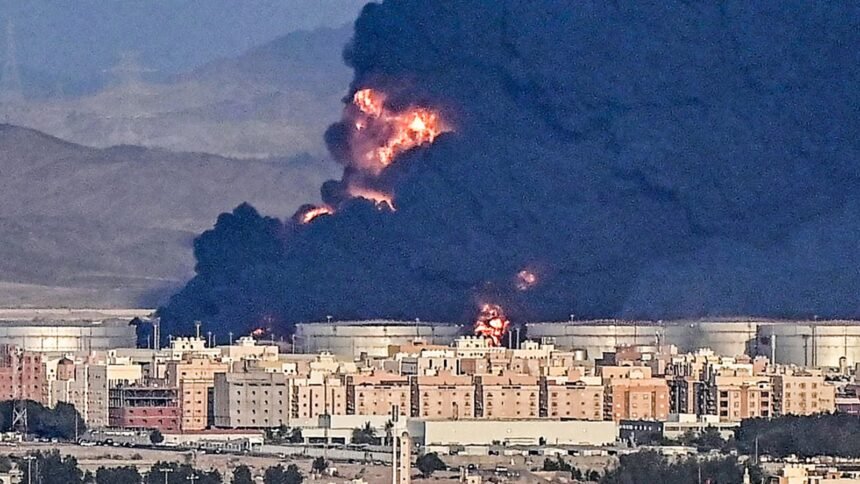
Saudi Aramco Oil Facility Attack, When a key Saudi oil hub gets caught in the crossfire of a regional showdown, the whole world pays attention. That is exactly what happene when Saudi Aramco’s Ras Tanura refinery was struck by debris from an intercepted Iranian drone, just as tensions between the United States, Israel, and Iran were already at boiling point. The incident didn’t just light a fire at the facility – it lit up global fears about energy security and the stability of the Middle East. This developing situation has quickly become leading Saudi Aramco refinery fire news, drawing intense global media coverage and market attention. As Saudi Aramco refinery fire news continues to trend worldwide, investors and policymakers are closely monitoring every update for its potential impact on oil prices and regional security.
What Happened At Ras Tanura?
Ras Tanura, one of the Middle East’s largest refining and export hubs, was hit on Monday after Saudi defenses intercept an Iranian drone in the area. According to a Saudi military spokesman, the interception caused falling debris, which then struck part of the Saudi Aramco facility. The statement, carried by the state-run Saudi Press Agency, confirmed that a fire broke out following the impact.
Fire Under Control – But Nerves Are Not
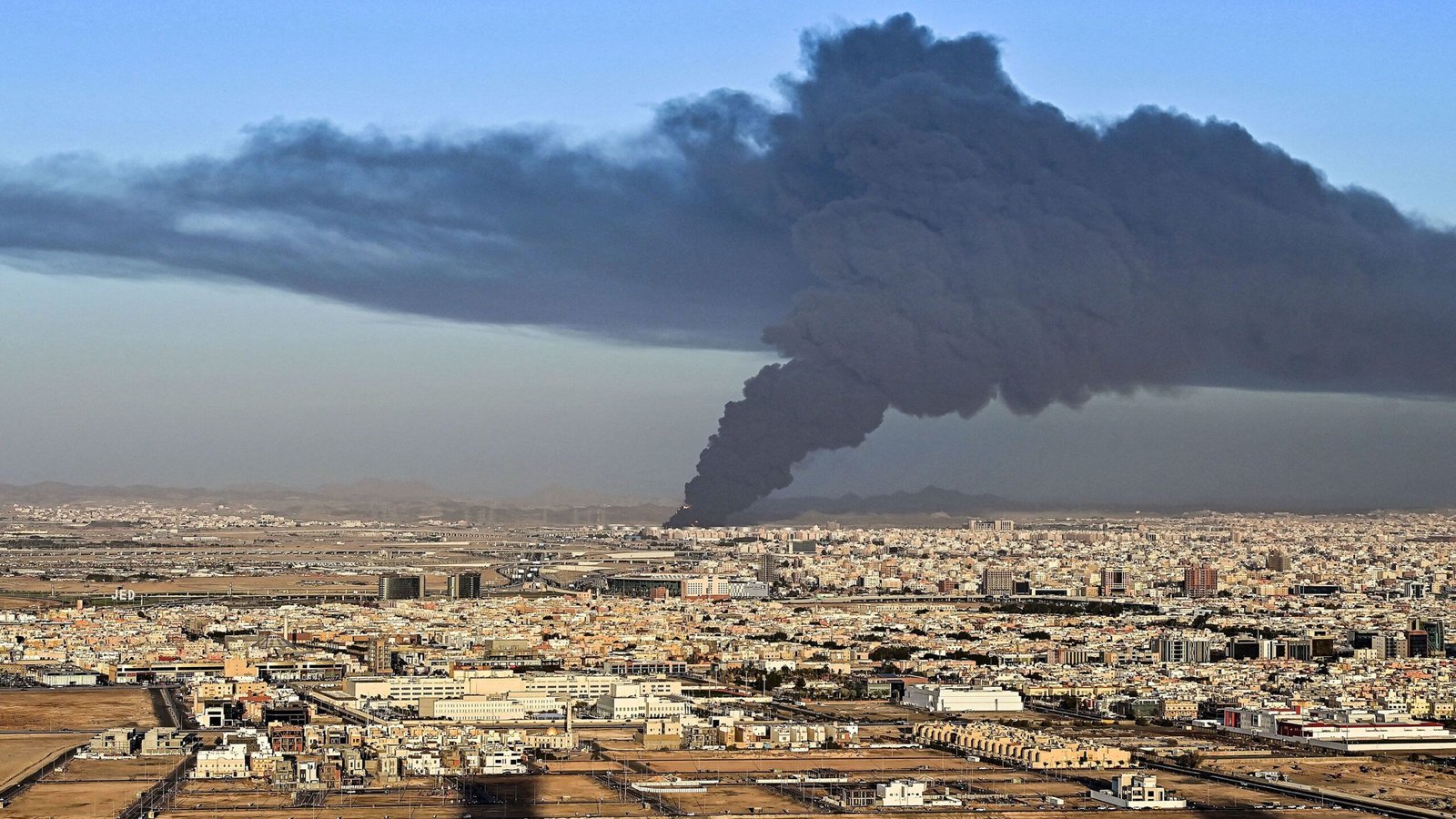
The good news? The blaze did not turn into a full-scale disaster. The Jerusalem Post, citing a Semafor reporter, note that the fire was small, isolated, and quickly brought under control. Videos circulating online, however, told a more dramatic story: thick black smoke billowing from the site, raising uncomfortable questions about how close the region is to a wider conflict. You can imagine traders, officials, and analysts watching those clips and thinking, “If this is just the beginning, what comes next?”
Temporary Shutdown And Oil Supply Jitters
As a precaution, Ras Tanura was temporarily shut down after the incident. That single decision was enough to rattle oil markets. Why? Because Ras Tanura is not just any refinery; it is a critical node in Saudi Arabia’s energy network, and Saudi Arabia itself is a cornerstone of global oil supply. Even a short pause in operations at such a facility can feel like someone briefly turning down the dimmer switch on the world’s energy flow.
Strait Of Hormuz: The Choke Point Under Strain
Saudi Aramco Oil Facility Attack, The timing could not be worse. Shipping through the Strait of Hormuz – the narrow waterway that carries around a fifth of the world’s oil – had already slowed to nearly a standstill after attacks on vessels in the area on Sunday. Picture the global oil market as a highway: the Strait of Hormuz is the main toll bridge. If that bridge gets block or even partially clog, everything behind it backs up. With tankers stuck or rerouted and a major Saudi facility disrupted, the sense of vulnerability in global supply chains has only deepened.
Iran’s Wider Wave Of Attacks
The Ras Tanura incident did not happen in isolation. It is part of a broader wave of Iranian strikes and counterstrikes playing out across the region. According to regional reports, Iran has been targeting locations linked to the United States and its allies, using missiles and drones to send a clear message: it is willing to leverage its regional reach. These attacks have hit multiple capitals and strategic sites, showing that this confrontation is no longer confine to one front.
Missile Strike Reported At Salman Port, Bahrain
Iranian state outlet Press TV also reported a missile strike on Salman Port in Bahrain. Iranian media claim the port was be use to move American logistical equipment in preparation for a potential strike on Iran. While independent verification remains limited, the allegation itself is telling. It suggests that Iran views not just US bases but also regional infrastructure that supports US operations as fair game. For a small island nation like Bahrain, whose ports are vital for trade and security cooperation, that is a deeply unsettling development.
Gulf Capitals In The Crosshairs
The strikes extended beyond Bahrain. Iranian attacks reportedly targeted Abu Dhabi and Dubai in the United Arab Emirates, Doha in Qatar, Manama in Bahrain, and Oman’s commercial port of Duqm. These cities are not only political capitals; they are financial centers, logistics hubs, and major energy gateways. Think of them as the circuit board of the Gulf’s economy: hitting multiple nodes at once risks short-circuiting investor confidence and regional stability.
Precautionary Shutdowns In Iraqi Kurdistan
Saudi Aramco Oil Facility Attack, The shockwaves have be felt further north as well. Over the weekend, most oil production in Iraq’s Kurdistan Region was shut down as a precaution. Operators in the region appear to be bracing for potential spillover or retaliatory strikes, choosing to cut output rather than risk damage to facilities or pipelines. For a region heavily dependent on energy exports, temporarily turning off the taps is a drastic but telling step.
How Did The Conflict Escalate So Quickly?
To understand why things are heating up so fast, you have to look at what triggered this latest spiral. The conflict escalated sharply after the United States and Israel conducted a targeted operation that killed Iran’s supreme leader, Ayatollah Ali Khamenei. This was an unprecedented move, crossing a line that many analysts long considered almost untouchable. In geopolitical terms, it was like kicking out one of the main pillars holding up the fragile balance of deterrence in the region.
Iran’s Retaliation: Missiles, Drones, And A Message
Iran’s response was swift and sweeping. In retaliation, Tehran launched missile and drone barrages across the Middle East, targeting US bases and allied facilities. The attacks were clearly design to demonstrate both capability and resolve. By hitting multiple countries and critical infrastructure points, Iran signaled that any attempt to decapitate its leadership would come at a high regional cost. The Ras Tanura incident, while technically caused by falling debris from an interception, still fits into this broader pattern of escalation.
Global Stakes: Energy, Security, And Uncertainty
Why should someone sitting thousands of miles away care about a drone over Ras Tanura or a missile near Salman Port? Because the Middle East remains the beating heart of the global oil system. When that heart skips a beat, economies feel it everywhere – from fuel prices and shipping costs to inflation and investment flows. Markets hate uncertainty, and right now the region is radiating uncertainty like heat from desert asphalt. If the Strait of Hormuz remains under threat and key facilities stay vulnerable, the ripple effects will reach far beyond the Gulf.
Read More: Israel US strikes on Iran: Explosions in Tehran as conflict escalates
Conclusion
Saudi Aramco Oil Facility Attack, caused by debris from an intercepted Iranian drone, is more than a localized incident. It is a vivid symbol of how volatile the Middle East has become in the wake of Ayatollah Khamenei’s killing and Iran’s sweeping retaliation. With ports, capitals, and energy hubs across the Gulf under threat or on high alert, the region is walking a tightrope between controlled confrontation and broader conflict. For now, fires like the one at Ras Tanura have be contain. The bigger question is whether the political and military firestorm can be contain as well – or whether the world is heading toward a more sustain energy and security crisis.