
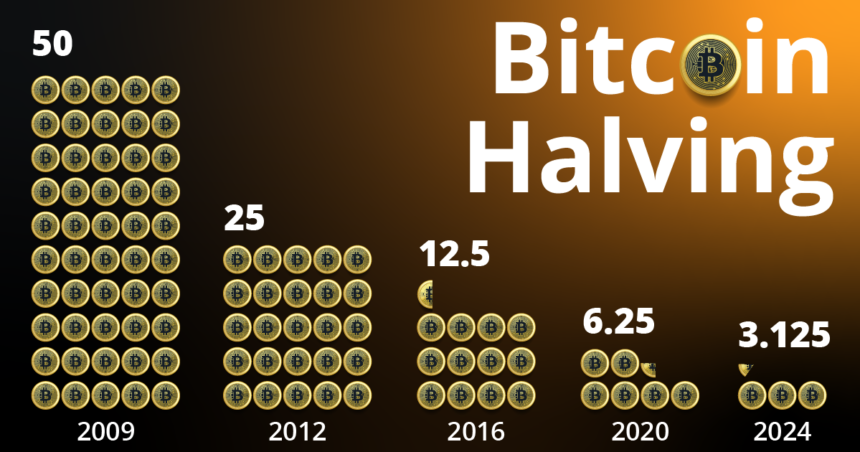
On April 19, 2024, the fourth Bitcoin halving occurred, slashing the block reward miners receive from 6.25 BTC to 3.125 BTC. This single programmatic event — baked into Bitcoin code by its creator Satoshi Nakamoto — has historically triggered the most explosive bull markets in cryptocurrency history. Now, over a year later in 2025, the question every crypto investor is asking is: has the post-halving bull market arrived, and how high can Bitcoin go? Bitcoin halving 2024 price impact.
This comprehensive guide examines exactly what happened to Bitcoin’s price following the April 2024 halving, how the current cycle compares to the previous three, what the experts are predicting, and — most importantly — what this means for investors considering Bitcoin in 2025 and 2026.
What Is the Bitcoin Halving and Why Does It Matter?
Bitcoin’s halving is a fundamental supply mechanism built into the Bitcoin protocol. Every 210,000 blocks (approximately every 4 years), the reward that miners receive for validating transactions and adding new blocks to the blockchain is cut in half. This means the rate at which new Bitcoin enters circulation is permanently reduced.
The economic logic is straightforward and powerful: when supply decreases and demand stays constant or increases, price should rise. Bitcoin’s total supply is capped at 21 million coins — no more can ever be created. The halving ensures that the path to this cap is a slow, predictable tightening of supply over decades.
Currently, approximately 19.7 million of the 21 million Bitcoin are already in circulation. After the 2024 halving, only 3.125 BTC are created every ~10 minutes compared to 6.25 BTC before. This reduction in new supply creation is the halving’s most direct price effect.
The Four Bitcoin Halving Events: Complete History
First Halving — November 28, 2012
Block reward cut: 50 BTC → 25 BTC. Pre-halving price: ~$12. Peak price 12-18 months later: ~$1,100 (November 2013). Percentage gain from halving to peak: ~8,900%.
The first halving proved the thesis. Before 2012, Bitcoin was largely confined to cypherpunks and tech enthusiasts. The supply shock created by the first halving, combined with early mainstream attention, drove a meteoric price rise that introduced millions of people worldwide to the concept of cryptocurrency investing.
Second Halving — July 9, 2016
Block reward cut: 25 BTC → 12.5 BTC. Pre-halving price: ~$650. Peak price 12-18 months later: ~$20,000 (December 2017). Percentage gain from halving to peak: ~2,900%.
The 2016-2017 bull market brought cryptocurrency into mainstream public consciousness. ICO (Initial Coin Offering) mania, retail investor floods, and genuine institutional curiosity created a speculative bubble that peaked at exactly $19,783 before a devastating 84% correction. The 2017 bull market also saw the emergence of Ethereum, Litecoin, and hundreds of altcoins as legitimate investment propositions.
Third Halving — May 11, 2020
Block reward cut: 12.5 BTC → 6.25 BTC. Pre-halving price: ~$9,000. Peak price 12-18 months later: ~$69,000 (November 2021). Percentage gain from halving to peak: ~666%.
The 2020-2021 bull market was fundamentally different from previous cycles. COVID-era money printing by global central banks, near-zero interest rates, and the entry of institutional investors — MicroStrategy, Tesla, Square, and Grayscale — alongside the approval of Bitcoin futures ETFs drove prices to their then all-time-high. The narrative shifted from “speculative gambling” to “digital gold” and “inflation hedge.”
Fourth Halving — April 19, 2024
Block reward cut: 6.25 BTC → 3.125 BTC. Pre-halving price: ~$64,000. Price action 2024-2025: Bitcoin reached new all-time highs above $100,000 in late 2024 and continued its trajectory in 2025.
The 2024 halving occurred in a uniquely favourable environment: the SEC’s approval of Bitcoin spot ETFs (BlackRock’s IBIT, Fidelity’s FBTC, and others) in January 2024 brought unprecedented institutional demand just months before the supply shock. The combination of a demand surge through ETF inflows and a supply reduction from the halving created a textbook supply-demand imbalance that drove prices to historic highs.
The Unique Factors Making the 2024-2025 Bitcoin Cycle Different
Bitcoin Spot ETF Approval — A Game Changer
The January 2024 approval of Bitcoin Spot ETFs by the US Securities and Exchange Commission was the most significant regulatory development in Bitcoin’s history. Products from BlackRock (the world’s largest asset manager), Fidelity, Invesco, Franklin Templeton, and nine other issuers gave institutional and retail investors access to Bitcoin through traditional brokerage accounts without the complexity of wallets, private keys, or crypto exchanges.
In the first 12 months following approval, Bitcoin ETFs accumulated over $50 billion in net inflows — a pace of adoption that surpassed even the wildly successful gold ETF launches of the early 2000s. This institutional demand pipeline, combined with post-halving supply reduction, created the conditions for Bitcoin’s sustained bull market.
Corporate Bitcoin Treasury Adoption
The trend of corporations holding Bitcoin as a treasury asset — started by MicroStrategy in 2020 — accelerated dramatically in 2024-2025. MicroStrategy itself has accumulated over 200,000 BTC worth billions of dollars. Other corporations following suit have created a class of persistent, non-panic-selling Bitcoin holders that reduces available supply on exchanges Bitcoin halving 2024 price impact.
Global Macro Environment
The 2024-2025 period saw major central banks begin cutting interest rates after the inflation-fighting cycle of 2022-2023. Lower interest rates reduce the opportunity cost of holding non-yielding assets like Bitcoin and gold, making them more attractive relative to bonds and savings accounts. The macro environment in 2025 is significantly more accommodative for Bitcoin than the high-rate environment of 2022-2023.
Bitcoin’s Maturing Market Structure
Bitcoin in 2025 is a fundamentally more mature asset than in previous cycles. Derivatives markets (futures, options) are more sophisticated, liquidity is higher, bid-ask spreads are tighter, and volatility — while still high by traditional asset standards — has structurally declined cycle over cycle. This maturation means each bull market tends to be less extreme in both the upside and the correction.
Bitcoin Price Prediction 2025-2026: Expert Analysis
Following the 2024 halving and Bitcoin’s breakthrough above $100,000, price predictions from major financial institutions and crypto analysts have been wide-ranging:
- **Standard Chartered Bank:** Predicted Bitcoin could reach $150,000-$200,000 by end of 2025, citing institutional demand via ETFs and post-halving supply dynamics as primary drivers.
- **Galaxy Digital Research:** Forecast Bitcoin reaching $100,000-$150,000 in the 12-18 months post-halving, based on historical cycle analysis adjusted for institutional adoption.
- **Bernstein Research:** Set a $200,000 Bitcoin price target for end of 2025, citing ETF inflows, corporate treasury adoption, and favourable regulatory environment.
- **PlanB (Stock-to-Flow model):** The creator of the controversial but widely-followed S2F model projects prices in the $200,000-$500,000 range in the current cycle, though his model has critics.
- **Conservative analysts:** Some traditional finance economists expect Bitcoin to consolidate in the $80,000-$120,000 range as the asset class matures and volatility decreases.
Important caveat: Price predictions in cryptocurrency are notoriously unreliable. The range between bull and bear forecasts ($80,000 to $500,000) reflects the genuine uncertainty in this market. Invest only what you can afford to lose.
The Diminishing Returns Pattern: What It Means for 2025
Observing the percentage gains across Bitcoin cycles reveals a clear pattern of diminishing returns: 8,900% (2012-2013), 2,900% (2016-2017), 666% (2020-2021). If this pattern continues, the current cycle might produce gains of 200-400% from the halving price (~$64,000), implying a potential peak of $190,000-$320,000.
Importantly, even with diminishing percentage returns, the absolute dollar gains are growing: $1,088 gain in Cycle 1, $19,350 in Cycle 2, $60,000 in Cycle 3. The fourth cycle’s absolute gain could be $100,000-$200,000+ per BTC even with smaller percentage moves.
This pattern also suggests that the bear market following the peak will be less severe in percentage terms than previous cycles. Bitcoin’s 84% drawdown after 2017 and 77% after 2021 may give way to a 50-60% correction as the market matures and institutional holders with longer time horizons reduce the panic-selling that characterises retail-driven bear markets.
How to Invest in Bitcoin Post-Halving in 2025
Dollar Cost Averaging (DCA) — The Most Recommended Strategy
Rather than trying to pick the perfect entry point — an exercise that even professional traders consistently fail at — Dollar Cost Averaging involves investing a fixed amount in Bitcoin at regular intervals (weekly or monthly) regardless of price. This strategy:
- Removes the psychological burden of market timing
- Automatically buys more Bitcoin when prices dip (lower average cost)
- Reduces the impact of short-term volatility on your overall position
- Builds discipline and long-term investing habits
For example: Investing ₹5,000 weekly in Bitcoin over 12 months acquires Bitcoin at your personal average price across the cycle — higher than the lows, lower than the highs — without the stress of trying to time either.
Self-Custody: Protecting Your Bitcoin
The crypto maxim “Not your keys, not your coins” is more relevant than ever following exchange collapses like FTX (2022). If you hold significant Bitcoin, moving it off exchanges to a hardware wallet (Ledger Nano X or Trezor Model T) provides the highest security. Hardware wallets store your private keys offline, making them immune to exchange hacks and collapses.
Portfolio Allocation: How Much Bitcoin Is Right?
Financial advisors who are positive on Bitcoin typically recommend a 1-10% portfolio allocation for most investors. At 1-5%, Bitcoin provides meaningful upside exposure without catastrophic downside risk to your overall portfolio. At 10%, you are making a concentrated bet that could be transformative or devastating depending on market outcomes.
Bitcoin Halving Impact on Miners and the Network
The halving directly impacts Bitcoin miners — the companies and individuals who validate transactions using powerful computers. Post-halving, miners receive half the Bitcoin reward, meaning:
- **Less efficient miners are forced out:** Miners with high electricity costs or older hardware become unprofitable when rewards are cut in half. This causes a period of miner capitulation and selling of Bitcoin reserves.
- **Hash rate initially dips then recovers:** As less efficient miners shut down, the network’s total computing power (hash rate) temporarily decreases before recovering as remaining miners upgrade their efficiency.
- **Network becomes more secure:** After the shakeout, the remaining miners are the most efficient in the world, creating a stronger, more decentralised, and more secure network.
- **Transaction fees become more important:** As block rewards decline over successive halvings, transaction fees paid by users become a larger proportion of miner revenue — an important sustainability factor for Bitcoin’s long-term security model.
Frequently Asked Questions — Bitcoin Halving 2024 Price Impact
Q1. What was the Bitcoin price before the 2024 halving?
Bitcoin was trading at approximately $60,000-$65,000 in the days surrounding the April 19, 2024 halving. This was already significantly above its previous cycle peak of $20,000 (2017), reflecting the extraordinary institutional demand from Bitcoin ETF approvals.
Q2. How long does it take for a Bitcoin halving to affect the price?
Based on historical patterns, the most significant price appreciation occurs 6-18 months after the halving. The immediate post-halving period often sees consolidation or modest gains, with the major bull market typically arriving 6-12 months later as the reduced supply effect compounds with growing demand.
Q3. Will the Bitcoin halving pattern continue forever?
The mathematical pattern will continue through all 32 halvings, the last of which is projected around 2140 when all 21 million Bitcoin will have been mined. However, with each halving the supply reduction in absolute terms becomes smaller, and the price effect may diminish as Bitcoin’s market cap grows and becomes harder to move dramatically.
Q4. Is it too late to buy Bitcoin after the 2024 halving?
This is a question only you can answer based on your own financial situation and risk tolerance. Historical precedent suggests significant price appreciation occurs in the 12-18 months post-halving. However, Bitcoin is a highly volatile asset, and there are no guarantees that historical patterns will repeat. Never invest more than you can afford to lose entirely.
Q5. How does the Bitcoin halving affect other cryptocurrencies?
Bitcoin halvings historically trigger bull markets across the entire cryptocurrency ecosystem — what the market calls “alt season.” The optimism and capital that flows into Bitcoin during bull markets typically spills over into Ethereum, Solana, and other cryptocurrencies 2-6 months after Bitcoin’s own rally.
Conclusion: The Halving’s Promise and Its Limits
The Bitcoin halving 2024 price impact has set the stage for what historical patterns suggest could be a significant bull market cycle. The combination of supply reduction, unprecedented institutional demand via ETFs, corporate treasury adoption, and improving macro conditions creates a uniquely favourable environment. But Bitcoin remains one of the most volatile assets ever created, and past cycles are imperfect guides to future outcomes.
The wisest approach: understand the mechanics, respect the volatility, invest only what you can afford to lose, and think in years rather than weeks.
Read more cryptocurrency insights on our Cryptocurrency section.
See how Bitcoin compares in our Gold vs Crypto 2025 investment guide.
Explore the top 5 crypto trends of 2025 for broader market context.