
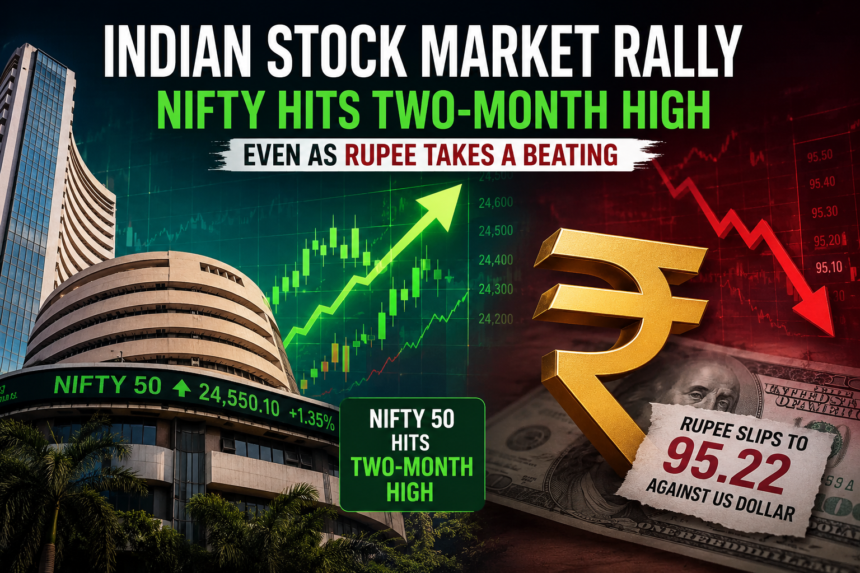
Indian Stock Market Rally, If you’ve been keeping an eye on the stock market lately, you’ve probably noticed something a little unusual: the bulls just won’t quit. For the fourth straight week, Indian benchmark indices have been on a roll, with the Nifty 50 climbing to its highest level in two months.
But before you pop the champagne, there’s a bit of a plot twist. While the Nifty 50 rally continued to push stocks higher, the Indian rupee was heading in the opposite direction, slipping to 95.22 against the US dollar.
So what’s really going on here? Is this a genuine turnaround or just another fleeting summer rally? And why is our currency feeling the heat even as equities cheer?
Grab your cup of chai, because we’re about to break it all down for you in plain English.
Why Is the Market Rallying for a Fourth Consecutive Week?
Let’s be honest: four weeks of gains in a row doesn’t happen by accident. It’s a bit like your favourite cricket team stringing together a few solid wins — it takes a mix of good bowling, smart batting, and maybe a little luck with the weather.
This time around, the market had several things working in its favour.
For starters, crude oil prices softened. Now, if you’re wondering why that matters, think of it this way: India imports the bulk of its oil. So when crude gets cheaper, our import bill drops, inflation eases, and companies (especially those in sectors like aviation, paints, and logistics) breathe a little easier.
Then there’s the geopolitical side of things. Hopes of a potential US-Iran peace arrangement, coupled with easing tensions in the Middle East, took the edge off global uncertainty. That’s always music to investors’ ears, as it tends to calm the nerves of global markets.
But that’s not all. Back home, the southwest monsoon made a much-awaited comeback, which is great news for rural demand, agriculture, and inflation. Add to that growing optimism around a potential India-US trade agreement, and you’ve got a recipe for renewed investor confidence.
Finally, we saw a noticeable shift in institutional flows. While foreign investors were still trimming their positions overall, the broader sentiment improved enough to keep the momentum going.
So yes, there were plenty of tailwinds pushing the market higher.
Nifty 50 Hits a Two-Month High: What Does That Tell Us?
Indian Stock Market Rally, The Nifty 50 didn’t just inch up this week — it powered its way to a two-month high. For many investors, that’s a sign that the market is starting to shake off the jitters we’ve seen in recent months.
But what does a “two-month high” really mean? Think of it like your fitness tracker showing your best step count in weeks. It’s encouraging, no doubt, but it doesn’t necessarily mean you’re ready to run a marathon just yet.
Still, this milestone matters. It signals growing investor optimism, improved risk appetite, and a belief that the worst of the recent volatility might be behind us. The rally also suggests that buyers are returning to the table, even as some global uncertainties linger.
That said, markets don’t move in straight lines forever. So while this is a positive sign, it’s worth keeping both eyes open.
Sectoral Performance: Realty Reigns Supreme, Others Follow Suit
If there was one star of the show this week, it was undoubtedly the real estate sector. The Nifty Realty index surged by nearly 8%, leaving every other sector in its dust.
Why the sudden love for bricks and mortar? Well, a few reasons spring to mind. Lower interest rate expectations (fueled by easing inflation hopes), improved monsoon prospects boosting rural sentiment, and a general uptick in housing demand have all played a part. Plus, many realty stocks had been trading at relatively attractive valuations, making them ripe for a rebound.
But realty wasn’t the only sector enjoying the sunshine.
The Nifty Pharma and Nifty Healthcare indices each gained around 3%, likely buoyed by steady demand and a defensive tilt from investors looking to hedge their bets. Meanwhile, the Nifty Capital Market and Nifty Defence indices advanced close to 2% apiece, reflecting growing investor interest in financial services and the continued momentum in India’s defence story.
Not every sector had it easy, though. The Nifty PSU Bank index took the hardest hit, tumbling 2.6%. The Nifty Energy index slipped 1%, while both the Nifty Bank and Nifty Private Bank indices edged down by around 0.5%.
This divergence tells us something important: the rally wasn’t broad-based across every corner of the market. Instead, investors were quite selective, picking their favourites while steering clear of others.
Midcaps and Smallcaps: The Broader Market Joins the Party
Indian Stock Market Rally, While the headline indices grabbed the spotlight, the broader market had its own story to tell. And for many investors, that’s often where the real action (and opportunity) lies.
The Nifty Midcap 100 index added about 0.6% over the week. Stocks like Oberoi Realty, L&T Finance, One 97 Communications (Paytm), Godrej Properties, Phoenix Mills, and Prestige Estates Projects led the charge. But it wasn’t all smooth sailing — names like KPIT Technologies, GE Vernova TD India, Tata Elxsi, and Hitachi Energy India saw some notable declines.
Meanwhile, the Nifty Smallcap 100 had a much stronger showing, surging 2% for the week. Standout performers included Aegis Logistics, Zensar Technologies, Ather Energy, Five-Star Business Finance, Inventurus Knowledge Solutions, Delhivery, and City Union Bank. On the flip side, Netweb Technologies India, Indraprastha Gas, Tata Chemicals, NBCC (India), Tata Technologies, and Godawari Power & Ispat ended the week in the red.
This kind of mixed performance is pretty typical for mid and smallcaps. They can offer explosive gains when sentiment is upbeat, but they’re also the first to feel the pinch when nerves return. Still, seeing both indices in positive territory suggests that risk appetite is slowly creeping back into the broader market.
Market Capitalisation: A Whopping ₹5 Lakh Crore Added
If you’re wondering just how big this rally was in rupee terms, here’s a number that’ll make your eyes pop: the total market capitalisation of BSE-listed companies jumped by a staggering ₹5 lakh crore over the week.
That’s not pocket change — it’s roughly the size of the GDP of some mid-sized economies!
So who drove this surge? Telecom heavyweight Bharti Airtel was among the biggest contributors, followed closely by Bajaj Finance, Eternal, and Bajaj Finserv. Their strong stock price performances added serious weight to the overall market value.
But it wasn’t all gains across the board. Some heavyweights saw their valuations take a hit. Larsen & Toubro, Reliance Industries, and Kotak Mahindra Bank were among the top laggards, witnessing the sharpest erosion in market capitalisation during the week.
This tug of war between winners and losers perfectly captures the market mood right now: selective optimism rather than across-the-board euphoria.
FIIs vs DIIs: The Eternal Tug of War Continues
If you’ve followed Indian markets for any length of time, you’ll know this story well: it’s often a battle between Foreign Institutional Investors (FIIs) and Domestic Institutional Investors (DIIs). And this week was no different.
FIIs continued to trim their exposure, selling equities worth around ₹4,000 crore over the week. That might seem counterintuitive given the market rally, but foreign investors often have a broader global lens. Concerns about global interest rates, currency volatility, or simply profit-taking could be behind this selling.
But thankfully, DIIs more than picked up the slack. Domestic institutions remained net buyers, pumping a whopping ₹12,633.54 crore into equities. That’s a serious show of confidence in the Indian market story, and it’s been the safety net for Indian indices on more than a few occasions recently.
Think of it like a relay race: just when the foreign runners slow down, the domestic team sprints ahead to keep the baton moving. Without that DII support, this four-week rally might have looked very different indeed.
Rupee Weakens: The Flip Side of the Rally
Indian Stock Market Rally, While stocks were celebrating, the rupee was nursing a hangover. The Indian currency ended the week at 95.22 against the US dollar, down a hefty 82 paise from the previous week’s close of 94.40.
It wasn’t a smooth ride either. The rupee swung between a high of 94.24 and a low of 95.39, underscoring just how volatile the currency market has been lately.
So why the weakness? A few factors are at play here.
First, the persistent FII outflows we just mentioned tend to put pressure on the rupee, as foreign investors sell rupees to buy dollars when exiting positions. Second, global trade uncertainties and a generally stronger US dollar have weighed on emerging market currencies across the board — and the rupee is no exception. Third, even though crude prices softened, other global dynamics kept the dollar well bid.
Currency weakness might not grab headlines like a stock market rally, but it affects all of us. It makes imports more expensive (especially oil and electronics), can push inflation higher, and impacts students studying abroad or travellers planning foreign trips. For companies with significant dollar-denominated debt, it also adds to costs.
So yes, this is one area where the news is less cheerful.
Global Factors Fueling the Volatility
Markets don’t operate in a vacuum, do they? What happens halfway across the world often has a direct impact on our portfolios and our currency.
This week was a perfect example. The softening of crude oil prices came largely on the back of improved diplomatic hopes between the US and Iran. Any sign of de-escalation in the Middle East tends to cool oil markets, which is a big win for import-dependent economies like India.
At the same time, easing geopolitical tensions more broadly helped lift investor sentiment globally. But that optimism was tempered by ongoing uncertainty around global trade policies. The buzz around a potential India-US trade agreement certainly helped local sentiment, but broader trade friction elsewhere kept markets on edge.
Add to that the strength of the US dollar and shifting expectations around US interest rates, and you’ve got a cocktail of global forces pulling markets in different directions. It’s no wonder we saw stocks rally while the rupee stumbled — sometimes the same global cues can have mixed effects on different asset classes.
Is This Rally Built to Last, or Are We in for a Reality Check?
Indian Stock Market Rally, Now comes the million-dollar question: can this four-week winning streak continue?
On one hand, there are plenty of reasons to be cautiously optimistic. The monsoon revival should support rural consumption, easing crude prices offer a much-needed breather for inflation, and the prospect of a trade deal with the US could boost investor confidence further. Plus, the unwavering support from DIIs suggests domestic investors still believe in the long-term India story.
On the other hand, there are some red flags worth noting. Persistent FII selling is a concern, as it reflects global wariness about emerging markets. The rupee’s weakness could also limit the Reserve Bank of India’s flexibility down the road. Then there’s the question of valuations — after four weeks of gains, some stocks may be starting to look a little pricey. And of course, global uncertainties (from trade wars to geopolitical flare-ups) can change the mood in the blink of an eye.
So is this rally sustainable? Probably in patches, but not without a few bumps along the way. Think of it more like a long-distance run with occasional water breaks and uphill stretches, rather than a smooth sprint to the finish line.
What Should Investors Do in This Market?
With all this going on, you’re probably wondering: should I buy, sell, or just sit tight?
The honest answer is — it depends on your goals, risk appetite, and time horizon. But a few principles tend to hold up well in times like these.
First, don’t let short-term noise derail your long-term plan. Market rallies and currency swings are par for the course. If you’re investing for the long haul, a bit of volatility is actually normal.
Second, focus on diversification. The sectoral divergence this week is a timely reminder that not every stock (or sector) moves together. Spreading your investments across sectors and asset classes can help cushion the blow if things turn sour.
Third, consider your exposure to export-oriented versus import-heavy sectors. A weaker rupee tends to benefit exporters (like IT services and pharmaceuticals) but hurts importers. That’s worth factoring into your portfolio thinking.
Fourth, avoid the temptation of chasing momentum blindly. Just because a stock has run up doesn’t mean it’s still a bargain. Do your homework, or stick to quality names with solid fundamentals.
Finally, keep some dry powder handy. Volatility often throws up attractive opportunities, and having a little cash on the sidelines can help you take advantage if markets correct.
In short, this is a time for measured optimism, not reckless exuberance.
Read More: HCLTech AI Deal Worth $1.14 Billion Signals New Era of Enterprise AI Transformation
Conclusion
Indian Stock Market Rally, So there you have it: Indian markets have extended their winning streak to a fourth week, with the Nifty 50 hitting a two-month high, fuelled by softer crude, improving monsoon prospects, trade deal hopes, and steadfast DII buying. But that cheer was tempered by a notably weaker rupee, persistent FII outflows, and uneven sectoral performance.
This market is telling two stories at once — one of resilience and recovery, another of caution and currency pressure. And honestly, that’s a pretty accurate reflection of where things stand right now.
The coming weeks will reveal whether this rally has the legs to go further, or whether global headwinds will bring it back down to earth. For now, the best approach is to stay informed, remain disciplined, and focus on the long game.
After all, investing is rarely about timing every twist and turn — it’s about staying the course through them.