
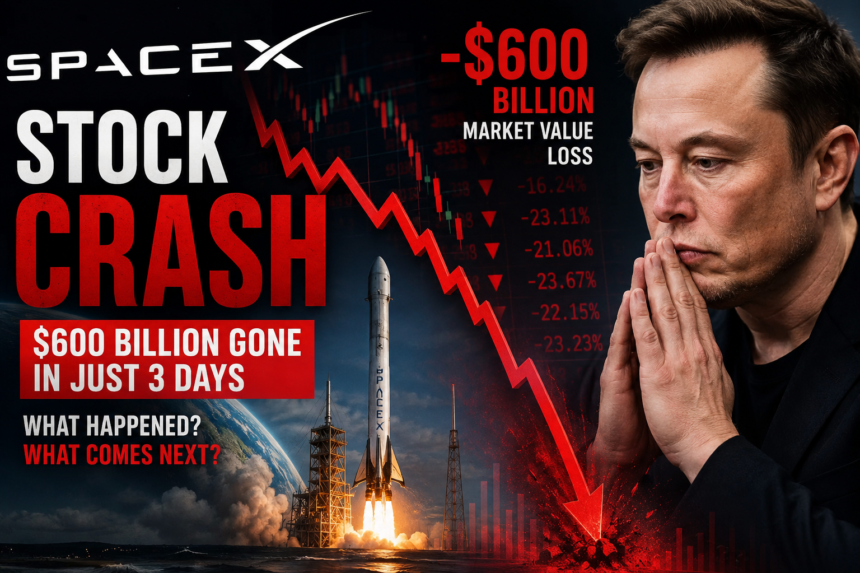
SpaceX Stock Crash, Have you ever watched a rocket soar to incredible heights, only to come crashing back down to Earth? Well, that’s essentially what happened to SpaceX’s stock price recently. In a stunning turn of events that left Wall Street speechless, Elon Musk’s space exploration giant lost a mind-boggling $600 billion in market value in just three days. The sharp decline has also reignited debate around the Elon Musk SpaceX valuation, with investors questioning whether the company’s massive market capitalization was justified. To put this in perspective, that’s nearly triple the combined wealth of India’s two wealthiest tycoons. Let’s dive into what caused this dramatic freefall and what it means for investors.
Understanding the Magnitude of the Loss
When we talk about $600 billion, we’re not just throwing around numbers. This is real money we’re discussing here. Imagine combining the entire fortunes of Mukesh Ambani, who heads Reliance Industries with a net worth of $88.3 billion, and Gautam Adani of the Adani Group, whose wealth stands at approximately $120 billion. Now multiply that by almost three. That’s the amount SpaceX saw evaporate from its market value in merely 72 hours.
The stock took a brutal beating, dropping 16% on Monday alone to close at $154.60 – marking its lowest point since the company first entered the public markets. Over the three-day period, shares plummeted by 23%, creating what some analysts are calling one of the most dramatic selloffs in recent corporate history.
The Rollercoaster Ride: From IPO Glory to Sharp Decline
SpaceX Stock Crash, Remember when SpaceX’s initial public offering was the talk of the town? The company raised a record-breaking $75 billion, and investors couldn’t get enough. It was like watching everyone rush to grab tickets for the hottest concert in town. The stock soared, and SpaceX quickly climbed the ladder to become one of the world’s most valuable companies.
But here’s the thing about meteoric rises – they often set the stage for equally dramatic falls. What goes up must come down, right?
Why Are Investors Hitting the Sell Button?
So what’s driving this mass exodus? According to market strategists, it might be a case of too much, too soon. Michael O’Rourke from JonesTrading put it bluntly when he noted that sellers are now in control, suggesting that everyone who wanted a piece of SpaceX has already bought in.
Think of it like a party where everyone arrived early and grabbed all the good snacks. Now what? The late arrivals are looking around wondering if it’s worth staying, while some early guests are already heading for the door.
The AI Gamble: Blessing or Curse?
Here’s where things get really interesting. SpaceX isn’t content with just dominating the space race – it wants a piece of the artificial intelligence pie too. The company recently announced plans to raise at least $20 billion through its first investment-grade bond offering to fuel its AI ambitions.
Additionally, SpaceX inked a multibillion-dollar deal with Reflection AI, a startup focused on artificial intelligence computing resources. While AI is undoubtedly the future, some investors are getting nervous. Are they spreading themselves too thin? Is this ambition or overreach?
The Retail Investor Phenomenon
SpaceX Stock Crash, Want to know who really fueled SpaceX’s initial surge? Everyday investors like you and me. During the first five trading sessions after the IPO, retail investors pumped a net $405 million into SpaceX shares. That’s more than they invested in all the Magnificent Seven tech stocks combined during the same period!
But here’s the catch with retail-driven rallies – they can be as unpredictable as weather patterns. When sentiment shifts, these stocks can experience wild swings. While retail investors kept buying on Monday, their purchasing pace slowed dramatically compared to the previous week.
What Are the Experts Saying?
Wall Street analysts are starting to weigh in with their official opinions, and not all of them are bullish. KeyBanc Capital Markets kicked off coverage with a hold-equivalent rating, essentially telling investors to pump the brakes.
Their analyst, Michael Leshock, acknowledged that SpaceX remains the undisputed leader in space-launch services. However, he suggested that the current stock price might already reflect all the future growth the company is expected to achieve. In other words, investors might be paying today for profits that won’t materialize for years.
The Valuation Debate: Too Much, Too Fast?
This brings us to the million-dollar question – or should we say, the trillion-dollar question. Is SpaceX’s valuation justified? Even after shedding $600 billion, the company still boasts a market capitalization exceeding $2 trillion. That’s astronomical by any measure.
The acquisition of Musk’s xAI earlier this year transformed SpaceX from a pure space company into a diversified technology and AI player. Supporters argue this justifies a premium valuation. Critics counter that the market got carried away with excitement and lost sight of fundamentals.
The xAI Factor: Game-Changer or Distraction?
SpaceX Stock Crash, SpaceX’s integration of xAI has certainly added a new dimension to its business model. No longer just a company that launches rockets and provides satellite internet, SpaceX now plays in the AI sandbox too. This diversification could be brilliant – imagine having multiple engines powering a single vehicle.
But it also raises questions. Can one company excel in both space exploration and artificial intelligence? Or is this like trying to juggle flaming torches while riding a unicycle?
Where Does SpaceX Go From Here?
Despite the recent turbulence, it’s worth noting that SpaceX shares still trade above their IPO price of $135. The company remains one of the world’s most valuable enterprises, and its core business in space launches and satellite communications continues to thrive.
The real question facing investors now is whether SpaceX’s ambitious plans can justify the extraordinary valuation Wall Street briefly bestowed upon it. Can the company deliver on both its space and AI promises?
Lessons for Investors
SpaceX Stock Crash, This episode offers several valuable lessons. First, even the most exciting companies can experience severe corrections when valuations get stretched. Second, diversification matters – putting all your eggs in one basket, no matter how promising, carries risk. Third, retail investor enthusiasm, while powerful, can be fickle.
Looking Ahead: What Should We Watch?
Moving forward, investors should keep their eyes on several key factors. How will SpaceX‘s AI initiatives progress? Can the company maintain its dominance in space services while expanding into new territories? Will the $20 billion bond offering succeed, and how will those funds be deployed?
These questions will shape SpaceX’s trajectory in the coming months and years.
Read More: JP Power Shares Jump 20% After Adani Power Acquires 24% Stake
Conclusion
SpaceX Stock Crash, SpaceX’s $600 billion loss in market value over just three days serves as a sobering reminder that even the most innovative companies aren’t immune to market forces. While the company’s long-term prospects remain intriguing, with its leadership in space technology and growing AI presence, the recent selloff suggests that investors are taking a more measured approach to valuation.
The company still stands tall with a $2 trillion market cap and shares trading above the IPO price, but the days of unbridled enthusiasm appear to be giving way to more cautious optimism. Whether this correction represents a buying opportunity or a warning sign will depend on SpaceX’s ability to execute on its ambitious dual mandate of space exploration and artificial intelligence.
For now, both bulls and bears are watching closely, waiting to see if Musk’s latest venture can truly reach for the stars without losing its footing here on Earth. One thing’s certain – the SpaceX story is far from over, and the next chapter promises to be just as fascinating as the last.