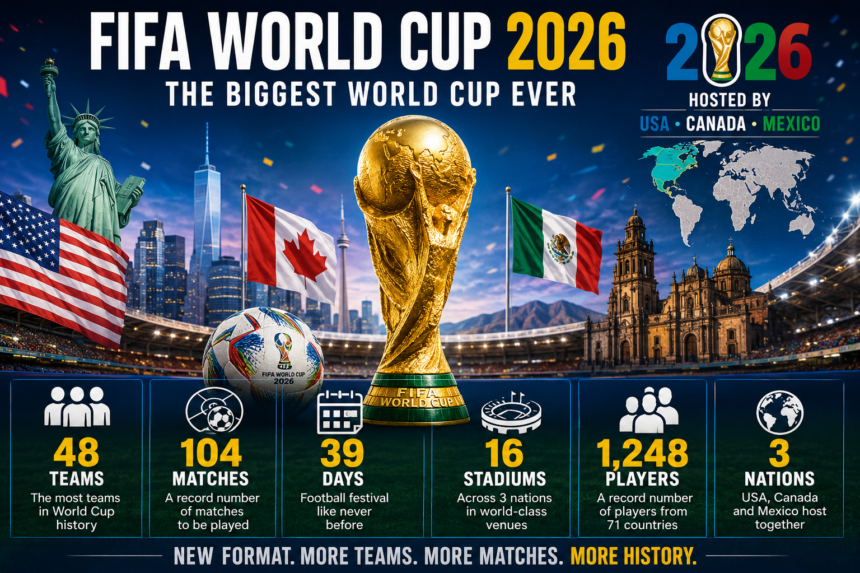
The countdown to the FIFA World Cup 2026 has begun, and one thing is already clear—this will be the biggest World Cup the world has ever seen.
Imagine a football festival stretched across three countries, featuring more teams than ever before, packed with record-breaking numbers, legendary players, rising stars, and an unprecedented 104 matches. That’s exactly what fans can expect when the tournament kicks off in June 2026.
Let’s dive into the numbers that make this World Cup unlike any other.
The Largest FIFA World Cup in History
For decades, the World Cup has evolved to accommodate the growing popularity of football. The last major expansion came in 1998 when the tournament increased from 24 teams to 32.
Now, FIFA is taking another giant leap forward.
The 2026 edition will feature 48 national teams instead of 32, increasing participation opportunities for nations across every continent. As a result, the tournament will grow from 64 matches to an astonishing 104 matches spread across 39 days.
This expansion isn’t just about adding more games. It’s about making football more inclusive and giving emerging nations a chance to shine on the biggest stage.
Three Host Nations, One Historic Tournament
For only the second time in World Cup history, multiple countries will host the tournament.
The first co-hosted World Cup took place in 2002 when Japan and South Korea shared hosting duties. In 2026, the scale will be much larger as the United States, Canada, and Mexico come together to stage the event.
This tri-nation hosting arrangement highlights football’s growing influence across North America and creates a truly continental celebration of the sport.
Sixteen Stadiums Ready for Football’s Biggest Party
The tournament will be played across 16 world-class venues.
- 11 stadiums in the United States
- 3 stadiums in Mexico
- 2 stadiums in Canada
Mexico City will host the opening match on June 11, 2026, featuring Mexico against South Africa.
Canada’s first match will take place in Toronto on June 12, where the hosts face Bosnia-Herzegovina.
Meanwhile, the United States will host the majority of the competition, including all quarterfinals, semifinals, and the grand final at MetLife Stadium in New Jersey.
With fans expected from every corner of the globe, these venues will become the beating heart of world football for over a month.
A Record 1,248 Players Will Compete
Numbers tell stories, and this one speaks volumes.
A total of 1,248 players will participate in the World Cup, making it the largest player pool in tournament history.
These players represent:
- 449 professional clubs
- 71 countries
- 48 national teams
Among them, 357 players have previous World Cup experience, while 891 players will make their World Cup debut.
For many young footballers, this tournament will be the realization of a lifelong dream.
England Leads the Global Football Production Line
FIFA World Cup 2026, When it comes to supplying World Cup talent, England remains at the top.
The country contributes 200 players through its domestic leagues, more than any other nation.
Other major contributors include:
- Germany – 109 players
- France – 86 players
- Spain – 86 players
- Italy – 71 players
- Saudi Arabia – 49 players
Major League Soccer (MLS) is also making significant progress. A record 44 active MLS players will participate, while more than 100 players have previous MLS experience.
This reflects the growing quality and influence of football in North America.
Club Giants Dominate the World Cup Rosters
Some clubs seem to have entire teams scattered across the tournament.
Manchester City leads all clubs with 19 players participating in the World Cup.
Close behind are:
- Bayern Munich – 18 players
- Paris Saint-Germain – 16 players
- Arsenal – 16 players
- Barcelona – 15 players
These clubs have become talent factories, supplying elite players to nations competing for football’s most prestigious trophy.
Cristiano Ronaldo and Lionel Messi Continue to Rewrite History
What would a World Cup be without two of football’s greatest icons?
Cristiano Ronaldo enters the tournament with a staggering 226 international appearances, the highest total ever recorded in men’s football.
The Portuguese superstar has already achieved something no other player has managed—scoring in five different World Cups.
Meanwhile, Lionel Messi remains a central figure for Argentina. The World Cup-winning captain already holds the record for most World Cup appearances with 26 matches.
Both legends are expected to become the first players ever to participate in six World Cup tournaments.
It’s a remarkable achievement that may never be matched.
Can Messi Catch the All-Time World Cup Goals Record?
FIFA World Cup 2026, One of the most fascinating storylines heading into 2026 revolves around goal-scoring records.
Germany’s Miroslav Klose remains the all-time World Cup top scorer with 16 goals.
However, Lionel Messi is closing in with 13 career World Cup goals.
The leaderboard currently stands as:
- Miroslav Klose – 16 goals
- Ronaldo Nazario – 15 goals
- Gerd Müller – 14 goals
- Lionel Messi – 13 goals
France’s Kylian Mbappé is also in contention with 12 goals despite playing only two World Cups.
Could 2026 witness the fall of one of football’s most iconic records?
Only Eight Nations Have Ever Lifted the Trophy
Despite nearly a century of competition, only eight countries have won the FIFA World Cup.
Those champions are:
- Brazil
- Germany
- Italy
- Argentina
- France
- Uruguay
- England
- Spain
Interestingly, only France and Spain have become first-time champions during the last 11 World Cups.
This statistic highlights just how difficult it is to break into football’s elite club.
The Challenge of Defending the Crown
Winning the World Cup is hard.
Defending it is even harder.
Only two nations have successfully won back-to-back World Cup titles:
- Italy (1934 and 1938)
- Brazil (1958 and 1962)
Recent history has been particularly brutal for defending champions. Six title holders have failed to advance beyond the group stage, including Italy in 2010, Spain in 2014, and Germany in 2018.
France managed to reach the final in 2022 but ultimately fell short against Argentina.
The pressure of defending a World Cup title remains one of football’s greatest challenges.
France Chasing a Rare Third Consecutive Final
FIFA World Cup 2026, France enters the tournament with another historic objective.
After winning the World Cup in 2018 and finishing runner-up in 2022, Les Bleus are aiming to become only the third nation ever to reach three consecutive World Cup finals.
The previous teams to achieve that feat were:
- West Germany (1982, 1986, 1990)
- Brazil (1994, 1998, 2002)
Given the depth of talent in the French squad, this milestone is well within reach.
Brazil’s Incredible World Cup Legacy
No nation embodies World Cup history quite like Brazil.
The South American giants are the only country to have appeared in all 23 World Cup editions since the inaugural tournament in 1930.
Brazil also leads the all-time rankings in:
- Tournament appearances
- Victories
- Goals scored
- Goal difference
With five World Cup titles, the Seleção remains the benchmark for international football excellence.
Four Nations Set for Their World Cup Debut
Every World Cup introduces new dreamers, and 2026 is no different.
Four countries will make their first-ever World Cup appearances:
- Cape Verde
- Curaçao
- Jordan
- Uzbekistan
Their inclusion increases the total number of nations that have competed in World Cup history to 84.
For these teams, simply reaching the tournament is already a historic achievement.
Can Egypt Finally End Its Winless World Cup Record?
Some records are less desirable than others.
Egypt enters the tournament having played seven World Cup matches without securing a single victory.
Their current record stands at:
- 0 wins
- 5 losses
- 2 draws
The Egyptians will hope to finally celebrate a World Cup victory when they begin their campaign against Belgium.
More Goals Than Ever Before Expected
The World Cup has already produced 2,720 goals across its first 22 editions.
With an additional 40 matches added to the 2026 tournament schedule, scoring records could tumble.
The current record for goals in a single tournament is 172, set during the 2022 World Cup in Qatar.
Given the expanded format, many analysts expect that mark to be surpassed comfortably.
Football fans love goals—and 2026 could deliver plenty of them.
A 25-Year Age Gap Between Youngest and Oldest Players
One of the most fascinating contrasts at the World Cup is the mix of youth and experience.
Scotland goalkeeper Craig Gordon will be 43 years old when the tournament begins, making him one of the oldest participants.
On the opposite end of the spectrum stands Mexico’s teenage sensation Gilbert Mora, who will be just 17 years old.
The age difference exceeds 25 years, showcasing football’s unique ability to unite generations on the same stage.
Conclusion
The FIFA World Cup 2026 is more than just another football tournament—it is a landmark event that will reshape the competition’s future. With 48 teams, 104 matches, three host nations, and thousands of players chasing glory, fans are set to witness the most ambitious World Cup ever organized.
From legendary stars like Lionel Messi and Cristiano Ronaldo pursuing more history to debut nations eager to make their mark, every statistic points toward one unforgettable summer of football. Whether you’re a lifelong supporter or a casual fan, the numbers behind the 2026 World Cup tell one story loud and clear: football’s biggest spectacle is about to get even bigger.