
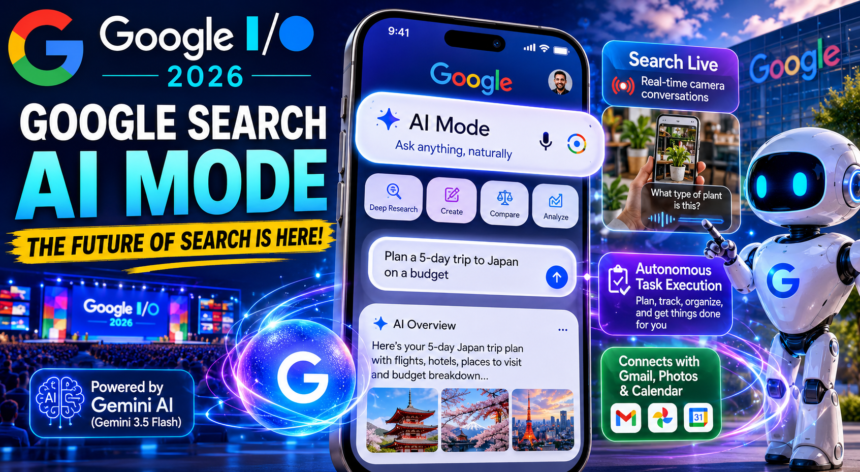
Google Search AI Mode, For more than two decades, people have used Google Search in basically the same way — type a few keywords, hit enter, and scroll through a page full of blue links. But at Google I/O 2026, Google made it crystal clear that the old version of Search is fading fast.
The tech giant unveiled what may be the biggest redesign of Google Search in over 25 years. And honestly? It feels less like a search engine now and more like a full-time AI assistant sitting inside your browser.
But while the innovations sound exciting, they also raise serious concerns about privacy, publisher traffic, misinformation, and the future of the open web.
Let’s break down everything announced at Google I/O 2026 and what it really means for users, creators, and the internet itself.
Google Search Is No Longer Just a Search Engine
For years, Google Search acted like a digital librarian. You asked a question, and it pointed you toward websites that might contain the answer.
That model is changing rapidly.
Google’s new vision transforms Search into an AI-powered conversational platform capable of understanding context, remembering tasks, and even completing actions on your behalf.
Instead of searching “best wedding venues near me,” users can now have a natural conversation with Search like they would with a human assistant.
Need help planning a wedding? Search can organize ideas, track bookings, compare venues, monitor prices, and suggest schedules — all inside a single interface.
It’s a dramatic shift. Google isn’t just helping people find information anymore. It now wants to do things for users too.
AI Mode Becomes the Core of Google Search
Google Search AI Mode, One of the biggest announcements from Google I/O 2026 was the expansion of “AI Mode,” which first appeared experimentally in 2025.
Now, AI Mode is becoming central to the entire Search experience.
Powered by Google’s Gemini 3.5 Flash model, AI Mode allows users to ask long, complex, and conversational questions instead of relying on short keyword searches.
Think of it like upgrading from a calculator to a personal research assistant.
Users can ask multi-part questions such as:
- “Plan a two-week Japan trip under my budget.”
- “Compare the best electric SUVs for families.”
- “Summarize these documents and create a checklist.”
And the system responds conversationally while maintaining context throughout the discussion.
Google has also redesigned the Search bar itself. It now supports back-and-forth interactions more naturally, almost like chatting with an AI chatbot rather than using a traditional search engine.
AI Mode is currently available in nearly 200 countries and supports 98 languages, making it one of the largest global AI rollouts in tech history.
Google Search Can Now Understand Documents, Images, and Browser Tabs
The new AI-powered Search doesn’t just process text anymore.
Users can upload documents, images, screenshots, and even browser tabs directly into Search prompts. That means Search can analyze multiple sources of information simultaneously before generating responses.
For example:
- Upload a PDF contract and ask for key risks.
- Share vacation photos and request travel recommendations.
- Open several shopping tabs and ask Search to compare prices and features.
It’s essentially turning Google Search into a multimodal AI workspace.
This capability comes from Google DeepMind’s ongoing development in multimodal AI systems — technology that combines text, images, audio, and video understanding into a single experience.
And frankly, that’s where things start feeling futuristic.
Search Live Introduces Real-Time Camera Conversations
Google Search AI Mode, Another standout feature announced at Google I/O 2026 is “Search Live,” powered by Project Astra.
This feature allows users to interact with Search in real time using their smartphone cameras.
Imagine pointing your phone at a broken appliance and asking:
“What’s wrong with this?”
Or scanning a restaurant menu and asking:
“What’s the healthiest option here?”
Search Live can analyze live video feeds, understand what it sees, and respond conversationally almost instantly.
This is a huge leap in multimodal AI interaction. Instead of typing questions, users can now literally show Google what they mean.
It feels less like searching the internet and more like having an intelligent companion walking beside you.
Google Wants Search to Complete Tasks for You
Perhaps the most ambitious update unveiled at Google I/O 2026 is Google’s push toward “agentic AI.”
In simple terms, Google Search is evolving from an information tool into an autonomous assistant capable of executing tasks independently.
The company demonstrated features where Search could:
- Track ongoing projects
- Monitor updates automatically
- Organize personal information
- Interact with services and websites
- Create planning dashboards
- Manage moving or wedding checklists
These capabilities are powered by a new system called “Antigravity.”
Antigravity creates lightweight task dashboards directly inside Search, allowing users to manage complex activities without constantly jumping between apps and websites.
For example, someone moving to a new city could ask Search to:
- Track apartment listings
- Monitor price changes
- Organize utility setup reminders
- Compare moving services
- Store important documents
That’s a massive jump from traditional web searching.
Initially, these autonomous features will launch for paid subscribers before becoming more widely available.
Gmail, Photos, and Calendar Are Becoming Part of Search
Google Search AI Mode, Google is also deeply integrating its ecosystem into Search.
Users can now connect services like Gmail and Google Photos directly to Search, allowing the AI system to personalize responses using personal data.
Search may access:
- Travel confirmations
- Purchase receipts
- Emails
- Photos
- Event details
- Booking information
Calendar integration is reportedly on the way as well.
On paper, this sounds incredibly convenient.
Need travel suggestions? Search can reference your booked flights.
Looking for a restaurant recommendation? It can consider your past dining habits.
Trying to remember an old receipt? Search can locate it instantly.
But here’s the catch — personalization at this level also raises major privacy concerns.
Critics argue that deeper AI integration means Google will gain even more insight into users’ habits, preferences, purchases, and routines.
Google says users will have full control over whether these integrations are enabled. Still, privacy advocates are expected to scrutinize how this personal data is stored, processed, and potentially used for advertising.
The Future of Websites and Publishers Looks Increasingly Uncertain
One of the biggest unanswered questions from Google I/O 2026 is this:
What happens to the open web when people stop clicking links?
Google’s AI-powered answers are increasingly designed to keep users inside Search instead of sending them to external websites.
This trend is known as the “zero-click internet.”
In many cases, users now receive summaries, answers, and recommendations directly from AI-generated responses without ever visiting the original source.
For publishers, bloggers, journalists, and online businesses, that’s a potentially massive problem.
Web traffic from Search has already started declining for some publishers due to AI-generated overviews. As AI Mode becomes the default experience, many fear referral traffic could shrink even further.
Advertising models built around search clicks may also face disruption.
It’s almost like Google is becoming both the library and the storyteller — while the original authors remain hidden in the background.
Accuracy and Trust Issues Still Haven’t Been Solved
Google Search AI Mode, Despite all the excitement around AI-powered Search, major reliability concerns remain unresolved.
Research published in 2026 found that generative search systems sometimes cite low-quality sources, AI-generated spam, or inaccurate information.
Google’s earlier AI Overviews faced criticism for producing misleading summaries and occasionally burying the original source material.
And that’s the uncomfortable truth about generative AI:
It can sound incredibly confident even when it’s wrong.
Google says its systems continue improving, especially around citation quality and factual accuracy. However, independent experts remain cautious.
Transparency is still a major issue too.
Many users may not fully understand where AI-generated answers come from, how sources are selected, or whether information has been verified properly.
In industries like healthcare, finance, education, and news, those mistakes can carry serious consequences.
Google Is Building an AI-First Internet
The announcements at Google I/O 2026 show one thing very clearly: Google believes the future of the internet is AI-first.
Search is no longer evolving slowly. It’s transforming at breakneck speed.
The company is combining conversational AI, multimodal understanding, personalized data integration, and autonomous digital agents into one giant ecosystem.
For users, this could make online experiences faster, simpler, and more convenient.
For publishers and creators, however, the future feels far less certain.
And for society as a whole, the questions are growing louder:
- How much personal data should AI systems access?
- Can AI-generated answers truly be trusted?
- What happens when websites lose visibility?
- Will AI help users discover information — or control it?
Those debates are only beginning.
Read More: Google I/O 2026: Every Major AI Announcement You Need to Know
Conclusion
Google Search AI Mode, Google I/O 2026 may ultimately be remembered as the moment Google Search stopped being a search engine and started becoming an AI assistant.
With AI Mode, Search Live, autonomous task execution, and deep integration across Google services, the company is reshaping how billions of people interact with information online.
The changes are undeniably impressive. Search is becoming smarter, more visual, more conversational, and more proactive than ever before.
But innovation often comes with trade-offs.
As Google pushes toward an AI-dominated web experience, concerns around privacy, transparency, misinformation, and publisher survival continue to grow.
The internet is entering a new era — one where AI doesn’t just help users search the web but increasingly acts as the web itself.
And whether that future becomes revolutionary or problematic may depend on how responsibly these systems evolve in the years ahead.