Now, new research suggests the answer may be more serious — and more hopeful — than expected.
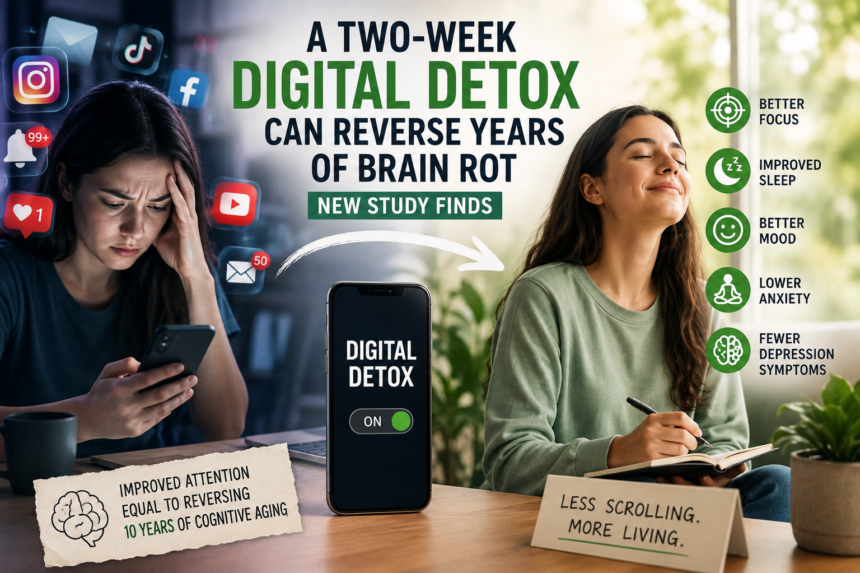
A recent study found that taking just a two-week break from smartphone internet use can significantly improve focus, sleep, mood, smartphone anxiety, and even symptoms of depression. Researchers say the mental improvements happened surprisingly fast, almost like giving the brain a long-overdue vacation.
Even more striking? Scientists discovered the improvement in attention span was roughly equal to reversing nearly 10 years of normal cognitive aging.
That means your brain may recover much faster than you think — if you simply give it room to breathe.
The Study That Got Everyone Talking
Researchers published the findings in PNAS Nexus after studying 467 adults with an average age of 32. Participants were asked to block internet access on their smartphones for two weeks.
There was one important catch: they could still make calls and send texts. So this wasn’t about disappearing into the wilderness or throwing phones into the ocean. It was about reducing constant online stimulation.
The results were dramatic.
Participants reported:
- Better focus and attention spans
- Lower anxiety levels
- Improved mood
- Better sleep quality
- Reduced symptoms of depression
The most shocking finding involved attention span. Researchers found participants’ sustained focus improved at levels comparable to reversing a decade of normal age-related cognitive decline.
Think about that for a second. Two weeks of reduced internet access produced mental improvements many people might expect from years of healthy habits.
That’s a powerful reminder that the brain is more adaptable than we often assume.
Why Smartphones Affect the Brain So Strongly
Digital Detox, Smartphones are not just tiny computers. They are constant companions.
Unlike laptops or televisions, phones follow us everywhere — into bedrooms, bathrooms, restaurants, workplaces, and even family conversations. They interrupt nearly every quiet moment of the day.
Researchers say this nonstop access creates a unique form of mental overload.
Social media apps are also intentionally designed to keep users hooked. Endless scrolling, autoplay videos, push notifications, and algorithm-driven feeds create what many experts call a “dopamine loop.”
It’s a little like eating chips straight from the bag. You rarely stop because you’re satisfied — you stop because the bag is empty.
The problem is that our brains never truly get downtime anymore.
Another Major Study Found Similar Results
The findings are not isolated.
A separate Harvard-linked study published in JAMA Network Open found that reducing smartphone use for just one week led to:
- A 16% drop in anxiety
- Nearly 25% fewer depression symptoms
- Better overall sleep quality
That consistency matters because it suggests the relationship between screen time and mental health is becoming harder to ignore.
For years, many people brushed off concerns about excessive smartphone use as overreactions. But mounting evidence now suggests our digital habits may quietly shape our mood, focus, and emotional well-being every single day.
What Experts Mean by ‘Brain Rot’
The phrase “brain rot” has exploded online recently, often used jokingly to describe the foggy feeling people get after hours of scrolling TikTok, Instagram, or YouTube.
But scientists are beginning to explore whether that mental exhaustion has real neurological consequences.
Excessive screen exposure may contribute to:
- Reduced attention span
- Mental fatigue
- Increased anxiety
- Poor emotional regulation
- Sleep disruption
- Information overload
Imagine your brain as a browser with 75 tabs open simultaneously. Eventually, everything slows down.
That’s essentially what nonstop notifications and endless content can do to the human mind.
You Don’t Need to Quit Technology Completely
Digital Detox, Here’s the good news: researchers are not telling people to abandon technology entirely.
You don’t need to move off-grid in the mountains or switch to a flip phone from 2004.
In fact, many participants still experienced mental improvements even when they didn’t follow the rules perfectly. The key takeaway is that small, consistent changes matter.
Your brain does not necessarily need perfection. It just needs fewer interruptions.
6 Practical Ways to Reset Your Brain From Smartphone Overload
1. Move Social Media Apps Off Your Home Screen
This sounds ridiculously simple — because it is.
Moving apps like TikTok, Instagram, Facebook, X, and YouTube into folders or secondary screens creates a tiny moment of friction before opening them.
And that small pause matters.
Many people open social media automatically without consciously deciding to do it. By making apps slightly harder to reach, you interrupt the habit loop.
It’s like putting junk food on the top shelf instead of leaving it on the kitchen counter.
2. Turn Off Most Notifications
Notifications train the brain to expect constant interruptions.
Every buzz, ping, and vibration acts like a mini dopamine reward. Over time, the brain becomes conditioned to seek stimulation nonstop.
Experts recommend disabling:
- Social media alerts
- Shopping notifications
- Breaking news banners
- Promotional pop-ups
- Random app reminders
Keep only the essentials like calls, texts, and calendar alerts.
Many people report feeling noticeably calmer within just 24 hours of silencing unnecessary notifications.
3. Stop Taking Your Phone Everywhere
Digital Detox, One of the biggest issues researchers identified is simple: smartphones never leave our side.
Try leaving your phone behind during:
- Short walks
- Grocery trips
- Meals
- Coffee runs
- Gym sessions
- Bathroom breaks
Even 20 to 30 minutes of phone-free time can help your brain reset and reduce mental clutter.
At first, it may feel uncomfortable. Then it starts feeling peaceful.
4. Turn Your Bedroom Into a Low-Phone Zone
Late-night scrolling quietly damages sleep in multiple ways.
It delays bedtime, increases mental stimulation, raises stress levels, and reduces sleep quality.
Experts suggest:
- Charging phones outside the bedroom
- Using a real alarm clock
- Avoiding screens 30 to 60 minutes before sleep
For many people, stopping nighttime doomscrolling produces the biggest improvement in mental health.
Your brain was never designed to consume bad news, arguments, and flashing videos seconds before sleep.
5. Use Blocking Apps Instead of Willpower
Willpower alone often fails because smartphone apps are specifically engineered to capture attention.
That’s why experts recommend using blocking tools like:
- Freedom
- Opal
- ScreenZen
- Forest
- Apple Screen Time
- Android Digital Wellbeing
These apps block selected apps or websites during chosen hours, reducing temptation before it even starts.
Think of them as guardrails for your attention.
6. Replace Scrolling With Physical Activities
Many people reach for their phones during moments of boredom without even realizing it.
Experts recommend replacing that reflex with offline activities like:
- Walking
- Stretching
- Reading
- Cooking
- Journaling
- Listening to music
- Short workouts
- Face-to-face conversations
Physical activities help retrain attention spans and reconnect the brain with the real world.
Even something as simple as a 15-minute walk can feel surprisingly refreshing after hours of digital overload.
How Social Media May Also Be Hurting Your Wallet
Digital Detox, The effects of nonstop scrolling are not just mental.
Social media constantly exposes users to influencer marketing, personalized ads, flash sales, and endless product recommendations.
That means boredom scrolling often turns into impulse spending.
Experts recommend trying a “low-buy weekend” where you avoid both social media and shopping apps for 48 hours.
Many people quickly realize how much unnecessary spending is tied directly to boredom and constant online exposure.
In other words, cutting screen time may help both your brain and your bank account.
Why These Findings Matter More Than Ever
Modern life is built around screens.
Most people work online, socialize online, shop online, and relax online. Smartphones are deeply woven into everyday routines.
That’s why these studies matter.
They suggest mental fatigue and reduced focus are not simply personal failures or lack of discipline. In many cases, they may be predictable outcomes of constant digital stimulation.
The encouraging part is that recovery may happen faster than expected.
The brain appears remarkably responsive when given even small breaks from nonstop online activity.
Read More: Online Gaming Rules India 2026: Complete Guide to PROG Act and Esports Laws
Conclusion
Digital Detox, The latest research sends a powerful message: excessive smartphone and social media use may be affecting attention span, anxiety, sleep, mood, and mental health far more than many people realize.
But the studies also offer hope.
A simple two-week reduction in smartphone internet use helped participants feel calmer, sleep better, focus longer, and improve overall mental well-being. Some cognitive improvements were so strong they resembled reversing years of mental aging.
That doesn’t mean technology is inherently bad. Smartphones remain valuable tools for communication, work, learning, and entertainment.
The real issue is balance.
And according to researchers, even small changes — fewer notifications, less doomscrolling, and more offline moments — may help the brain recover faster than expected.
In a world constantly competing for our attention, sometimes the healthiest thing we can do is simply disconnect for a little while.