
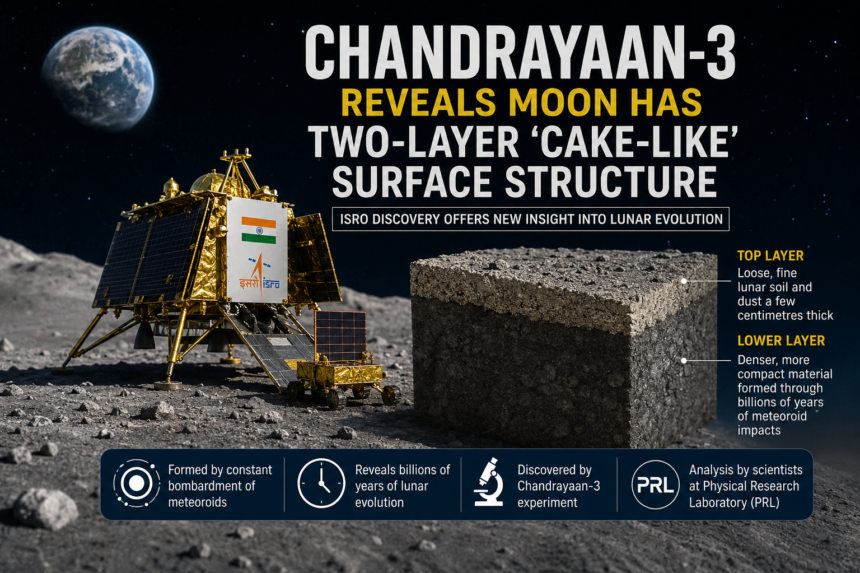
India’s lunar ambitions have just uncovered another fascinating secret about the Moon. Scientists working with India’s historic Chandrayaan-3 mission have discovered that the Moon’s surface is not simply a flat blanket of dust and rock. Instead, it appears to have a distinct two-layer structure — almost like a layered cake.
And honestly, this changes the way scientists look at the Moon’s outer shell. What once appeared to be a simple dusty surface now looks more like a dynamic geological archive recording billions of years of impacts and transformations.
What Did Chandrayaan-3 Discover on the Moon?
The Chandrayaan-3 mission revealed that the Moon’s surface consists of two distinct layers. The top layer is surprisingly thin — only a few centimeters thick — while the lower layer is denser and structurally different.
Scientists described this arrangement as “cake-like” because of its layered composition. Think of it like the crust on a freshly baked cake: soft and crumbly at the top but firmer underneath.
This discovery helps researchers better understand the Moon’s regolith — the loose layer of dust, rocks, and broken particles covering the lunar surface.
Why the Lunar Surface Looks Like a Layered Cake
So, how did the Moon end up with this unusual structure?
The answer lies in billions of years of relentless meteoroid impacts. Unlike Earth, the Moon has no atmosphere to protect it from space debris. Tiny meteoroids constantly strike the lunar surface at extremely high speeds.
Over time, these impacts crush and pulverize rocks into fine dust. The uppermost layer becomes loose and fluffy because it is continuously disturbed by these collisions. Meanwhile, the lower layer remains comparatively compact.
It’s a bit like walking on a beach. The sand on top feels soft and loose, but dig a little deeper and the ground becomes firmer and packed.
How Chandrayaan-3 Collected the Data
The findings were made possible using instruments aboard Chandrayaan-3, India’s third lunar mission that successfully landed near the Moon’s south pole in August 2023.
The mission carried advanced scientific payloads designed to study the Moon’s composition, temperature, seismic activity, and surface properties.
Researchers analyzed data gathered during the mission to determine how heat and mechanical properties changed across different layers of the lunar soil. These subtle variations helped scientists identify the distinct layering pattern beneath the surface.
The study was led by scientists from the Physical Research Laboratory, a prestigious research institution known for pioneering work in planetary science and astrophysics.
Why This Discovery Matters for Future Moon Missions
At first glance, a few centimeters of lunar dust may not sound revolutionary. But for scientists and engineers planning future Moon missions, this discovery is incredibly important.
Understanding the Moon’s surface structure directly affects:
- Future lunar landings
- Rover mobility
- Construction of Moon bases
- Mining operations
- Astronaut safety
Imagine trying to build a structure on unstable ground without knowing what lies underneath. That’s exactly why lunar soil analysis matters.
A thin loose layer over compact material means future spacecraft and equipment will need specialized engineering solutions to avoid sinking or instability.
The Moon Is Constantly Under Attack From Space
One of the most striking parts of the study is what it reveals about the Moon’s violent history.
The lunar surface has been continuously bombarded by meteoroids since the Moon’s crust solidified billions of years ago. Because there is no atmosphere, even tiny particles traveling at cosmic speeds slam directly into the surface.
Over millions of years, these impacts reshape the Moon’s outer layer like a sculptor slowly carving stone.
The result? A fragile dusty top layer sitting above denser material formed through repeated compression and fragmentation.
In many ways, the Moon acts like a giant cosmic punching bag floating silently in space.
How the Discovery Helps Scientists Understand Lunar Evolution
The Moon serves as a time capsule for the early solar system. Unlike Earth, which constantly changes due to weather, oceans, and tectonic activity, the Moon preserves ancient geological evidence.
That makes discoveries like this extremely valuable.
By studying the Moon’s layered structure, scientists can better understand:
- How planetary surfaces evolve
- The history of meteoroid activity
- The formation of lunar soil
- Long-term space weathering effects
These insights may even help researchers study other rocky planets and moons across the solar system.
India’s Chandrayaan Program Continues to Impress the World
Chandrayaan-3 was already a landmark mission before this discovery. India became the first country to successfully land near the Moon’s south polar region, a scientifically important area believed to contain water ice.
The mission showcased India’s growing capabilities in space exploration and placed ISRO among the world’s elite space agencies.
Now, discoveries like this further strengthen India’s reputation in planetary science.
What makes it even more impressive is the cost-efficiency of the mission. ISRO continues proving that groundbreaking science does not always require massive budgets.
The Role of the Physical Research Laboratory
The Physical Research Laboratory (PRL) played a key role in analyzing the Chandrayaan-3 data.
Based in India, PRL is one of the country’s premier scientific institutions focused on space and planetary research. Its scientists specialize in studying celestial bodies, atmospheric science, astrophysics, and solar system evolution.
Their analysis helped uncover the hidden structure beneath the lunar surface, adding another major achievement to India’s growing list of scientific accomplishments.
Could This Discovery Affect Future Human Settlements on the Moon?
Absolutely.
As countries and private companies prepare for future Moon missions, understanding lunar terrain becomes essential. NASA’s Artemis program, China’s lunar projects, and multiple commercial ventures all aim to establish long-term operations on the Moon.
Knowing the Moon’s surface is layered helps planners design:
- Better landing systems
- Stronger habitats
- More reliable rovers
- Safer astronaut operations
Even small details about soil composition can determine whether a mission succeeds or fails.
After all, building on the Moon isn’t like building on Earth. Every grain of lunar dust matters.
The Moon Still Holds Many Mysteries
Despite decades of exploration, the Moon continues surprising scientists.
From hidden water ice deposits to mysterious seismic activity and unusual surface chemistry, researchers are constantly discovering new details about Earth’s closest celestial neighbor.
The Chandrayaan-3 findings remind us that even something as familiar as the Moon still contains secrets waiting to be uncovered.
And perhaps that’s what makes space exploration so exciting. Every mission peels back another layer of the unknown — literally, in this case.
Read More: ISRO 2026 Missions Gaganyaan Update: India’s Human Spaceflight Dream Nears Reality
Conclusion
The Chandrayaan-3 experiment has provided scientists with a fascinating new understanding of the Moon’s surface. ISRO’s discovery of a two-layer “cake-like” lunar structure reveals how billions of years of meteoroid impacts shaped the Moon into what we see today.
The research not only deepens humanity’s understanding of lunar geology but also plays a critical role in preparing for future Moon exploration and possible human settlements.
India’s Chandrayaan-3 mission continues to prove that space exploration is not just about reaching distant worlds — it’s about uncovering the hidden stories written into their surfaces over billions of years.
In the grand puzzle of the universe, even a few centimeters of lunar dust can unlock extraordinary scientific knowledge.