
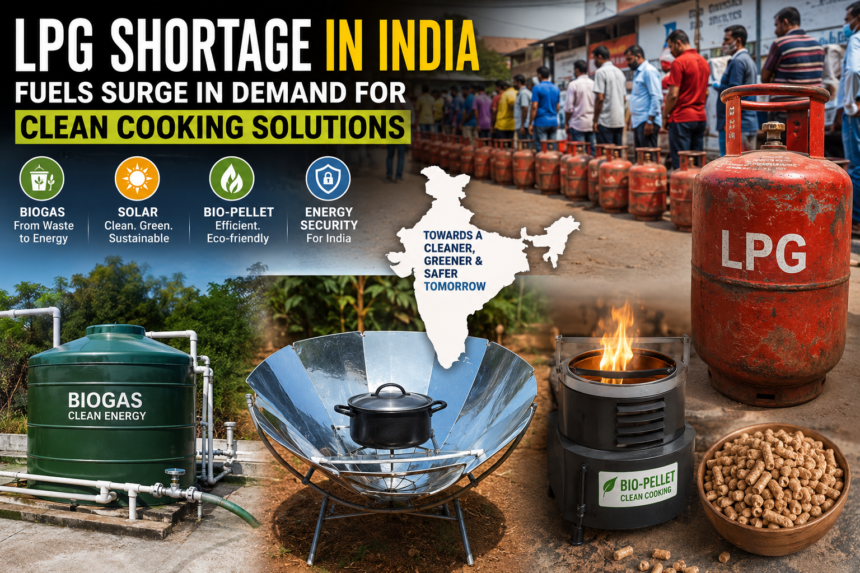
LPG Shortage India, India’s recent LPG crisis has done more than create long queues outside gas agencies — it has triggered a nationwide rethink about how Indians cook their food. As tensions in West Asia disrupted supplies through the Strait of Hormuz, households, restaurants, caterers, and industries suddenly found themselves scrambling for alternatives to liquefied petroleum gas (LPG).
And what happened next was fascinating.
But is this just a temporary reaction to a supply shock? Or could this moment become a turning point in India’s clean-energy transition?
Let’s dive deeper.
India’s Dependence on Imported LPG Became a Major Weakness
India imports nearly 60% of its LPG requirements, and roughly 90% of those imports pass through the strategically critical Strait of Hormuz. When the recent geopolitical conflict in West Asia disrupted shipping routes, the impact was immediate and severe across India.
Suddenly, LPG cylinders became scarce.
People began waiting in long queues for refills. Black-market rates surged dramatically, with cylinders that normally cost around ₹950 being sold for as much as ₹2,500 to ₹5,000 in several cities.
For millions of Indian households dependent on LPG for daily cooking, the situation quickly became stressful.
Ironically, the very fuel promoted for years as a “clean cooking solution” revealed how fragile centralized energy dependence can be during global crises.
Many Families Returned to Traditional Stoves
As LPG Shortage India intensified, countless households reverted to older cooking methods.
Wood-fired stoves, cow-dung cakes, charcoal burners, and makeshift cooking setups started reappearing in urban and rural areas alike. Some households shifted to induction stoves, but rising electricity usage and inconsistent power supply created additional challenges.
This backward shift highlighted a harsh reality: when modern energy systems fail, people fall back on whatever is available.
And that’s precisely why experts are now emphasizing decentralized energy systems that communities can control locally.
Biogas Systems Suddenly Became Highly Valuable
LPG Shortage India, One of the biggest winners during the crisis has been decentralized biogas technology.
Priyadarshan Sahasrabuddhe, founder of Pune-based Vaayu Mitra, says demand for his waste-to-energy biogas systems exploded almost overnight after the LPG shortage began.
For years, he had been advocating a simple idea: households and businesses could convert kitchen waste into usable cooking gas instead of depending entirely on LPG cylinders.
Now, people are finally listening.
His company has installed over 440 biogas systems since 2015, with more than 400 currently operational. Together, these systems process over 1,100 tonnes of organic waste annually and have reportedly saved around 3,000 LPG cylinders over the past decade.
That’s not just environmentally beneficial — it’s economically powerful.
How Biogas Works Like a Circular Economy
Think of biogas as turning garbage into fuel.
Food waste, vegetable peels, leftover meals, and organic kitchen waste are placed into a digester where microorganisms break the material down naturally. The process releases methane-rich gas, which can then be used directly for cooking.
Instead of throwing away waste and buying imported fuel, households effectively create their own local energy source.
It’s a little like owning a mini gas plant on your rooftop.
And during a crisis, that kind of self-reliance becomes priceless.
Residential Communities Are Adopting Shared Biogas Networks
In Pune’s Hinjawadi area, a residential township has already integrated biogas systems across multiple buildings.
Nearly 100 flats now receive biogas through dedicated pipelines connected to rooftop digesters. Residents who were initially skeptical are now feeling more secure amid the ongoing LPG uncertainty.
Developers initially feared the systems would create foul smells, attract insects, or become maintenance nightmares. But after trial installations proved successful, many residents voluntarily opted for the biogas connections.
The concept is simple but revolutionary: apartment buildings generating cooking gas from their own waste.
That’s urban sustainability in action.
Families Are Saving Money While Reducing Fuel Dependence
LPG Shortage India, Several households using biogas systems say they have dramatically reduced their LPG usage.
One Pune-based family of five reportedly eliminated almost all dependence on LPG over the past few years. Their digester runs using wet waste purchased from local waste workers for just a few hundred rupees each month.
The result?
They save approximately 12 LPG cylinders annually while also reducing the amount of waste going into landfills.
In a country where both waste management and energy security are massive challenges, biogas addresses two problems at once.
That’s the kind of “two birds with one stone” solution policymakers dream about.
The Biggest Barrier Is Still the Upfront Cost
Despite the benefits, widespread adoption still faces serious obstacles.
Biogas systems require significant initial investment. Household installations can cost around ₹1 lakh, while larger residential township systems may cost several crores depending on scale.
For environmentally conscious families, the investment may seem worthwhile in the long term. But for middle-class households already struggling with inflation and rising living costs, the upfront expense is often too high.
Real estate developers face similar concerns.
While the systems eventually save electricity and waste-management expenses, builders are often reluctant to absorb additional installation costs during construction.
Without subsidies or financial incentives, scaling up remains difficult.
Social Attitudes Toward Waste Are Also a Challenge
Interestingly, technology isn’t the only problem.
Social perception plays a huge role too.
Many people still associate waste-processing systems with dirt, smell, and unhygienic conditions. Some residents oppose digesters simply because they dislike the idea of storing organic waste near their homes.
Changing this mindset may be just as important as improving the technology itself.
After all, if people view waste as a resource rather than garbage, decentralized energy systems become far easier to accept.
Solar Cookers Are Seeing a Massive Revival
LPG Shortage India, The shortage has also reignited interest in solar cooking technologies.
For years, solar cookers were often dismissed as slow, inconvenient, or impractical. But modern innovations are changing that perception quickly.
Organizations promoting renewable cooking solutions report a dramatic rise in inquiries from households, caterers, community kitchens, and rural organizations.
And the timing couldn’t be more important.
Modern solar cookers are no longer the clunky devices people remember from decades ago. Newer models can cook efficiently even during partially cloudy weather, while advanced parabolic systems can generate heat levels comparable to LPG stoves.
That’s a major leap forward.
Bio-Pellet Stoves Are Becoming Popular Across India
Another fast-growing alternative is bio-pellet cooking technology.
Bio-pellets are made from agricultural waste and compressed biomass. They provide a cleaner alternative to firewood and charcoal while utilizing materials that would otherwise be discarded.
Manufacturers of pellet-based stoves say demand has surged dramatically since the gas crisis began.
Commercial kitchens, hotels, cafes, and catering companies across Maharashtra, Gujarat, Kerala, Bengaluru, Chennai, Hyderabad, Kolkata, and Delhi have started adopting these systems.
In just a few months, thousands of domestic and commercial pellet stoves have reportedly been sold nationwide.
That’s a remarkable shift in consumer behavior.
Government Support Could Determine the Future
Experts widely agree that clean cooking alternatives cannot scale nationwide without policy support.
India already subsidizes solar panels and promotes renewable electricity generation. Similar incentives for biogas digesters, solar cookers, and bio-pellet systems could transform adoption rates dramatically.
Property tax rebates, installation subsidies, low-interest financing, research funding, and public awareness campaigns may all play critical roles.
Because here’s the truth: most people are willing to adopt cleaner technologies if they are practical, affordable, and reliable.
The crisis has already proven the demand exists.
Now the question is whether policymakers can build the ecosystem needed to sustain that momentum.
Why Clean Cooking Alternatives Matter Beyond This Crisis
LPG Shortage India, This isn’t just about surviving one LPG shortage.
India’s energy future depends heavily on diversification and resilience.
Centralized energy systems are vulnerable to geopolitical conflicts, shipping disruptions, price volatility, and global market shocks. Decentralized clean-energy solutions reduce that risk significantly.
Biogas, solar cooking, and bio-pellet systems also offer additional benefits:
- Reduced carbon emissions
- Lower household energy costs
- Better waste management
- Reduced indoor air pollution
- Greater local energy independence
- Support for circular economy models
In many ways, the current crisis has simply accelerated conversations India needed to have anyway.
Read More: PM Modi Work From Home Appeal Pushes India Inc to Review Office Attendance Policies
Conclusion
LPG Shortage India has exposed the vulnerabilities of relying heavily on imported fuel. But amid the disruption, something unexpected has happened — millions of people have started exploring cleaner, decentralized cooking alternatives that were once considered niche or experimental.
Biogas systems are turning kitchen waste into fuel. Solar cookers are becoming more practical and efficient. Bio-pellet stoves are helping businesses continue operations during fuel shortages.
What once looked like backup solutions are now emerging as essential components of energy security.
The challenge ahead is no longer about proving these technologies work. The real challenge is making them accessible, affordable, and socially acceptable on a national scale.
If India successfully supports this transition, the LPG crisis of 2026 may eventually be remembered not just as an energy emergency — but as the moment the country accelerated toward a cleaner and more resilient cooking future.