
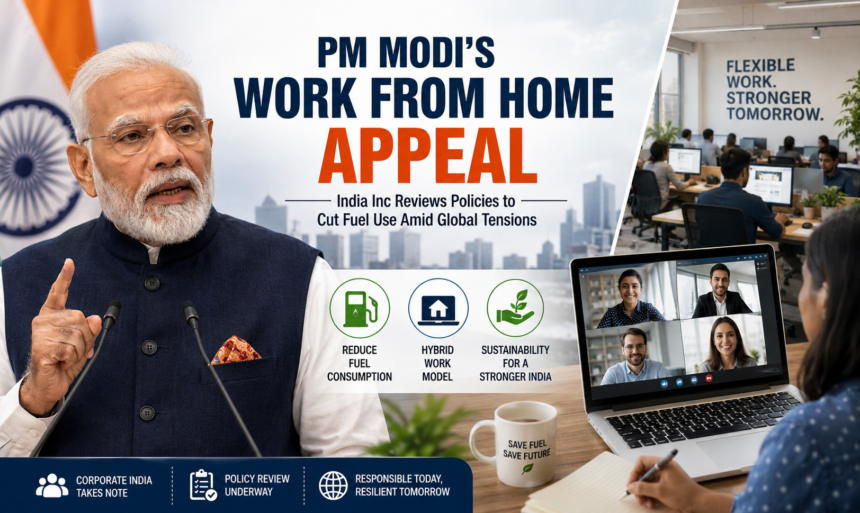
PM Modi Work From Home Appeal, The debate around work-from-home is back in the spotlight — and this time, it’s not just about employee comfort or corporate productivity. It’s about national interest.
Now, from tech giants to infrastructure conglomerates, India Inc is quietly reassessing whether flexible work arrangements could once again become part of everyday business life.
Why PM Modi’s Appeal Matters Right Now
India imports a significant portion of its crude oil requirements. Whenever geopolitical instability hits oil-producing regions, the ripple effects are felt almost immediately across fuel prices, transportation costs, logistics, and industrial operations.
That’s exactly why PM Modi’s message struck a chord with corporate India.
Rather than presenting the situation as a crisis, the Prime Minister framed it as a precautionary and practical step — encouraging businesses and individuals to reduce unnecessary fuel consumption wherever possible. One of the easiest ways to achieve that? Fewer daily commutes.
Think of it like switching off unnecessary lights during a power shortage. A single bulb may not seem important, but millions of them together make a massive difference.
Corporate India Begins Reviewing Workplace Policies
PM Modi Work From Home Appeal, India’s leading business houses have wasted little time in responding.
Major conglomerates including Reliance Industries and Tata Group are now evaluating whether greater flexibility in workplace attendance could help reduce fuel usage while maintaining operational continuity.
Reliance Industries, led by billionaire Mukesh Ambani, currently follows a strict work-from-office model with no hybrid option for most employees. However, company officials have confirmed that the situation is under assessment.
Similarly, the Tata Group is reviewing flexibility measures across several of its companies, although no unified group-wide policy has been announced yet.
This marks an interesting shift because many corporations had recently begun tightening return-to-office mandates after years of remote work during the pandemic.
Infrastructure Companies Face a Different Challenge
For engineering and infrastructure giants such as Larsen & Toubro and KEC International, implementing blanket work-from-home policies is far more complicated.
Why? Because much of their workforce operates directly from construction sites, factories, and project locations where physical presence is essential.
You can’t remotely supervise a bridge construction project from your dining table.
Still, these firms are taking precautions where possible. Following rising tensions in West Asia, Larsen & Toubro reportedly issued internal advisories encouraging employees to avoid non-essential travel and shift meetings online whenever feasible.
This hybrid response reflects a broader corporate trend: reduce avoidable movement without disrupting critical operations.
Industry Leaders Call the PM’s Request ‘Pragmatic’
PM Modi Work From Home Appeal, Business leaders across sectors appear to support the Prime Minister’s appeal.
Confederation of Indian Industry president Rajiv Memani, who also serves as chairman of EY India, described the message as sensible and pragmatic rather than alarming.
According to him, the idea is not to create panic but to encourage responsible consumption during a period of global uncertainty. Reducing fuel dependency, especially in imported sectors, could help India manage economic pressure more efficiently.
Meanwhile, Vir S Advani, chairman and managing director of Blue Star, acknowledged that while such measures might create minor business disruptions, they ultimately serve the country’s broader interests.
That sentiment captures the balancing act businesses now face — protecting productivity while contributing to national stability.
IT Sector Faces a Major Workplace Dilemma
Perhaps no industry is watching this situation more closely than India’s massive IT sector.
Over the last two years, technology companies have aggressively pushed employees back to offices. Many executives believe physical workplaces strengthen collaboration, improve supervision, and help rebuild company culture weakened during extended remote work periods.
But PM Modi’s appeal could complicate those return-to-office strategies.
India’s technology workforce has grown to nearly 5.9 million employees in 2026, making it one of the largest white-collar sectors in the country. Even small changes in commuting patterns within this industry could significantly impact fuel consumption nationwide.
The problem? Most IT companies have already invested heavily in stricter attendance policies.
TCS, Wipro, and HCLTech Tighten Attendance Rules
PM Modi Work From Home Appeal, Several major IT firms recently introduced tougher office attendance mandates.
Tata Consultancy Services has implemented one of the strictest policies, requiring employees to work from office five days a week. The company has reportedly linked compliance with variable pay and career progression.
Wipro now expects employees to attend office at least three days a week under its hybrid model.
HCLTech has mandated a minimum of 12 in-office days per month.
Other major firms including Cognizant, Tech Mahindra, and Capgemini have also strengthened attendance requirements.
For these firms, reversing course again may not be easy.
After years of remote operations, many companies believe office environments are essential for innovation, mentorship, and long-term employee engagement. Yet the current geopolitical environment is forcing a fresh rethink.
Nasscom Says Hybrid Models Already Provide Flexibility
India’s leading IT industry association, Nasscom, believes the sector is already prepared for such disruptions.
According to Nasscom, most technology companies operate on mature hybrid frameworks that allow businesses to quickly adjust workplace attendance depending on operational requirements and external circumstances.
The organization also noted that many firms have intensified energy-saving initiatives across campuses. These include:
- Optimising non-essential power consumption
- Reducing selected facility services
- Encouraging virtual collaboration
- Expanding remote work where feasible
- Lowering commuting-related energy use
Nasscom emphasized that these measures are not temporary reactions but part of a broader long-term strategy focused on operational resilience and sustainability.
In simpler terms, the IT sector has already built a flexible system capable of adapting quickly when situations change.
The Bigger Economic Picture Behind the Debate
This discussion extends far beyond office attendance.
Global fuel prices influence inflation, transportation, manufacturing costs, airline operations, food prices, and overall economic stability. When supply chains face uncertainty, governments often encourage conservation measures before conditions worsen.
India, as one of the world’s largest energy importers, remains particularly sensitive to geopolitical developments in oil-producing regions.
That’s why PM Modi’s appeal is being viewed not merely as a workplace suggestion but as part of a broader economic preparedness strategy.
The idea is simple: small collective adjustments today can help prevent larger disruptions tomorrow.
Could Hybrid Work Become India’s Long-Term Reality Again?
PM Modi Work From Home Appeal, The pandemic permanently changed how businesses view remote work. Before 2020, many companies believed productivity was impossible outside traditional offices. Today, most executives acknowledge that at least some level of hybrid flexibility is workable.
The current situation may accelerate another evolution in workplace culture.
Instead of fully remote or fully office-based systems, companies may increasingly adopt dynamic attendance models — adjusting office presence according to business needs, external risks, energy concerns, or regional conditions.
In many ways, the future workplace may look less rigid and more adaptive.
And honestly, isn’t flexibility becoming the most valuable corporate skill of all?
Balancing Productivity, Sustainability, and National Interest
Corporate India now faces a delicate balancing act.
Businesses must maintain productivity, employee engagement, and operational efficiency while also responding responsibly to national concerns around fuel conservation and geopolitical uncertainty.
Some sectors can shift more easily toward remote work. Others, especially manufacturing, engineering, and infrastructure, require physical operations that simply cannot move online.
Still, the broader direction is becoming clear: flexibility is no longer just an employee perk — it is increasingly a strategic business tool.
Employees Push for Mandatory Work-From-Home
While corporations evaluate options, employee groups are pushing for stronger intervention.
The IT employees’ union NITES has urged India’s labour ministry to formally mandate work-from-home arrangements for technology workers during the current geopolitical tensions.
Employee representatives argue that remote work can simultaneously reduce fuel consumption, improve safety, and lower operational stress during uncertain times.
For many workers, especially those in major cities, commuting remains one of the biggest daily expenses — both financially and mentally.
Anyone who has spent two hours crawling through traffic just to attend virtual meetings from an office cubicle understands the frustration.
Read More: Viksit Bharat 2047: India’s Roadmap to Becoming a Developed Nation
Conclusion
PM Modi Work From Home Appeal for reduced fuel consumption has reopened India’s work-from-home conversation at a critical moment. As geopolitical tensions continue to impact global energy markets, companies across sectors are reconsidering how workplace policies affect both business continuity and national resilience.
From IT giants reassessing office mandates to industrial firms limiting travel and encouraging virtual meetings, corporate India appears willing to explore practical adjustments where possible.
The coming weeks may determine whether this becomes a temporary response or the beginning of another major shift in India’s evolving workplace culture.
One thing is certain: the future of work in India is no longer driven only by productivity metrics — it is now closely connected to sustainability, energy efficiency, and economic preparedness.