
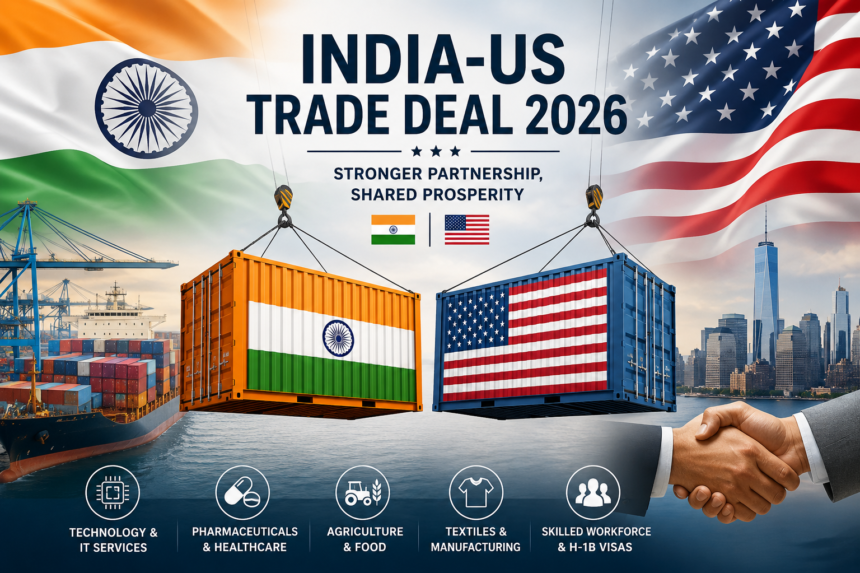
India-US Trade Deal 2026, The India-US bilateral trade relationship stands at a defining crossroads in 2026. The United States — India’s single largest trading partner — and India are currently engaged in intensive negotiations toward a comprehensive bilateral trade agreement. If finalised, this could become one of the most significant trade deals signed by either country in recent years.
These negotiations are taking place against the backdrop of rising US tariff pressures, India’s expanding global trade ambitions, and the broader geopolitical push to strengthen India-US economic ties. As a result, the stakes are exceptionally high for both economies.
Therefore, understanding the India-US trade negotiations is essential for Indian businesses, exporters, professionals, investors, and consumers alike.
Current State of India-US Trade in 2026
Trade Volumes and Composition
India-US Trade Deal 2026, India and the United States now share their largest-ever bilateral trade relationship.
Key Trade Figures
- Total bilateral trade: USD 190 billion in FY2025-26
- India’s exports to the US: USD 87 billion
- India’s imports from the US: USD 43 billion
- India’s trade surplus with the US: Approximately USD 44 billion
India’s major exports to the United States include:
- Pharmaceuticals
- IT and technology services
- Textiles and garments
- Engineering goods
- Gems and jewellery
Meanwhile, India imports the following major products from the US:
- Defence equipment
- Crude oil and LNG
- Semiconductors
- Industrial machinery
- High-end technology products
The large trade surplus India enjoys with the United States remains one of Washington’s primary concerns during negotiations.
Key Sectoral Trade Relationships
IT Services
India exports more than USD 45 billion worth of IT services to the US every year, making technology services the single largest component of bilateral trade. Indian IT companies remain deeply dependent on the American market.
Pharmaceuticals
India is the largest supplier of generic medicines to the United States and accounts for over 40% of the US generic drug market. Indian pharmaceutical exports play a critical role in keeping healthcare costs affordable for American consumers.
Textiles and Garments
India’s textile exports to the US have expanded steadily as global companies attempt to reduce dependence on Chinese manufacturing. This shift has created major opportunities for Indian textile manufacturers.
Defence Trade
The United States has also emerged as an increasingly important defence supplier for India. American defence exports now include drones, fighter aircraft platforms, logistics systems, surveillance technologies, and advanced military equipment.
What India Wants From the Trade Deal
H-1B Visa Reform and Skilled Worker Access
One of India’s most politically and economically important demands is improved access for Indian skilled workers in the United States.
India sends the largest number of H-1B visa holders to the US, especially in the technology and healthcare sectors. Consequently, India wants:
- Faster H-1B processing
- Greater visa certainty
- Reduced restrictions on skilled migration
- Easier mobility for Indian professionals
Any improvement in visa access would significantly benefit India’s IT sector and hundreds of thousands of Indian professionals working in the United States.
Preferential Market Access for IT Services
India is also seeking stronger protections and guaranteed market access for its IT service providers.
Specifically, India wants the US to address:
- “Buy American” restrictions
- State-level outsourcing barriers
- Unequal access to government technology contracts
A trade agreement that guarantees fair treatment for Indian IT companies would protect India’s most valuable export industry.
Pharmaceutical Market Access
India wants smoother FDA approvals for Indian drug manufacturers and protection from punitive tariffs on pharmaceutical exports.
At the same time, India seeks resolution of long-standing intellectual property disputes that have periodically disrupted pharma trade relations between the two countries.
Since Indian generic medicines help reduce healthcare costs in the United States, India argues that easier pharmaceutical trade benefits both nations.
Restoration of GSP Benefits
India also wants the restoration of the Generalized System of Preferences (GSP), which the US terminated in 2019.
Under the earlier GSP arrangement, many Indian exports entered the US market duty-free. Restoring these benefits — or creating a similar preferential tariff structure — remains one of India’s major objectives in the negotiations.
What the United States Wants From India
Agricultural Market Access
Agriculture remains one of the most sensitive areas of negotiation.
The US wants India to reduce tariffs on:
- Dairy products
- Poultry
- Apples
- Almonds
- Soybeans
- Other American farm products
Currently, India imposes very high tariffs on several agricultural imports, especially dairy products.
However, this issue is politically explosive in India because agriculture supports hundreds of millions of livelihoods. Any perception that foreign agricultural imports could harm Indian farmers would generate major political opposition.
E-Commerce and Digital Trade
American technology companies are pushing for greater access to India’s rapidly growing digital economy.
The US wants India to:
- Ease data localisation requirements
- Open e-commerce markets further
- Reduce regulatory barriers for US digital platforms
- Avoid policies that favour domestic tech firms
India’s evolving digital governance framework, including the Digital Personal Data Protection Act, has become a significant discussion point during negotiations.
Intellectual Property Protection
The US pharmaceutical industry has repeatedly demanded stronger patent protections in India.
In particular, American companies want India to:
- Restrict compulsory licensing provisions
- Strengthen patent enforcement
- Expand recognition of pharmaceutical patents
India, however, has historically prioritised affordable access to medicines. Therefore, balancing public healthcare needs with intellectual property commitments remains one of the most difficult parts of the negotiations.
Reduction of Tariffs on American Goods
The US also wants India to lower tariffs on a wide range of manufactured products, including:
- Automobiles
- Motorcycles
- Electronics
- Machinery
- Industrial goods
American officials frequently argue that India’s tariff structure remains significantly higher than US tariffs on Indian imports.
Impact on Key Indian Sectors
IT and Technology Services — Major Opportunity
India-US Trade Deal 2026, A successful trade agreement could become a major boost for India’s USD 250 billion-plus IT and technology sector.
Companies such as:
- Tata Consultancy Services
- Infosys
- Wipro
- HCL Technologies
- Tech Mahindra
would benefit significantly from reduced uncertainty and better access to the US market.
Improved visa rules and guaranteed market access could strengthen India’s dominance in global IT outsourcing.
Pharmaceuticals — Optimism With Caution
India’s pharmaceutical industry stands to benefit from easier access to the US market. However, stricter intellectual property commitments could limit India’s ability to manufacture affordable generic medicines.
As a result, India faces a delicate balancing act between:
- Protecting public healthcare access
- Supporting domestic pharma manufacturing
- Meeting US patent protection demands
This will likely remain one of the toughest negotiation areas.
Agriculture — India’s Defensive Priority
India is expected to strongly defend its agricultural sector during negotiations.
Opening domestic markets too aggressively to American farm products could create economic stress for Indian farmers and trigger political backlash.
Therefore, India will likely continue protecting sensitive agricultural sectors such as:
- Dairy
- Grains
- Poultry
- Fruits and food products
Textiles and Manufacturing — Significant Potential
India’s textile and garment industry could emerge as one of the biggest beneficiaries of a trade deal.
As the US continues reducing dependence on Chinese manufacturing, Indian textile exporters are gaining strategic importance.
If Indian textiles receive preferential tariff access in the US market, the sector could experience:
- Higher exports
- Increased manufacturing investment
- Job creation
- Greater global competitiveness
India already possesses a strong cost and quality advantage in cotton textiles and apparel manufacturing.
What Indian Consumers Can Expect
India-US Trade Deal 2026, If the trade agreement is finalised successfully, Indian consumers could see several noticeable changes.
Potential Benefits
- Lower prices on American electronics and consumer goods
- Better access to imported technology products
- Increased product variety in food and agriculture
- More competitively priced imported vehicles
Possible Challenges
At the same time, increased foreign competition could place pressure on certain domestic industries. This may affect pricing and profitability for some Indian manufacturers.
Therefore, the final structure of tariff concessions will determine how consumers and industries are impacted.
The Geopolitical Importance of the India-US Trade Deal
The India-US trade negotiations are not occurring in isolation. Instead, they are part of a much larger geopolitical realignment.
The United States increasingly sees India as a reliable strategic and economic partner capable of reducing global dependence on China. Meanwhile, India wants to strengthen ties with major economies while maintaining strategic autonomy.
A successful trade agreement would:
- Deepen the India-US strategic partnership
- Accelerate supply chain diversification away from China
- Increase American investment into India
- Improve India’s access to advanced US technology
- Strengthen India’s position in global manufacturing networks
- Create momentum for future trade agreements with the EU and UK
Consequently, the agreement carries significance far beyond simple tariff reductions.
Read More: RI Investment in India 2026: Complete Guide to Banking, Property, Tax & Mutual Funds
Conclusion
India-US Trade Deal 2026, A carefully negotiated India-US trade agreement could become one of the most important economic developments for India in the coming decade.
The deal has the potential to:
- Expand India’s access to the world’s largest consumer market
- Strengthen India’s role in global supply chains
- Deepen strategic ties with the United States
- Increase exports, investment, and technology cooperation
However, India must also ensure that the agreement protects its farmers, workers, public healthcare system, and domestic industries.
The success of the negotiations will ultimately depend on whether both countries can strike a balance between market access and national economic interests.
As trade talks continue, the outcome will shape not only the future of India-US economic relations but also India’s broader position in the evolving global economic order.