
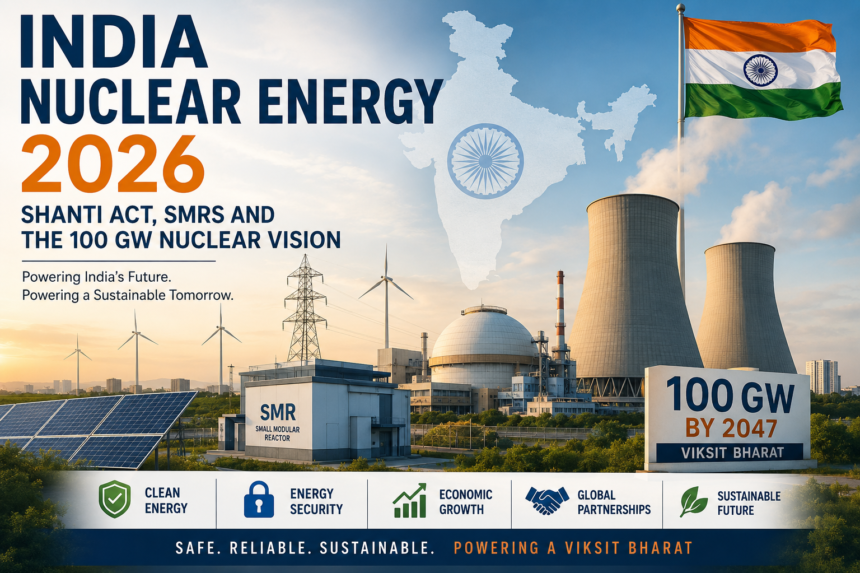
India Nuclear Energy 2026, India’s nuclear energy sector is undergoing its most fundamental transformation in decades. The SHANTI Act — Sustainable Harnessing and Advancement of Nuclear Energy for Transforming India — enacted in 2025, has repealed decades-old restrictions that effectively kept nuclear energy as an exclusive state monopoly.
For the first time, private Indian companies and foreign investors can participate directly in India’s nuclear sector. Consequently, this marks a seismic policy shift that could dramatically accelerate India’s progress toward its ambitious 100 GW nuclear energy target by 2047.
Today, nearly 75% of India’s electricity generation still depends on coal and fossil fuels. At the same time, India has committed to achieving net-zero emissions by 2070. Therefore, under the evolving India nuclear energy policy, nuclear energy is no longer optional for India’s energy transition. Instead, it is increasingly viewed as an essential source of reliable, zero-carbon baseload power.
This comprehensive guide explains India’s nuclear energy strategy in 2026, the impact of the SHANTI Act, the role of Small Modular Reactors (SMRs), and what these developments mean for India’s energy security and climate commitments.
India’s Current Nuclear Capacity and the Scale of Ambition
India currently operates 24 nuclear reactors with a total installed capacity of approximately 8,880 MW. Despite decades of development, nuclear energy still contributes only around 3-4% of India’s total electricity generation.
However, the government’s long-term ambitions are enormous.
India plans to increase nuclear capacity to 22,480 MW by 2031-32 and eventually reach 100 GW by 2047 as part of the Viksit Bharat vision. Achieving this target would require a nearly tenfold expansion from today’s installed capacity.
To understand the scale of this challenge, India would effectively need to add the equivalent of its current entire nuclear fleet every three to four years for the next two decades.
India’s Nuclear Energy Targets
- Current nuclear capacity: 8,880 MW across 24 reactors
- Target by 2031-32: 22,480 MW
- Target by 2047: 100 GW
- Current contribution to electricity generation: 3-4%
- Expected contribution by 2047: Nearly 25% of total electricity generation
Recent milestones already demonstrate India’s growing manufacturing and engineering capability.
Three indigenous 700 MWe Pressurised Heavy Water Reactors (PHWRs) were commissioned in consecutive years:
- KAPP-3 in June 2023
- KAPP-4 in March 2024
- RAPP-7 in April 2025
As a result, India’s nuclear electricity generation has increased by nearly 60% over the past decade.
The SHANTI Act 2025: India’s Nuclear Revolution
India Nuclear Energy 2026, The SHANTI Act is the most significant reform of India’s nuclear sector since the Atomic Energy Act of 1962. More importantly, it fundamentally changes who can participate in India’s nuclear ecosystem.
What the SHANTI Act Changes
Private Sector Entry
Indian private companies can now build, own, and operate nuclear power plants. Previously, only Department of Atomic Energy (DAE) entities and government-controlled organisations were permitted to operate nuclear facilities.
Foreign Investment Access
Foreign companies are now allowed to invest in nuclear equipment manufacturing and material supply chains. Earlier, liability concerns and restrictive laws discouraged international participation.
Civil Liability Reform
The earlier Civil Liability for Nuclear Damage Act (CLNDA) of 2010 imposed supplier liability provisions that alarmed Western technology providers for more than a decade.
Under the SHANTI framework, these provisions have been rationalised, making India a far more attractive destination for international nuclear partnerships.
Fast-Track Approval for SMRs
The Act also creates a dedicated regulatory pathway for Small Modular Reactors (SMRs). Consequently, approval timelines and commercial deployment processes are expected to become significantly faster.
Private Participation in the Fuel Cycle
Private companies can now participate in:
- Uranium mining
- Fuel fabrication
- Nuclear waste management
- Supply-chain manufacturing
This change could create an entirely new industrial ecosystem around India’s nuclear sector.
Why Private Sector Participation Matters
India Nuclear Energy 2026, India’s Department of Atomic Energy and NPCIL alone cannot realistically deliver 100 GW of nuclear capacity within two decades.
The scale of investment required is enormous. In addition, the engineering workforce, project management capability, manufacturing capacity, and financing needs far exceed what the public sector can manage independently.
Therefore, private participation is essential for several reasons:
- Faster project execution
- Access to private capital
- Technology partnerships with global firms
- Improved operational efficiency
- Domestic manufacturing expansion
Without private participation, India’s 2047 nuclear target would likely remain unattainable.
Small Modular Reactors (SMRs): The Game-Changer
Small Modular Reactors are emerging as one of the most important technologies in the future of global nuclear energy.
What Are SMRs?
SMRs are nuclear reactors with an electrical output of less than 300 MWe. In contrast, conventional nuclear reactors typically generate between 700 MWe and 1,600 MWe.
Unlike traditional reactors, SMRs are designed for factory-based manufacturing and modular assembly. Components can be manufactured centrally and transported to project sites for faster installation.
As a result, SMRs offer several advantages:
- Lower upfront capital cost
- Faster construction timelines
- Improved scalability
- Enhanced safety systems
- Deployment flexibility in remote regions
They are particularly useful for:
- Industrial clusters
- Islands and remote regions
- Grid-constrained states
- Heavy manufacturing hubs
- Hydrogen production facilities
India’s SMR Development Programme
India is actively developing indigenous SMR technologies through the Department of Atomic Energy and BARC (Bhabha Atomic Research Centre).
AHWR: India’s Thorium-Based Reactor
The Advanced Heavy Water Reactor (AHWR) is India’s flagship 300 MWe thorium-based reactor design.
This project is strategically important because India possesses one of the world’s largest thorium reserves. Therefore, thorium-based reactors could eventually reduce India’s long-term dependence on imported uranium.
CANDU-Based Adaptations
India is also exploring SMR designs derived from Canada’s CANDU technology, which aligns well with India’s existing heavy-water reactor infrastructure.
International Technology Partnerships
Following the SHANTI Act reforms, several international companies are now in discussions with Indian entities regarding SMR collaboration, including:
- Rolls-Royce (UK)
- GE-Hitachi (USA)
- NuScale Power (USA)
Additionally, partnerships with South Korean and Japanese firms are being explored under the new policy framework.
India’s Three-Stage Nuclear Programme
India’s nuclear strategy is unique because it is specifically designed around the country’s vast thorium reserves.
India is estimated to possess nearly 650,000 tonnes of thorium reserves — among the largest in the world.
Stage 1: PHWRs Using Natural Uranium
India has already mastered the first stage using Pressurised Heavy Water Reactors fuelled by natural uranium.
Stage 2: Fast Breeder Reactors
The second stage focuses on Fast Breeder Reactors (FBRs), which use plutonium extracted from spent nuclear fuel.
The Prototype Fast Breeder Reactor (PFBR) at Kalpakkam is approaching first criticality and represents a major milestone for India’s nuclear ambitions.
Stage 3: Thorium-Based Reactors
The final stage involves Advanced Heavy Water Reactors using thorium fuel.
Once commercialised at scale, this stage could provide India with long-term energy independence based largely on domestic resources.
Importantly, no other major country has pursued a thorium-focused nuclear roadmap with comparable strategic commitment.
Nuclear Safety in India: Is It Safe?
Safety remains the most important public concern regarding nuclear expansion. However, India’s nuclear safety record has been relatively strong.
India has operated nuclear reactors since 1969 without experiencing a major nuclear accident.
Key Nuclear Safety Measures
Stronger Regulatory Independence
The SHANTI Act strengthens the independence of the Atomic Energy Regulatory Board (AERB) from the Department of Atomic Energy.
This separation improves transparency and governance standards.
International Safety Standards
Indian nuclear facilities follow International Atomic Energy Agency (IAEA) safety standards and protocols.
Passive Safety Systems
Modern reactors include passive safety systems that can automatically shut down reactors without human intervention or external electricity supply.
Strategic Plant Siting
Most Indian nuclear facilities are located away from dense urban populations and include comprehensive emergency planning zones.
Nuclear Energy vs Renewable Energy: Complementary, Not Competitive
A common misconception portrays nuclear energy and renewable energy as competing technologies.
In reality, both are essential for India’s long-term energy transition.
Why Renewables Alone Are Not Enough
Solar and wind power are inherently intermittent. Electricity generation depends on weather conditions, daylight availability, and seasonal variations.
Although battery storage technology is improving, grid-scale storage at India’s required scale remains extremely expensive.
Nuclear Provides Baseload Reliability
Nuclear power plants operate at capacity factors of nearly 80-90% throughout the year.
Therefore, they provide stable round-the-clock electricity generation regardless of weather conditions.
India’s 2047 Energy Mix
India’s future energy system will likely require:
- Solar and wind for daytime renewable generation
- Nuclear energy for 24/7 baseload power
- Pumped hydro and batteries for short-term storage
- Green hydrogen for industrial decarbonisation and seasonal storage
Together, these technologies form a complementary energy ecosystem rather than competing alternatives.
International Partnerships Driving India’s Nuclear Expansion
India Nuclear Energy 2026, India’s nuclear ambitions are increasingly supported through international cooperation.
United States
The India-US Civil Nuclear Agreement, commonly called the 123 Agreement, enables technology transfer and fuel supply cooperation.
Companies such as GE-Hitachi and Westinghouse are in discussions regarding advanced reactor deployment in India.
France
EDF is engaged in advanced negotiations for six EPR reactors at Jaitapur in Maharashtra.
If completed, Jaitapur would become the world’s largest nuclear power project.
Russia
Russia remains India’s most consistent nuclear technology partner.
Kudankulam Units 5 and 6 are currently under construction with Russian collaboration.
Canada
India’s PHWR technology has strong historical links with Canadian CANDU reactor designs, making future cooperation strategically valuable.
South Korea and Japan
Both countries are emerging as potential SMR technology and manufacturing partners under the post-SHANTI framework.
Challenges India Still Faces
Despite major policy reforms, significant challenges remain.
High Capital Costs
Nuclear plants require enormous upfront investment and long construction timelines.
Public Opposition
Land acquisition and safety concerns continue to create resistance in several regions.
Waste Management
Long-term nuclear waste storage remains a global challenge, including for India.
Skilled Workforce Requirements
India will require a massive expansion of nuclear engineers, technicians, safety experts, and specialised manufacturers.
However, the SHANTI Act is expected to accelerate solutions to many of these challenges by expanding private-sector participation.
Read More: Green Hydrogen India 2026: Mission, Projects, Investment and Future Growth
Conclusion
India Nuclear Energy 2026, India cannot realistically achieve net-zero emissions by 2070 without a major expansion of nuclear energy.
The numbers are increasingly clear. Renewable energy alone cannot provide the continuous baseload electricity, industrial heat, and energy security required for a future multi-trillion-dollar Indian economy.
The SHANTI Act represents the most important structural reform in India’s nuclear sector in more than six decades. By opening the sector to private and foreign participation, India is laying the foundation for rapid nuclear expansion over the next twenty years.
The 100 GW target is undoubtedly ambitious. Nevertheless, India’s renewable energy growth over the past decade demonstrates that seemingly impossible energy transitions can become achievable with the right policy framework, financing, and industrial capability.
As India moves toward its Viksit Bharat vision, nuclear energy is likely to become one of the defining pillars of the country’s long-term energy security and climate strategy.
Anjali Verma is the voice of authority at Taza Newsz for national affairs and sports. A fearless journalist with a background in political science, she has spent the last 12 years covering state elections, parliamentary sessions, and major sporting events across the country. Anjali excels at connecting the dots between policy decisions and their ground-level reality. Her dual passion for democracy and cricket allows her to switch seamlessly between analyzing election manifestos and dissecting the Indian cricket team's strategy for the World Cup. Her reporting is defined by accuracy, neutrality, and a deep respect for the facts. Outside the newsroom, Anjali is a marathon runner and an advocate for women in sports. | View all posts