
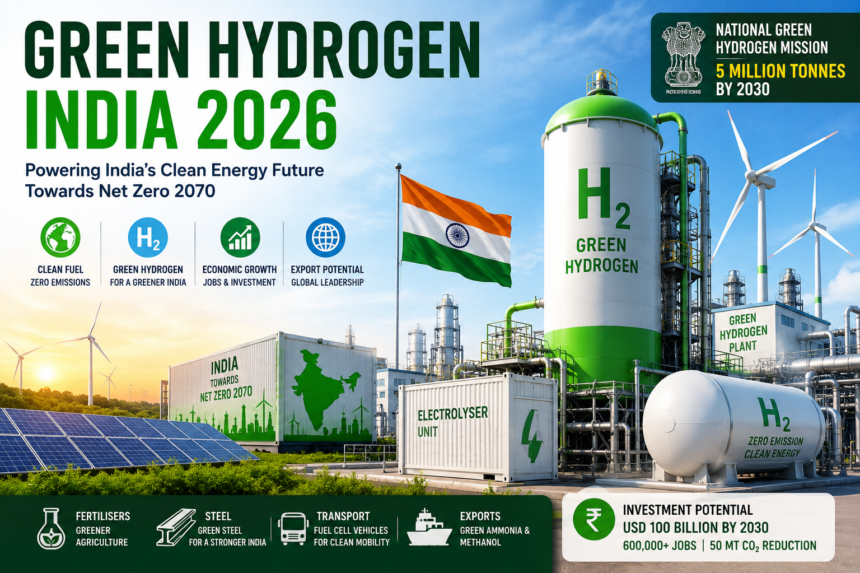
Green Hydrogen India 2026 — hydrogen produced by splitting water using electricity from renewable sources — could be the fuel that completes India’s clean energy transition. While solar and wind can decarbonise electricity generation, they cannot easily replace fossil fuels in industries like steel, cement, fertilisers, and long-distance shipping. Green hydrogen can. It burns cleanly, produces only water as a byproduct, can be stored and transported, and can replace coal and natural gas in the most emissions-intensive industrial processes.
What Is Green Hydrogen and Why Does It Matter?
Types of Hydrogen by Production Method
- Green hydrogen: Produced by electrolyser splitting water using renewable electricity — zero emissions. The target.
- Blue hydrogen: Produced from natural gas with carbon capture and storage (CCS) — low but not zero emissions
- Grey hydrogen: Produced from natural gas without CCS — high emissions. Current dominant form globally.
- Pink hydrogen: Produced using nuclear electricity — zero emissions but currently expensive
Why Green Hydrogen Is Strategic for India
India currently produces approximately 6 million tonnes of hydrogen annually — almost entirely grey hydrogen from fossil fuels, used in fertiliser production and petroleum refining. Replacing this grey hydrogen with green hydrogen alone would eliminate a significant chunk of India’s industrial emissions. Beyond domestic use, India has the potential to become a major green hydrogen exporter to energy-hungry nations in Europe, Japan, and South Korea that cannot produce enough domestically.
- India’s advantage: Abundant solar and wind resources — cheapest renewable electricity in the world makes green hydrogen economically viable
- Export opportunity: Green hydrogen valued at USD 500 billion globally by 2050 — India could capture 10%
- Job creation: Green sector projected to generate 50 million jobs by 2070 — hydrogen sector significant contributor
National Green Hydrogen Mission: Key Targets and Timeline
Green Hydrogen India 2026, India’s National Green Hydrogen Mission was approved by the Cabinet in January 2023 and is now in active implementation phase in 2026. Key targets:
- Production target: 5 million tonnes of green hydrogen per year by 2030
- Electrolyser manufacturing: 5 GW of domestic electrolyser manufacturing capacity by 2030
- Investment mobilisation: Rs 8 lakh crore (USD 100 billion) of total investment by 2030
- Export target: India to become a top exporter of green hydrogen and its derivatives (ammonia, methanol)
- Employment: 600,000 direct jobs by 2030 in green hydrogen sector
- CO2 reduction: 50 million tonnes of CO2 emissions reduced annually by 2030
Major Green Hydrogen Projects in India 2026
Adani Green Energy — Largest Renewable Energy Developer
Adani Green Energy has committed to producing 1 million tonnes of green hydrogen per year as part of its massive renewable energy expansion. The group is developing integrated solar-wind-electrolyser complexes in Rajasthan and Gujarat — leveraging India’s best renewable resources in these sunshine-rich states. Adani New Industries is manufacturing electrolysers domestically — the key equipment for green hydrogen production.
Reliance Industries — Green Hydrogen and Giga-Factory
Reliance Industries committed USD 10 billion to its new energy business, with green hydrogen as a central pillar. The company is developing a fully integrated green hydrogen ecosystem at its Jamnagar complex in Gujarat — solar panels, wind turbines, electrolysers, fuel cells, and hydrogen storage in a single integrated facility. Reliance’s ambition is to produce green hydrogen at USD 1 per kg by 2030 — the global cost target that makes it competitive with grey hydrogen.
NTPC — Public Sector Green Hydrogen Push
NTPC, India’s largest power company, is developing green hydrogen projects at multiple locations. The NTPC green hydrogen pilot at Leh (Ladakh) — supplying fuel cell buses — is India’s first operational green hydrogen mobility project. NTPC is also developing offshore wind-linked hydrogen projects and supplying green hydrogen to fertiliser plants.
ONGC, IOC, BPCL — Oil Companies Pivoting
India’s major oil and gas companies are investing in green hydrogen as part of their energy transition strategies. IOC’s green hydrogen pilot at Mathura refinery, BPCL’s hydrogen-CNG blend projects, and ONGC’s offshore hydrogen plans are all underway — reflecting the broader transition of fossil fuel majors into energy transition companies.
Green Hydrogen Applications in India
Fertilisers — The Biggest Near-Term Market
India’s fertiliser industry consumes approximately 5 million tonnes of hydrogen annually — almost entirely grey hydrogen derived from natural gas. Replacing this with green hydrogen would eliminate one of India’s largest industrial emission sources and also reduce dependence on imported natural gas for fertiliser production. The government is piloting green hydrogen supply to fertiliser plants under the Green Hydrogen Consumption Mandate.
Steel Industry
Green hydrogen can replace coking coal in the steel manufacturing process — producing ‘green steel’ with dramatically lower emissions. Tata Steel and JSW Steel are both exploring hydrogen-based steelmaking. Green steel commands premium prices from European buyers under EU carbon border adjustment mechanisms — creating an export premium for India’s steel industry if it transitions early.
Transportation — Fuel Cell Vehicles and Buses
Green hydrogen fuel cell vehicles emit only water vapour and are particularly suited for heavy transport — buses, trucks, and trains where battery weight is prohibitive. NTPC’s Leh fuel cell bus project is India’s operational pilot. Hydrogen-powered trains are being explored for routes with high gradient and limited electrification feasibility.
Export — Ammonia and Methanol
Shipping pure hydrogen internationally is technically complex. Instead, green hydrogen can be converted to green ammonia (used in fertilisers and as a hydrogen carrier) or green methanol — both of which are easier to transport as liquids. India’s green ammonia export potential — particularly to Japan, South Korea, and Europe — is enormous and already being explored through bilateral energy agreements.
Challenges India Must Overcome
- Cost competitiveness: Green hydrogen is currently 3-4x more expensive than grey — massive scale and technology improvement needed
- Water availability: Electrolysis requires significant water — challenging in India’s water-stressed regions where solar resources are best
- Infrastructure: Hydrogen pipelines, storage, and distribution infrastructure is largely absent — requires massive investment
- Safety regulation: Hydrogen is highly flammable — robust safety standards and trained workforce required
- International competition: Australia, Chile, Saudi Arabia, and Middle East also targeting green hydrogen export — competition is intense
Green Hydrogen Production Cost: The Economics
Green Hydrogen India 2026, The central challenge for green hydrogen is cost. Currently, green hydrogen in India costs approximately USD 4-6 per kilogram to produce — compared to USD 1-1.5 per kilogram for grey hydrogen from natural gas. For green hydrogen to compete commercially, this cost must fall to USD 1-2 per kilogram — the ‘green hydrogen parity’ target.
How India Can Achieve USD 1 Per Kg
- Solar electricity cost: Already below Rs 2 per unit in India — among the lowest globally. Further cost reductions continue.
- Electrolyser cost reduction: Mass manufacturing of electrolysers will reduce costs by 50-70% by 2030 — India’s domestic manufacturing push accelerates this
- Scale: Larger projects achieve lower production costs — India’s GW-scale projects drive economies of scale
- Technology improvement: Alkaline and PEM electrolysers are becoming more efficient — more hydrogen per unit of electricity
NITI Aayog projects that India could achieve green hydrogen production at USD 1 per kilogram by 2030 — making it competitive with grey hydrogen and potentially the world’s cheapest green hydrogen producer.
Read More: India Semiconductor Mission 2026: Can India Become a Global Chip Manufacturing Powerhouse?
Conclusion
Green Hydrogen India 2026, India’s green hydrogen mission represents one of the most ambitious clean energy initiatives in the world — and one that aligns perfectly with India’s unique advantages: abundant solar and wind resources, existing chemical and engineering expertise, a large domestic demand base, and the economic incentive of reducing fossil fuel imports. If India executes successfully, it could be producing the world’s cheapest green hydrogen by 2030 — transforming not just its energy sector but its export economy.
Taza Newsz covers India’s energy transition, green hydrogen developments, renewable energy news, and climate policy. Follow us for the latest from India’s clean energy revolution.