
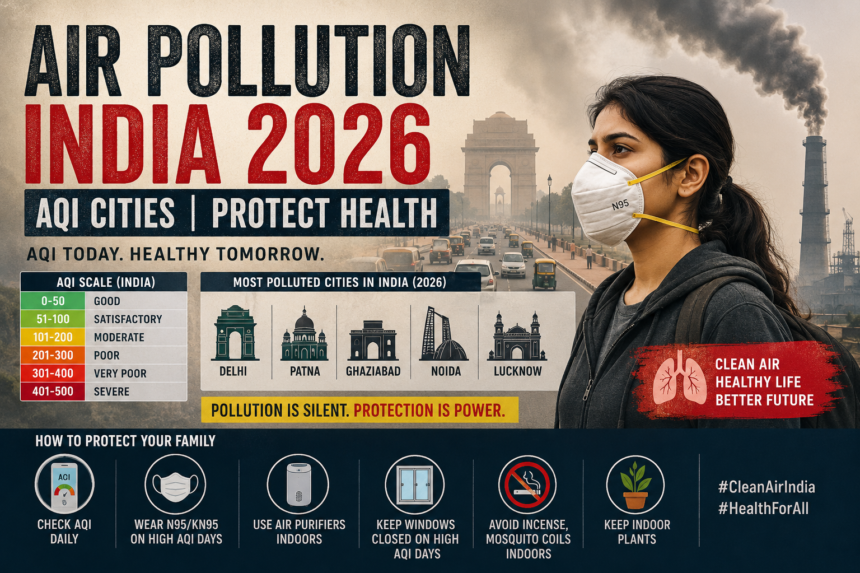
Air Pollution India 2026 AQI Cities Protect Health, India’s air quality crisis is one of the most devastating and under-addressed public health emergencies in the world. In 2026, nine of the world’s twenty most polluted cities are in India. Air pollution is responsible for an estimated 2 million premature deaths in India every year — more than tobacco, more than traffic accidents, and more than any single infectious disease. Yet for most Indians, checking the AQI before stepping outside remains an afterthought, and the health impacts of breathing polluted air are deeply underestimated.
This comprehensive guide covers India’s air quality situation in 2026, today’s AQI levels for major cities, the health impacts of prolonged exposure to polluted air, and practical, evidence-based steps every Indian family can take to protect themselves — regardless of whether their city has clean or polluted air.
What Is AQI and Why Does It Matter?
AQI stands for Air Quality Index — a standardised scale that measures how clean or polluted the air is and what associated health effects might be of concern. India’s National AQI scale, maintained by the Central Pollution Control Board (CPCB), runs from 0 to 500 and is divided into six categories:
- 0-50 (Good): Air quality is satisfactory; little or no risk
- 51-100 (Satisfactory): Acceptable; minor discomfort possible for sensitive groups
- 101-200 (Moderate): Breathing discomfort possible for sensitive groups — asthma, heart disease
- 201-300 (Poor): Breathing discomfort to most people on prolonged exposure
- 301-400 (Very Poor): Respiratory illness on prolonged exposure; heart disease patients affected
- 401-500 (Severe): Affects even healthy people; serious risk to those with existing disease
Most Polluted Cities in India: 2026 Rankings
Delhi: The Capital’s Chronic Crisis
Delhi consistently ranks among the world’s most polluted cities and remains India’s most severe air quality emergency. The combination of vehicle emissions from over 13 million registered vehicles, industrial activity, crop burning in Punjab and Haryana (particularly October-November), construction dust, and geographical factors (lack of wind, temperature inversions) creates a lethal cocktail. Winter AQI in Delhi regularly reaches 400-500+ — the Severe category — for weeks at a time.
In summer 2026, Delhi’s AQI is somewhat improved from winter peaks but still regularly exceeds 150-200 (Moderate to Poor) on most days. The Delhi government’s odd-even vehicle rationing scheme, the Graded Response Action Plan (GRAP), and the push toward electric buses are steps in the right direction — but progress is painfully slow relative to the crisis.
Other Severely Polluted Indian Cities in 2026
- Patna (Bihar): Consistently high AQI due to brick kilns, vehicle emissions, and crop burning
- Muzaffarpur: One of India’s most polluted smaller cities — industrial and agricultural burning
- Ghaziabad and Noida (Delhi NCR): Industrial corridor and construction activity
- Faridabad and Gurugram: Vehicle pollution and industrial emissions
- Lucknow: Rapidly growing city with worsening air quality
- Kolkata: Vehicle emissions and industrial pollution from Howrah
Relatively Better Air Quality Cities
- Chennai: Sea breeze provides natural dispersion; better AQI than north India
- Mumbai: Coastal location and sea winds help; but AQI still often Moderate during winter
- Shimla, Coorg, Ooty: Hill stations with consistently good AQI — popular among health-conscious urbanites
Major Pollutants: What Is Actually in India’s Air?
PM2.5 — The Most Dangerous Pollutant
Particulate Matter 2.5 micrometres (PM2.5) is the most damaging air pollutant for human health. These microscopic particles — smaller than 1/30th the diameter of a human hair — bypass the body’s natural defenses and penetrate deep into the lungs and bloodstream. PM2.5 from India’s air has been linked to lung cancer, heart attacks, strokes, diabetes, and reduced cognitive function in children.
PM10 — Coarse Particles
PM10 particles (2.5-10 micrometres) come from road dust, construction, and industrial sources. They are less dangerous than PM2.5 but contribute significantly to respiratory symptoms and aggravate asthma and COPD.
NO2, SO2, and Ozone
Nitrogen dioxide (from vehicles and industry), sulphur dioxide (from coal burning and industry), and ground-level ozone (formed by chemical reactions in sunlight) are all significant components of India’s urban air pollution, each causing distinct health impacts from respiratory irritation to long-term lung damage.
Health Impacts of Air Pollution on Indians
- Children: Impaired lung development, increased asthma risk, reduced cognitive function and IQ scores
- Pregnant women: Increased risk of premature birth, low birth weight, and gestational complications
- Elderly: Dramatically increased risk of heart attacks, strokes, and respiratory failure on high AQI days
- People with asthma: Severe exacerbation risk; attacks can be life-threatening during Severe AQI days
- Long-term healthy adults: Chronic exposure increases lifetime risk of lung cancer, COPD, heart disease, and stroke
How to Check AQI in India: Best Apps and Websites
- SAMEER app (by CPCB): India’s official AQI app with real-time data from government monitoring stations
- AQI India (aqicn.org): Comprehensive real-time AQI map for Indian cities
- IQAir: Global air quality platform with India city data and health recommendations
- AccuWeather and Weather apps: Now routinely include AQI in their forecasts
Practical Steps to Protect Your Family from Air Pollution
Indoor Air Quality — Often Worse Than Outdoors
Surprisingly, indoor air quality in Indian homes is often worse than outdoor air — cooking smoke from gas stoves, incense, mosquito coils, cleaning products, and furniture off-gassing all contribute. Key steps to improve indoor air quality:
- Ventilate kitchens well — use exhaust fans while cooking and keep windows open where outdoor AQI permits
- Use air purifiers with HEPA filters in bedrooms — particularly for children and elderly family members
- Avoid burning incense sticks, agarbatti, or dhoop indoors in closed rooms
- Switch to induction cooking or well-ventilated gas cooking — reduces indoor PM2.5 significantly
- Indoor plants (money plant, snake plant, peace lily) provide modest air purification benefit
Outdoor Protection
- Check AQI every morning before outdoor activities — SAMEER app is free and reliable
- On AQI 200+ days: Reduce outdoor exercise; avoid morning walks (pollution peaks before noon)
- On AQI 300+ days: Stay indoors as much as possible; keep windows closed
- Wear N95 or KN95 masks on high AQI days — not cloth masks which do not filter PM2.5
- Avoid outdoor exercise near busy roads — pollution levels are highest within 150 metres of heavy traffic
Government Action on Air Pollution in 2026
Air Pollution India 2026 AQI Cities Protect Health, India has the National Clean Air Programme (NCAP) targeting a 40% reduction in PM2.5 levels in 131 cities by 2026. Progress has been uneven — some cities have shown improvement, others have worsened. Key government initiatives include:
- BS-VI fuel and vehicle emission standards: Significantly cleaner vehicle emissions since 2020
- Push for electric vehicles: FAME III scheme supporting EV adoption to reduce vehicle emissions
- Industrial emission norms: Stricter standards for thermal power plants and industrial units
- Stubble burning solutions: Subsidy for happy seeder machines to reduce crop burning in Punjab and Haryana
Read More: India Water Crisis 2026 Cities Running Out of Water: Full State-by-State Report
Conclusion
Air Pollution India 2026 AQI Cities Protect Health — It requires sustained policy action, industrial transformation, agricultural reform, and urban planning over decades. But while that happens, every Indian family can make choices that meaningfully reduce their exposure and health risk. Check the AQI. Use an air purifier. Wear the right mask. Support clean energy and public transport.
Taza Newsz covers India’s environmental news, daily AQI updates, pollution policy, and health guidance comprehensively. Follow us for the information you need to make healthier choices for you and your family.