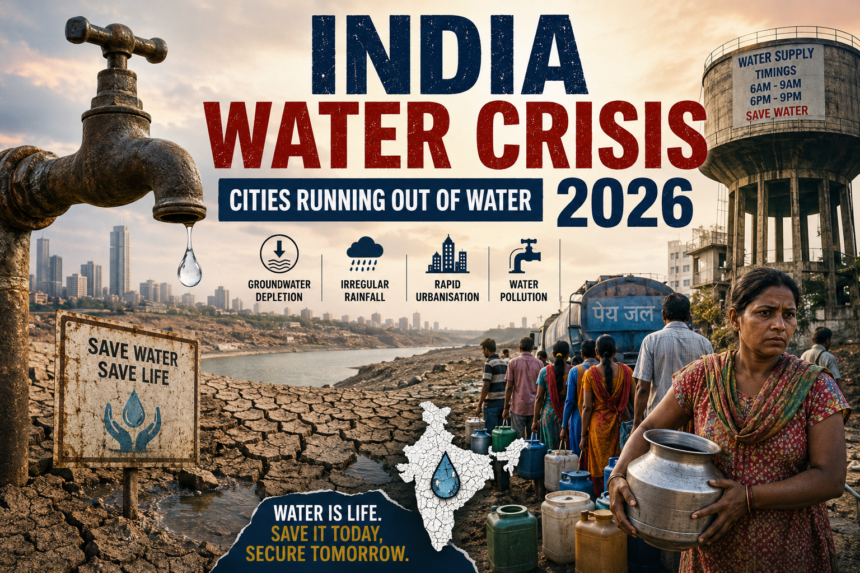
India Water Crisis 2026 Cities Running Out of Water, India is facing one of its most serious water security crises in recorded history. In the summer of 2026, multiple major cities are experiencing acute water shortages, groundwater depletion has reached critical levels across entire states, and millions of rural Indians still lack access to safe piped drinking water. At the same time, extreme weather events — prolonged droughts in some regions and devastating floods in others — are making water management more unpredictable and urgent than ever before.
This is not a future problem — it is happening right now, in the cities and villages where millions of Indians live, work, and depend on reliable water access for their daily survival. This comprehensive guide covers India’s water crisis in 2026: which cities are most affected, what is causing the crisis, what the government is doing, and practical steps every Indian household and community can take to be part of the solution.
India’s Water Crisis: The Numbers
- India has 18% of the world’s population but only 4% of its freshwater resources
- Over 600 million Indians face high to extreme water stress, according to Niti Aayog
- 21 major Indian cities including Delhi, Bengaluru, Chennai, and Hyderabad are expected to run out of groundwater in the coming decade without intervention
- Groundwater levels have declined by 61% over the past decade in key agricultural states
- India extracts 25% of the world’s groundwater — more than any other country
- Only 25% of wastewater in India is treated before being discharged into rivers or land
Most Water-Stressed Cities in India in 2026
Bengaluru: The IT Capital’s Water Emergency
Bengaluru’s water crisis in 2024 shocked the world — the city of 14 million people faced catastrophic tanker shortages, prices of water skyrocketing to Rs 1,000 per 1,000 litres, and widespread appeals for citizens to conserve. In 2026, while improved Cauvery water supply has provided partial relief, Bengaluru’s combination of explosive urban growth, depleted lakes (the city had 272 lakes in 1960 and has fewer than 70 today), and overextracted borewells means the underlying crisis persists.
Chennai: The City That Ran Out
Chennai’s ‘Day Zero’ in 2019 — when the city’s four major reservoirs ran completely dry — remains the most dramatic demonstration of what India’s water crisis can look like in practice. Since then, Chennai has made significant investments in desalination plants and rainwater harvesting mandates. In 2026, Chennai is in a more stable position than peak crisis years, but extreme weather events and urban growth continue to challenge its water security.
Delhi: The Yamuna Paradox
Delhi receives the Yamuna river but the river is so pollute by the time it passes through the capital that its water is largely unusable without extensive treatment. depends on a combination of Yamuna water, Ganga canal water, and rapidly depleting groundwater. The city of 33 million people regularly experiences severe water cuts, illegal water tanker mafias, and inequitable distribution where poor neighbourhoods get hours of water per day while wealthy colonies use freely.
Hyderabad: Lakes Under Threat
Hyderabad historically had over 3,000 tanks and lakes — a sophisticated ancient water management system. Urbanisation has encroached on and destroyed hundreds of these water bodies. In 2026, the remaining lakes face pollution, encroachment, and seasonal water level fluctuations that create periodic water stress for the city’s 11 million residents.
Rural India: Invisible Water Crisis
While city water shortages make headlines, India’s rural water crisis is arguably more severe. In states like Rajasthan, Gujarat, Maharashtra, and Bundelkhand (UP and MP), women and girls walk kilometres daily to collect water from distant sources. Agricultural water stress — falling groundwater levels depleted by tube-well irrigation — threatens the livelihoods of millions of farming families.
Causes of India’s Water Crisis
Over-extraction of Groundwater
India Water Crisis 2026 Cities Running Out of Water, India’s Green Revolution, while it transformed food security, came at an enormous water cost. The spread of bore-well irrigation, powered by subsidised electricity, led to reckless groundwater extraction. States like Punjab, Haryana, Rajasthan, and parts of UP have seen water tables drop by 1-3 metres per year — a depletion rate that is completely unsustainable.
Disappearing Urban Water Bodies
India’s rivers, lakes, and ponds are disappearing at an alarming rate. Urban expansion, real estate encroachment, industrial effluent discharge, and lack of political will to protect water bodies have destroyed the natural water storage and recharge infrastructure that Indian cities depended on for centuries.
Climate Change and Irregular Rainfall
Climate change is making India’s already variable monsoon even more unpredictable. Longer dry spells, more intense but shorter rainfall events, and shifting monsoon timing all reduce the effectiveness of natural water recharge. India’s glaciers — which feed perennial Himalayan rivers like the Ganga, Yamuna, and Brahmaputra — are retreating rapidly.
Government Solutions: Jal Jeevan Mission and More
Jal Jeevan Mission: Tap Water for Every Home
The Jal Jeevan Mission — PM Modi’s flagship drinking water scheme — aims to provide functional household tap connections to every rural home in India by 2024 (now extended to 2026 for completion). As of early 2026, over 80% of rural homes have been connected — a remarkable achievement. The scheme involves constructing water supply infrastructure, treating available water sources, and ensuring regular supply.
Atal Bhujal Yojana: Groundwater Management
The Atal Bhujal Yojana (ABHY) is a World Bank-supported scheme to improve groundwater management in water-stressed states through community participation, demand-side management, and convergence with existing government programs. It targets states including Gujarat, Haryana, Karnataka, Madhya Pradesh, Maharashtra, Rajasthan, and UP.
What Every Indian Can Do to Save Water
At Home
- Fix leaking taps immediately — a dripping tap wastes over 15 litres per hour
- Install low-flow showerheads and aerators on taps — reduces water use by 30-50%
- Take shorter showers — replacing a 10-minute shower with a 5-minute shower saves 50 litres
- Use washing machine only for full loads — saves 30-40 litres per cycle
- Reuse cooking and vegetable washing water for plants
- Collect and use rainwater — many cities now mandate rooftop rainwater harvesting
Rainwater Harvesting: The Most Important Step
India Water Crisis 2026 Cities Running Out of Water, Rooftop rainwater harvesting — collecting rainwater from rooftops and directing it into storage tanks or directly into groundwater recharge pits — is one of the most effective solutions for water security at the individual and community level. Several Indian states, including Tamil Nadu, Delhi, Karnataka, and Maharashtra, now make rooftop rainwater harvesting mandatory for buildings above a certain plot size.
In Agriculture
- Drip irrigation: Delivers water directly to roots; reduces agricultural water use by 30-70%
- Sprinkler irrigation: More efficient than flood irrigation for most crops
- PM Krishi Sinchayee Yojana provides subsidies for drip and sprinkler systems — apply through your district agriculture office
Read More: Monsoon 2026 India Arrival Date IMD Forecast: Early Rain Relief Likely Across India
Conclusion
India Water Crisis 2026 Cities Running Out of Water, India’s water crisis is one of the defining challenges of our time. It affects every Indian — whether you are a farmer dependent on groundwater, an urban resident facing water cuts, or a future generation that will inherit whatever water resources we leave behind. The solutions exist — from policy interventions to technology to individual behaviour change — but they require collective urgency and action.
Taza Newsz is committed to comprehensive coverage of India’s water and environment crisis. Follow us for the latest on water policy, conservation news, and practical guidance for Indian households and communities.