Paytm PPBL News, When a stock drops more than 8% in a single trading session, panic usually spreads faster than wildfire. Investors rush for the exits, analysts start revising targets, and headlines scream trouble. That’s exactly what happened when Paytm shares tumbled sharply after the Reserve Bank of India (RBI) cancelled the banking licence of Paytm Payments Bank Limited (PPBL).
The sudden fall in Paytm share price sparked concerns across the market, with investors questioning whether the regulatory blow could trigger deeper risks for the fintech giant.
But then something interesting happened.
The stock clawed back a chunk of those losses.
So, what changed? Was the market overreacting? Or did investors suddenly realize the selloff may have been exaggerated?
Let’s break down what happened, why Paytm’s shares recovered, what the PPBL shutdown really means, and—most importantly—what investors should be watching next.
Why Paytm Shares Crashed 8% in Early Trade
Markets hate uncertainty. And regulatory shocks? Even worse.
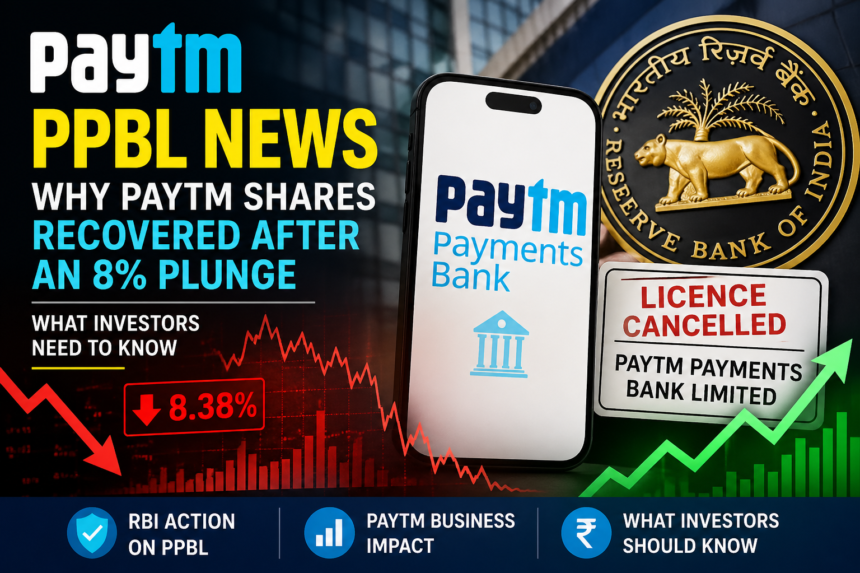
On Monday, shares of One 97 Communications, Paytm’s parent company, sank as much as 8.38%, hitting ₹1,051.10 during morning trade. The trigger was clear: the RBI’s decision to revoke Paytm Payments Bank’s licence due to persistent non-compliance and concerns over depositor interests.
For many investors, the headline alone was enough to spark fear.
Banking licence cancelled?
That sounds serious.
And yes—it is serious for PPBL.
But here’s where nuance matters.
The market initially treated the news as if it directly threatened Paytm’s broader fintech empire. That assumption, analysts say, may have been misplaced.
Why The Stock Recovered After the Sharp Selloff
Paytm PPBL News, Paytm had trimmed a big portion of its losses, trading around 3% lower instead of remaining deep in the red.
Why the rebound?
Because investors started digesting the details instead of reacting to the headline.
And the details tell a much calmer story.
Paytm quickly clarified that the RBI action has no direct financial or operational impact on its listed parent company.
Think of it like turbulence during a flight. It feels alarming at first. Then the pilot explains everything is under control—and suddenly passengers relax.
That’s exactly what happened with Paytm.
What the RBI Action Against PPBL Actually Means
The RBI’s move specifically targets Paytm Payments Bank, not Paytm’s core fintech business.
According to the central bank, PPBL failed to comply with licensing conditions and was operating in a manner considered detrimental to depositors.
That led to cancellation of its banking licence effective April 24, 2026.
A dramatic development?
Absolutely.
But important distinction:
PPBL and Paytm are no longer deeply intertwined operationally.
And that changes the investment narrative significantly.
Paytm Says Its Business Remains Unaffected
Paytm PPBL News, Paytm wasted no time reassuring markets.
In regulatory filings, the company stressed:
- It has no material business arrangement with PPBL
- It has no financial exposure to the bank
- None of its services operate in partnership with PPBL
- Paytm’s management has no role in PPBL operations or board decisions
That includes major products such as:
- Paytm App
- Paytm UPI
- Paytm Gold
- Paytm QR
- Soundbox
- Card Machines
- Payment Gateway
- Paytm Money
All continue running normally.
No disruptions, shutdowns and business freeze.
That message helped cool nerves.
The Big Financial Cushion Investors Should Notice
Here’s a detail many panic sellers missed:
Paytm had already impaired its investment in PPBL as of March 31, 2024.
That means much of the financial hit had already been recognized.
In accounting terms, the wound was already treated before the market noticed the injury.
That matters.
Because if the exposure was already written down, the latest RBI action doesn’t suddenly create a fresh massive financial shock.
For investors, that changes risk calculations materially.
Voluntary Winding Up of PPBL: Why It Could Be a Clean Exit
Following the RBI order, PPBL’s board approved resolutions for winding up the payments bank.
At first glance, “winding up” sounds alarming.
But sometimes shutting down a troubled structure is healthier than dragging uncertainty along.
It can act more like surgery than collapse.
Once effective, PPBL will cease being an associate company of Paytm under corporate and securities regulations.
And ironically, that may remove a regulatory overhang that has weighed on Paytm for years.
Sometimes cutting baggage helps a company move faster.
This could be one of those moments.
Why Analysts Aren’t Panicking
Paytm PPBL News, Several analysts see upside emerging from this.
That surprised many investors.
Bernstein, for example, called the development incremental rather than disruptive.
Their view?
Paytm had already created substantial separation from PPBL after earlier regulatory actions.
So Friday’s move doesn’t alter the core business story much.
In fact, some analysts believe it could improve Paytm’s long-term strategic flexibility.
That’s a very different narrative from “disaster.”
Could This Open New Growth Opportunities for Paytm?
Here’s where things get intriguing.
Analysts suggest PPBL’s exit may actually clear the road for Paytm to pursue other regulatory licences, including:
NBFC Opportunities
A Non-Banking Financial Company (NBFC) licence could expand Paytm’s lending and credit ambitions.
And lending often carries better margins than payments.
That could boost profitability.
PPI and Wallet Expansion
Alternative payment licences may also allow Paytm to deepen its wallet ecosystem and prepaid payment offerings.
That’s potentially significant in India’s digital payments race.
Stronger Focus on Core Fintech
Without payments bank baggage, Paytm may focus harder on what it does best:
- Merchant payments
- Financial distribution
- Credit products
- Wealth services
- Consumer engagement
Sometimes removing one branch lets the whole tree grow stronger.
Investor Sentiment Took a Hit—But Fundamentals May Not Have
Let’s be honest.
Sentiment did get bruised.
Regulatory headlines always do damage.
But sentiment and fundamentals are not the same thing.
And that distinction matters.
Paytm’s core ecosystem remains intact.
That’s why the stock recovered intraday.
Markets often react emotionally first…
…and analytically later.
Monday looked like one of those cases.
What Investors Should Watch Next
Paytm PPBL News—or are considering it—here’s what matters now:
1. Regulatory Developments
Will Paytm pursue fresh licences?
That could reshape growth prospects.
2. Margin Expansion
Analysts believe removing PPBL overhang could support profitability improvements.
Watch quarterly numbers.
3. Management Execution
Can Paytm turn this disruption into opportunity?
Execution will be everything.
4. Market Sentiment Recovery
Stocks often overshoot on fear.
Will this become a buy-the-dip story?
Investors are watching closely.
Is This a Crisis or a Reset Moment?
That’s the million-dollar question.
Is Paytm facing structural damage?
Or simply passing through a messy but manageable transition?
Right now, evidence points more toward reset than collapse.
Yes, losing a banking licence in an associate entity is serious.
But if the core business isn’t financially exposed…
if services remain unaffected…
and if new growth paths emerge…
then this may end up being remembered less as a crisis—
and more as a turning point.
Why The Market May Have Overreacted
Markets sometimes act like a startled herd.
One loud noise…
everyone runs.
Then comes perspective.
The initial 8% plunge looked driven largely by fear rather than a reassessment of Paytm business model.
Once investors separated PPBL headlines from Paytm fundamentals, the recovery began.
That doesn’t mean risks have disappeared.
But it does suggest the first reaction may have been too harsh.
And in markets, overreactions often create opportunity.
Read More: Paytm Payments Bank Licence Cancelled by RBI: Key Updates, Timeline, and Consequences
Conclusion
Paytm PPBL News, Paytm’s sharp fall after the RBI cancelled PPBL’s licence triggered understandable panic, but the recovery in the stock tells a deeper story.
The payments bank issue is serious—but it appears largely ring-fenced from Paytm’s main fintech operations.
The company says there’s no financial exposure.
Services remain uninterrupted.
Analysts see strategic upside.
And investors are starting to recognize this may not be the existential blow early trading suggested.
Sometimes a stock plunge signals real danger.
Sometimes it signals confusion.
For Paytm, this increasingly looks like the latter.