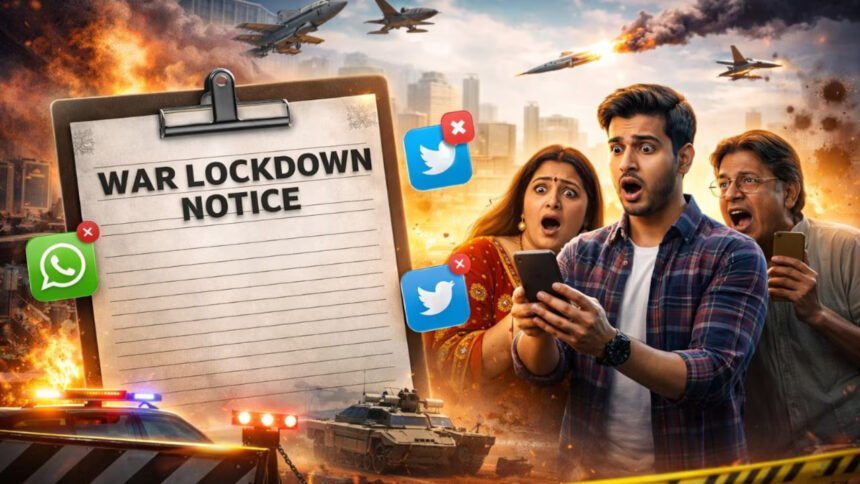
Ever received a message that made your heart skip a beat? That’s exactly what happened when a so-called “war lockdown” notice started circulating online. Within hours, it spread like wildfire across WhatsApp, X (formerly Twitter), and other platforms, leaving people confused—and honestly, a bit scared.
But here’s the real question: was there ever any truth to it?
Let’s break it down step by step.
The Sudden Surge: Why ‘War Lockdown’ Started Trending
On April 1, searches for the term “war lockdown” spiked dramatically. People were scrambling for answers. Was India about to go into another lockdown? Had the government issued a secret directive?
The timing couldn’t have been more sensitive. With global tensions already high, even a whisper of restrictions was enough to trigger alarm bells.
The Viral Document: What Did It Look Like?
The message came in the form of a PDF titled “War Lockdown Notice.” And here’s the clever part—it looked real.
- Formal layout
- Government-style language
- Structured formatting
At first glance, it felt authentic. The kind of document you wouldn’t ignore.
Naturally, people opened it immediately. Who wouldn’t?
The Twist: What Was Inside the File
Once users actually opened the document, the truth became obvious.
Instead of official instructions, they found just two words:
“April Fool.”
Yes, the entire thing was a prank.
But by the time people realized it, the message had already spread far and wide.
Why Did People Believe It So Quickly?
Let’s be honest—this wasn’t just about a fake PDF. The environment was already tense.
Several factors made the rumour believable:
- Recent global conflicts
- Economic uncertainty
- Memories of COVID-19 lockdowns
When people are already anxious, even a small spark can ignite panic. This message was that spark.
The Role of Political Statements in Fueling Confusion
Part of the confusion can be traced back to remarks made by Narendra Modi.
During a recent Lok Sabha address, he spoke about:
- The evolving situation in West Asia
- The need for preparedness
- Maintaining stability in supply chains
He even referenced the discipline shown during COVID-19.
Now here’s where things got messy.
Some people took “COVID-like discipline” and twisted it into “COVID-like lockdown.” That small misinterpretation snowballed into a full-blown rumour.
Global Tensions: The Bigger Picture Behind the Panic
The global backdrop played a huge role in amplifying fear.
The ongoing tensions between Israel and Iran, along with involvement from the United States, have created uncertainty worldwide.
One critical concern? The Strait of Hormuz—a vital oil route.
Any disruption there could affect countries like India, which rely heavily on imported energy.
So when a “lockdown notice” appeared, people connected the dots—right or wrong.
The Power of Timing: April Fool’s Day Effect
Let’s not ignore the obvious.
This happened on April 1.
While April Fool’s pranks are common, this one crossed into dangerous territory. Why? Because it mimicked official communication during a time of real global stress.
It’s like shouting “fire” in a crowded room—even as a joke, the consequences can be serious.
How Fast Misinformation Travels Today
In today’s digital ecosystem, information doesn’t just travel—it explodes.
One forward leads to ten. Ten become thousands.
And before you know it:
- Screenshots are circulating
- People are speculating
- Panic begins to build
The “war lockdown” message is a textbook example of viral misinformation.
Psychology Behind Panic Sharing
Why do people forward such messages without verifying them?
Simple.
- Fear triggers urgency
- Urgency overrides logic
- Logic gets replaced by reaction
It’s human nature. When something feels threatening, we act first and think later.
Lessons Learned: How to Avoid Falling for Hoaxes
So, what can you do next time?
Here’s a quick checklist:
- Verify the source – Is it from an official government channel?
- Check multiple platforms – Are credible news outlets reporting it?
- Look for inconsistencies – Poor formatting or vague language is a red flag
- Pause before sharing – Ask yourself: Is this confirmed?
Think of it like digital hygiene—just as important as washing your hands during a pandemic.
Why This Incident Matters More Than You Think
This wasn’t just a harmless prank.
It exposed:
- How fragile public trust can be
- How quickly misinformation spreads
- How global tension amplifies local panic
In a way, it was a stress test for our information ecosystem—and it revealed some cracks.
Read More: Strait of Hormuz Crisis: India Among Nations Allowed Safe Passage by Iran
Conclusion
War Lockdown Notice, The viral “war lockdown” notice turned out to be nothing more than an April Fool’s joke. But its impact was very real.
It triggered anxiety, confusion, and widespread speculation—all within a matter of hours.
And that’s the takeaway: in today’s hyper-connected world, even a simple prank can spiral into something much bigger.
Here’s the bottom line.
Not everything that looks official is official.
The next time a message pops up claiming urgent government action, take a step back. Breathe. Verify.
Because in the age of instant information, being informed isn’t enough—you need to be informed correctly.