
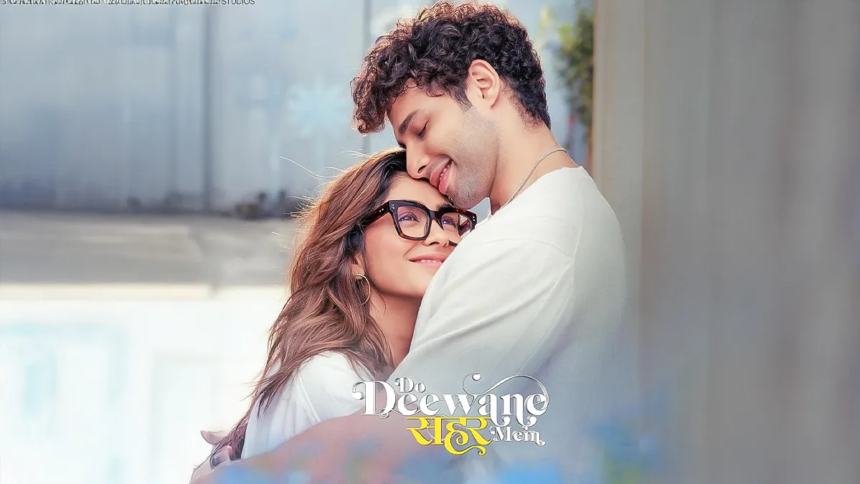
Do Deewane Seher Mein Movie Review, Ravi Udyawar’s film walks into theatres holding the hand of nostalgia, humming Gulzar’s classic Do Deewane from Gharaonda. On paper, it promises a soulful exploration of love, loneliness, and the search for belonging in a big city. In reality, it ends up as a visually polished but emotionally undercooked romantic drama that never quite finds its heartbeat. Do Deewane Seher Mein Rating reflects this gap between promise and payoff, highlighting how the film looks beautiful but struggles to leave a strong emotional impact.
A Classic Song, A Compromised Soul
The film leans heavily on the emotional weight of the timeless song that inspired its title. That haunting melody once captured the dreams and heartbreaks of middle-class lovers in Bombay, battling housing woes and harsh realities. Here, the old gold is repackaged for a new generation, but the emotional carat feels distinctly reduced.
Instead of a sharp social commentary, we get a softer, more personal story that doesn’t fully live up to the moral heft its title suggests.
From Housing Struggles To Inner Insecurities
Do Deewane Seher Mein Movie Review, Where Gharaonda was about survival and disillusionment in a ruthless city, Do Deewane Seher Mein shifts focus inward. The battles are no longer about rent and roofs, but about self-image and self-worth. The idea is interesting: trade external struggles for internal scars. The execution, however, is far too gentle and sanitized to leave a lasting mark.
Two Awkward Millennials In Maximum City
We meet Shashank (Siddhant Chaturvedi) and Roshni (Mrunal Thakur), two socially awkward millennials navigating Mumbai:
-
Shashank, hailing from Patna, works in marketing and struggles with a speech impediment common in the Hindi belt, where his “sh” turns into “s”. The missing “h” in the film’s title is a clever nod to this.
-
Roshni is a content creator at a fashion magazine, insecure about her looks and body type. No nail art, no lenses, no Instagram-perfect persona.
In a world obsessed with visibility and performance, both feel like misfits — in the office, at home, and most of all in their own skin.
Arranged Marriage As An Escape Route
Instead of letting these two stumble into each other organically, the film takes the traditional route: arranged marriage. Their parents decide that this match might “fix” what’s wrong with them, as if partnership were a social repair job.
Over time, Shashank and Roshni are supposed to heal each other’s complexes and gradually accept their imperfections. It’s a sweet idea, and the film clearly wants us to root for them. But the emotional journey never feels fully convincing or deep enough to resonate.
A Beautiful Shell With A Bland Core
Do Deewane Seher Mein Movie Review, This is a tasteful film. Frames are pretty, locations are well-chosen, and the overall aesthetic is easy on the eyes. Being a Sanjay Leela Bhansali production, you expect a certain level of style, and you absolutely get that.
What you don’t get is spark.
-
The screenplay feels stretched and thin.
-
The conflicts feel flimsy and overstated.
-
The tone is far too safe to be truly affecting.
It’s as if the film is too afraid to get messy or uncomfortable, so it keeps circling around its themes instead of diving into them.

Body Positivity, Language, And Forced Conflicts
The story tries to hang itself on two big hooks: body image and “imperfect” language.
-
Roshni’s insecurities about her looks and body feed into standard body-positivity conversations.
-
Shashank’s speech issue becomes a symbol of class and cultural discomfort in polished urban spaces.
But here’s the problem: none of this feels fresh. We’ve seen body positivity and inclusivity explored in many films and shows already. Meanwhile, in an era where news anchors and influencers casually mix languages on screen, worrying about “pure” speech feels a bit outdated as a central conflict.
So instead of feeling organic, these issues come off as overly amplified, as if the film is desperately trying to create drama where there isn’t enough real tension.
A Mental Block That Stays On Paper
Do Deewane Seher Mein Movie Review, Shashank’s speech problem is meant to function as a mountain only he can see, a small hurdle that turns into a massive mental block. Many viewers will relate to that feeling: what’s easy for others feels exhausting for you.
But on screen, that emotion rarely lands.
-
The stutter is there, technically.
-
The frustration is mentioned, occasionally.
-
The inner turmoil? Barely felt.
The film avoids loud melodrama, which is good, but it also avoids genuine confrontation with deeper psychological and social realities. As a result, the conflict remains more conceptual than visceral.
Characters Out Of Place In Their Own World
Another issue is believability. The world the film builds doesn’t seem to truly belong to the characters it puts inside it.
-
Shashank lives in a sleek sea-facing apartment, carries himself like a confident urban professional, and looks every bit the “cool dude”. His speech complex feels tacked on rather than deeply rooted in his personality.
-
Roshni, played by Mrunal Thakur, looks stylish and composed. The film wants us to believe she is deeply insecure about her appearance, but the way she is styled and framed undercuts that entirely. Her supposed self-doubt comes across as superficial and forced.
You can’t sell deep insecurities with surface-level signals. The film keeps telling us these two are broken, but rarely shows us how.
Performances That Never Fully Ignite
Siddhant Chaturvedi and Mrunal Thakur are both capable actors, and you can sense them trying to inject life into the material. Unfortunately, the script doesn’t give them much to bite into.
-
Their chemistry never quite evolves into something electric or emotionally charged.
-
The “big moments” — the stutters, the breakdowns, the quiet confessions — feel more like performance beats than lived experiences.
-
The supporting cast, despite boasting some prominent names, appears to be phoning it in, as if they’re just cashing a cheque rather than inhabiting fully realised people.
When actors don’t get the space or depth to become their characters, it becomes hard for the audience to invest in their journey.

Too Safe For Its Own Good
At its core, Do Deewane Seher Mein could have been a tender, introspective look at awkward love in an unforgiving city. It could have embraced silence, discomfort, and hesitation, letting the small moments breathe.
Instead, it chooses the safer route:
-
It relies on convenient emotional beats.
-
It ticks off predictable insecurities.
-
It avoids confronting sharper social realities.
-
It polishes away rough edges that might have made the story memorable.
In trying not to offend or overwhelm, the film ends up underwhelming.
A Missed Opportunity For A Truer Story
There’s a sense that a better, braver version of this film is hiding just beneath the surface. Imagine if the story had followed real newcomers from small towns landing in Mumbai with limited means, clashing with the city’s brutal pace, class divide, and casual cruelty. The themes of speech, identity, and body image would feel much more grounded.
Instead, the narrative is parked in a comfortable multiplex-ready zone — glossy apartments, magazine offices, filtered struggles. It’s Valentine’s week cinema designed to soothe rather than stir.
Similar Articles: Toxic Teaser Breakdown: Yash Returns With Explosive Action Spectacle
Conclusion
Do Deewane Seher Mein Movie Review, Film wants to celebrate imperfect love in an image-obsessed world, but it never fully trusts its own premise. The result is a romantic drama that looks good, sounds nostalgic, and occasionally strikes a relatable chord, yet rarely moves you in any lasting way.
If you’re craving a gentle, visually appealing watch and are content with familiar beats and mild emotions, this film might pass as a one-time outing. But if you’re hoping for a passionate, layered love story that truly wrestles with insecurity, identity, and urban alienation, this one feels like a promise half-kept — much like a love letter that never quite gets to the point.