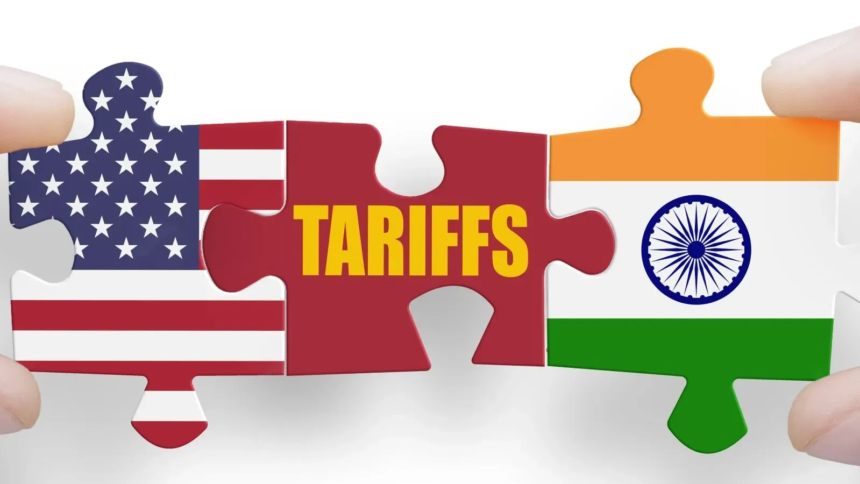
U.S. tariffs on India, During a casual yet impactful conversation aboard Air Force One, former U.S. President Donald Trump dropped remarks that quickly caught international attention. He revealed that Indian Prime Minister Narendra Modi “knew he wasn’t happy” about India’s oil purchases from Russia — a sentiment hinting at broader trade implications.
Speaking to reporters while heading from Florida to Washington D.C. on January 4, 2026, Trump didn’t mince words. According to him, “Modi is a good man, but he knew I wasn’t happy” with India–Russia trade, adding that it was important to make him happy. The former president added pointedly that the India–Russia oil trade could trigger swift retaliation, warning, “We can raise tariffs on them very quickly. It would be very bad for them.”
Those words, delivered in Trump’s typical blunt tone, underscored Washington’s leverage over its trade partners, especially one as significant as India.
Trump’s Tariff Warning to India
Trump’s comment wasn’t just an emotional response — it carried a strong economic undercurrent. When he said the U.S. could “raise tariffs on India very quickly,” it was both a reminder and a threat. In the landscape of international diplomacy, tariffs have long been one of Trump’s favorite tools to pressure nations into compliance.
For India, such a threat is no small matter. The United States remains one of India’s largest trading partners, and any hike in tariffs could ripple through industries ranging from pharmaceuticals to IT services. The message was clear: trade negotiations aren’t just about economics; they’re about political signaling.
Why the Fuss Over Russian Oil?
U.S. tariffs on India, At the heart of the issue lies India’s continued purchase of Russian crude oil. After Russia’s invasion of Ukraine, the U.S. and its allies slapped severe sanctions on Moscow, aiming to cut off one of the nation’s main revenue sources — oil exports.
However, India, balancing between affordability and foreign policy, continued buying discounted Russian crude to meet its domestic energy needs. This stance, pragmatic from an Indian standpoint, was perceived in Washington as undermining the sanctions-based pressure campaign.
Trump’s remarks revealed frustration not only over trade but also over what he sees as India’s unwillingness to align fully with the West’s anti-Russia stance.
Lindsey Graham Joins the Conversation
Travelling alongside Trump on Air Force One was U.S. Senator Lindsey Graham, a key political ally and one of the most vocal proponents of using economic measures to enforce international behavior.
Graham echoed Trump’s sentiments, revealing an interesting detail — India’s reduction in Russian oil imports was largely due to American-imposed tariffs. “The tariffs that President Trump put on India are the chief reason they’re buying less Russian oil,” said Graham, emphasizing the policy’s effectiveness.
He also mentioned a proposal to impose 500% levies on imports from countries continuing to buy oil from Russia. His reasoning was straightforward: to end the Russia-Ukraine conflict, pressure must be placed not only on Moscow but also on the nations funding it indirectly.
The Indian Ambassador Steps In
In an anecdote that added a touch of diplomatic irony, Senator Graham shared that he recently attended a dinner at the Indian Ambassador’s residence. According to him, the primary topic of conversation was India’s reduced Russian oil imports and the plea for tariff relief.
“I was at the Indian Ambassador’s house about a month ago, and all he wanted to talk about was how they’re buying less Russian oil,” Graham recounted. “He asked me to tell the President to relieve the tariff.”
This exchange highlights how tariffs have become a major pain point in U.S.–India relations. While India hopes for some leniency, Washington sees tariffs as a bargaining chip.
Understanding the U.S.–India Trade Tensions
Trade disagreements between the U.S. and India are nothing new. Even before the Russia-Ukraine war, Trump had criticized India’s trade policies, labeling the country as “tariff king.”
He frequently argued that American companies face unfair barriers in India’s markets while Indian exporters enjoy comparatively easy access to the U.S. consumer base. The current conversation around Russian oil is, therefore, not just about geopolitics — it’s part of a long-standing saga over market access and economic reciprocity.

India’s Tightrope Walk Between Allies
U.S. tariffs on India, India’s position is a tricky one. On one hand, it has nurtured strategic defense and technology partnerships with the U.S. On the other, its historical ties and energy dependencies with Russia run deep. For decades, Moscow has been a reliable defense supplier, and Russian oil remains vital to India’s energy security.
New Delhi has repeatedly clarified its stance: its foreign policy is guided by national interest, not foreign expectations. Hence, while the U.S. pushes for reduced Russian imports, India continues buying when prices align with its energy needs.
The Domestic Impact on India
A potential tariff escalation might hit Indian exporters hard. Key sectors such as textiles, pharmaceuticals, and automotive parts rely heavily on American markets. If Washington follows through on Trump’s warning, it could translate into costlier exports and reduced competitiveness.
Moreover, it could further strain diplomatic relations at a time when both nations are cooperating on crucial issues such as defense, space exploration, and semiconductor manufacturing.
Geopolitical Ripples Beyond India and the U.S.
Trump’s statement doesn’t just concern India — it sends a wider message to countries still doing business with Russia. Nations buying Russian energy could face similar tariff-based threats if Trump or any of his political allies return to power. It’s a clear sign that Washington views economic pressure as an effective weapon in modern diplomacy.
This could complicate the global oil market, pushing countries to diversify supply chains or brace for rising costs. A ripple effect could also emerge across Asia and Europe, reshaping trade patterns and energy alliances.
A Tug of War Between Diplomacy and Economics
At its core, this episode underscores the delicate interplay between foreign policy and trade. While Donald Trump rhetoric often seems impulsive, it taps into real geopolitical anxieties — especially the global struggle to isolate Russia economically.
For India, this is a reminder of how intertwined its foreign trade is with global politics. Decisions about where to buy oil or whom to trade with are no longer purely economic; they’re markers of diplomatic loyalty.
Similar Articles: Trump’s Tariffs Shake Global Markets: Dow Jones Stock Markets Face Major Setback
Conclusion
U.S. tariffs on India, Trump’s comments about PM Modi “knowing he wasn’t happy” reflect more than personal discontent — they reveal the ongoing recalibration of U.S.–India relations in a world where energy politics dominate. Whether or not tariffs are actually raised, the message is evident: Washington expects partners to align with its strategic objectives, even at an economic cost.
India, meanwhile, continues to walk its thin diplomatic line, prioritizing national interests while managing the expectations of global powers.