As 2025 winds down, Indian politics feels a bit like a chessboard mid-gamepieces are being moved, alliances are shifting, and every side is trying to think three steps ahead. Keeping up with politics and legislation trends in present times is crucial, as the Winter Session of Parliament is almost wrapped up. Political parties across the spectrum are juggling legislative battles, electoral calculations, and growing pressure from the ground. Nothing is happening in isolation. Every decision, every defection, and every fiery statement is feeding into a larger narrative about where Indian democracy is headed next.
So, what exactly is shaping the political mood right now? Lets break it down, piece by piece.
A Year-End Political Atmosphere Charged With Uncertainty
The closing weeks of the year have brought with them a sense of urgency in New Delhi and beyond. Parliament is racing against time to clear key legislation, while opposition parties are equally determined to slow things down and demand deeper scrutiny. Outside the House, state-level politics is bubbling with allegations, counter-allegations, and intense power struggles.
Think of it as a pressure cooker. The lid hasnt blown off yet, but the steam is unmistakable.
At the heart of this moment is a broader question: is Indian politics entering a phase of consolidation under the ruling establishment, or are we witnessing the early signs of a more fragmented and contested future?
Maharashtras Political Shake-Up Signals Deeper Opposition Strain
Politics and Legislation Trends in Present, One of the most talked-about developments comes from Maharashtra, a state that has become synonymous with political volatility in recent years. Pragya Satav, a Congress leader and the widow of the late Rajeev Satav, has officially crossed over to the Bharatiya Janata Party (BJP).
This is not just another defection. Symbolically and strategically, it matters.
For the Congress, her exit weakens its numbers in the Maharashtra Legislative Council and complicates equations around the Leader of the Oppositions post. More importantly, it reinforces a perception that the party is struggling to hold its ranks together at a time when unity is critical.
From the BJPs perspective, the move fits neatly into its broader narrative of expanding influence, even in regions traditionally seen as competitive or opposition-leaning. Its like adding another brick to a wall theyve been steadily building.
Defections and the Psychology of Political Momentum
Why do defections matter so much in Indian politics? Because theyre not just about numbers; theyre about momentum.
Every time a leader switches sides, it sends a psychological signalto voters, to party workers, and to rival politicians. For opposition parties, repeated defections can sap morale and create a sense of inevitability. For the ruling party, they serve as proof of dominance.
In Maharashtra, this trend has intensified the perception that opposition formations are still searching for a coherent strategy to counter the BJPs organisational strength and electoral machinery.
National Leaders Step Out, Messaging Moves In
While state politics simmers, national leaders are actively shaping narratives on the ground.
Union Home Minister Amit Shahs visit to Himachal Pradeshs Kangra district for the 62nd establishment day of the Sashastra Seema Bal was more than a ceremonial appearance. It reinforced the governments emphasis on internal security, border management, and disciplined paramilitary forceskey themes that consistently resonate with its core support base.
These visits are carefully calibrated. They blend governance with political communication, sending a clear message about priorities and performance.
Indias Growing Global Profile Adds Another Layer
At the same time, Indias international standing continues to rise. Prime Minister Narendra Modi being conferred Omans highest civilian honour has been widely interpreted as recognition of Indias growing diplomatic clout.
Adding to that, the expected presence of several European leaders at Indias upcoming Republic Day celebrations signals deepening global engagement. For the government, these moments are not just about foreign policytheyre also powerful domestic talking points.
In simple terms, global recognition becomes political capital at home.
Winter Session of Parliament: Lawmaking Amid Loud Confrontation
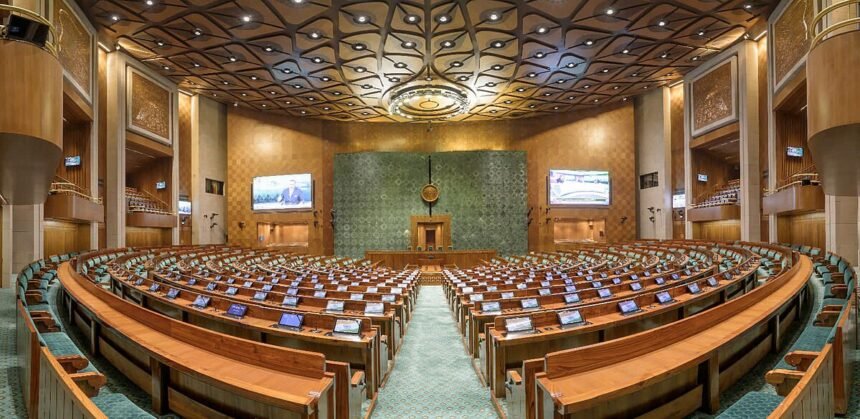
Inside Parliament, the atmosphere has been anything but calm. As the Winter Session approaches its final days, the government is pushing hard to clear pending bills, while the opposition is digging in its heels.
The most contentious piece of legislation this session has been the Viksit Bharat Guarantee for Rozgar and Ajeevika Mission (Gramin) Bill, 2025, also known as the VB-G RAM G Bill.
Passed in the Lok Sabha on 18 December, the bill proposes a significant restructuring of the rural employment framework, effectively overhauling the long-standing MGNREGA system.
VB-G RAM G Bill: Reform or Risk?
Politics and Legislation Trends in Present, The government has framed the VB-G RAM G Bill as a bold and necessary reform. By increasing guaranteed employment days and redesigning how rural job assurance works, it claims the legislation will better align welfare delivery with modern economic needs.
However, critics see it differently.
Opposition parties and civil society groups argue that the proposed changes risk diluting crucial safeguards that have protected rural workers for years. Protests have already surfaced in multiple states, reflecting deep anxieties at the grassroots level.
In response, opposition partiesmost notably the Congresshave issued whips to ensure full attendance during crucial votes. Their goal is clear: prevent what they describe as the rushed passage of socially sensitive legislation without adequate debate.
Rising Rhetoric and Political Predictions in Maharashtra
As legislative battles rage, political rhetoric outside Parliament has reached a fever pitchespecially in Maharashtra.
Shiv Sena (UBT) leader Sanjay Raut has made headlines by predicting a major political explosion that could alter power equations at the Centre. While BJP leaders have dismissed these statements as speculative noise, theyve undeniably added drama to an already tense environment.
For seasoned observers, such declarations are less about immediate outcomes and more about narrative warfare. They energise party workers, keep supporters engaged, and apply psychological pressure on opponents.
In modern Indian politics, perception often travels faster than policy.
Punjabs Grassroots Battle Over Electoral Fairness
Moving north to Punjab, political tensions are playing out at the local level. Senior Congress leader Sukhpal Singh Khaira has accused the Aam Aadmi Party-led state government of orchestrating what he calls a pre-planned hijacking of village-level elections.
According to Khaira, administrative machinery was allegedly misused to tilt the electoral processfrom voter rolls to counting procedures. These claims have sparked demands for judicial intervention and official probes.
Whether proven or not, such allegations underline a larger issue: trust in local democratic processes. When village elections become contentious, it signals deeper cracks in governance and political consensus.
Mumbais Civic Politics Reflect Urban Fragmentation
In Indias financial capital, Mumbai, attention remains focused on the Brihanmumbai Municipal Corporation (BMC). Historical data shows that no single party has ever secured a clear-cut mandate in the civic body.
This fragmented landscape makes Mumbai a microcosm of urban Indian politicsdiverse, competitive, and fiercely contested. As parties position themselves for future civic polls, alliances and strategies remain fluid.
Urban voters, it seems, are less predictable and more demanding than ever.
When Politics Pauses for Governance
Amid all the confrontation, there are moments that remind us of another side of Indian politicsone driven by constituency needs rather than party rivalry.
Congress MP Priyanka Gandhi Vadras meeting with Union Road Transport and Highways Minister Nitin Gadkari is a case in point. Their discussion focused on infrastructure issues affecting her Wayanad constituency in Kerala.
Such interactions rarely dominate headlines, but they are crucial. They show that beyond the noise, Parliament still functions as a space for negotiation, problem-solving, and issue-based cooperation.
Its the quiet engine that keeps the system running.
Reform Versus Continuity: The Big Political Divide
As 2025 draws to a close, two themes dominate the political narrative.
On one side is the governments push for reformreshaping welfare schemes, redefining policy frameworks, and projecting decisiveness. On the other is the oppositions insistence on continuity, safeguards, and deeper democratic consultation.
This tension is not new, but it has become sharper as the next electoral cycle approaches.
Who controls the narrative? Who convinces voters that their vision is more credible? Those questions will define the months ahead.
Looking Ahead to the 2026 Electoral Cycle
While dramatic predictions and daily controversies grab attention, the real shifts will emerge from how policies translate into lived experiences.
Will rural workers feel more secure or more uncertain under new employment frameworks? Will urban voters reward efficiency or punish perceived overreach? And can opposition parties find cohesion before its too late?
Indian democracy, as always, is noisy, argumentative, and intensely competitive. But it is also resilient.
Read More: The New Income Tax Bill 2025: Everything You Need to Know
Conclusion
Politics and Legislation Trends in Present, Indias political moment at the end of 2025 is best described as dynamic rather than decisive. Parliament remains a battleground, states continue to assert their own political rhythms, and narratives clash across platforms every single day.
Defections, legislation, rhetoric, and diplomacy are all pieces of a much larger puzzleone that will only become clearer as the country moves closer to its next electoral milestone.
For now, the game is still on, the stakes are high, and every move counts.