
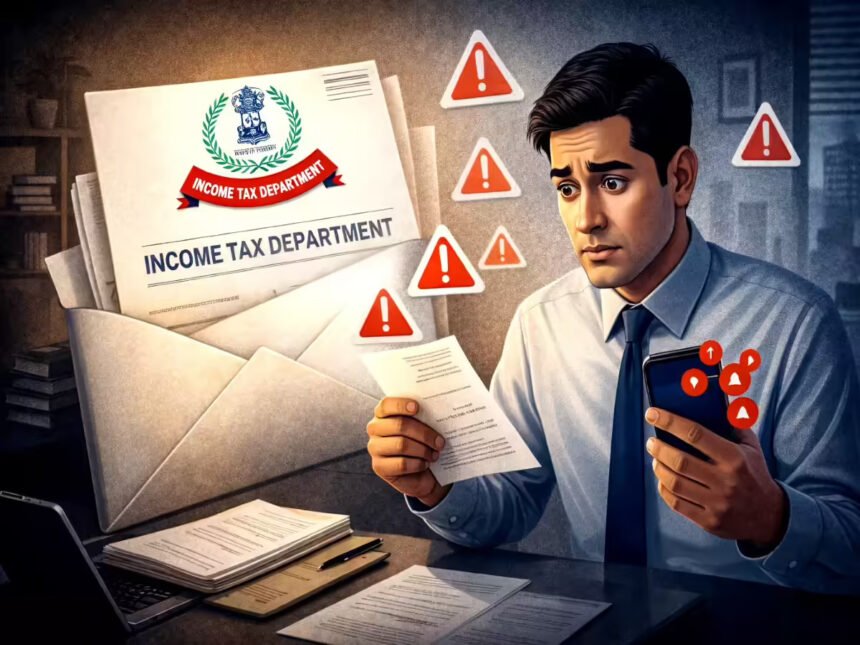
Have you recently received a message or email from the Income Tax Department asking you to review your tax return? Dont panic youre not alone. In the financial year 202526, millions of Indian taxpayers have been alerted under the governments latest compliance initiative, the NUDGE Campaign Income Tax , aimed at improving voluntary compliance.
The Income Tax Department has adopted this approach as part of its trust-based, data-driven compliance strategy. Using advanced analytics and integrated data frameworks, the department has identified possible discrepancies in taxpayers’ filings, especially regarding deductions, exemptions, and refund claims.
Why the Buzz Around ITR Filing This Year
The financial year 202425 has been a busy one for taxpayers in India. The last date to file income tax returns (ITRs) was extended to September 15, 2025, because the tax portal and return forms took longer than usual to roll out. However, the deadline for filing revised or updated returns still stands at December 31, 2025, leaving little time for those who need to make corrections.
Interestingly, the Income Tax Department shared that over 21 lakh taxpayers have already updated their ITRs for previous assessment years (AY 202122 to AY 202425), collectively paying more than ¹2,500 crore in additional taxes. Moreover, around 15 lakh revised ITRs have been filed for the current year alone proof that the new system is prompting self-correction among taxpayers.
What Exactly Is the NUDGE Campaign?
Think of the NUDGE (Non-Intrusive Usage of Data to Guide and Enable) campaign as the tax departments polite way of saying, Double-check your numbers. This initiative aims to encourage voluntary compliance instead of intimidating taxpayers with notices and audits.
The departments communication usually via SMS or email gently asks you to review your return if there’s a mismatch or a suspicious claim. Maybe its a deduction you arent eligible for or an exemption that doesnt align with reported income. Whatever the issue, the department wants to give you the opportunity to revise your return before December 31, 2025, without facing penalties or scrutiny later.
According to the department, this step reflects a trust-first approach creating a non-intrusive, technology-driven environment where taxpayers can correct unintentional mistakes with ease.
How Does the Tax Department Identify Discrepancies?
ITR Filing Alert, You might be wondering how the system detects inconsistencies in millions of tax returns. The answer lies in big data and advanced analytics.
The governments digital infrastructure now cross-verifies multiple databases from PAN and Aadhaar to banking and investment records. These tools work within a risk management framework, enabling tax authorities to spot red flags such as:
-
Deductions not matching income profile
-
Invalid PAN details of political donation recipients
-
Foreign assets not reported as required under FATCA (Foreign Account Tax Compliance Act)
-
Excessive claims under sections like HRA (House Rent Allowance)
-
Duplicate or inflated exemption claims
Such sophisticated data integration helps the department ensure transparency, accuracy, and accountability, while also minimizing manual interventions.
Why Are Taxpayers Receiving the Nudge?
The purpose of the NUDGE isnt to scare you; its to ensure your ITR reflects reality. If your deductions or exemptions dont line up with authenticated data sources, you might receive one of these friendly reminders.
Tax expert Amarpal Chadha, Partner at EY India, explains that the campaigns core aim is to promote voluntary compliance:
The initiative uses data analytics to notify taxpayers of potentially ineligible claims. Its a proactive communication asking them to reassess their filings before the deadline.
In other words, if youve accidentally overstated a deduction say, an inflated rent allowance or an incorrect donation entry youll get a reminder to revisit your filing.
Common Deduction and Exemption Claims Under the Scanner
ITR Filing Alert, Tax advisors have noticed a pattern in the types of claims currently attracting scrutiny. According to Tanu Gupta, Partner at Mainstay Tax Advisors LLP, any exemption or deduction that doesnt align with factual records could be questioned.
Lets look at some of the common claims being reviewed:
-
Donations to Political Parties Incorrect or invalid PAN details of recipients have triggered red flags.
-
House Rent Allowance (HRA) Claims without proper rent receipts or landlord PAN details.
-
Section 80G Deductions Overstated or unverifiable charitable donations.
-
Foreign Asset Declarations Inconsistent disclosures under FATCA regulations.
-
Investment Declarations Deductions under Section 80C for investments or life insurance that lack proof.
In short, the department is double-checking whether the claims youve made are consistent with their database which aggregates information from financial institutions, employers, and third-party sources.
What Should You Do If You Get a Nudge?
First things first: dont panic. Getting a nudge doesnt automatically mean youve done something wrong. Heres what experts recommend doing next:
-
Read the communication carefully.
The message or email will specify which part of your return needs attention whether its a deduction, exemption, or income mismatch. -
Log in to your income tax portal.
Verify the claim in question using your filed ITR data and supporting documents. -
Cross-check all related proofs.
Ensure rent receipts, donation certificates, or investment proofs are in order. Missing documents? Retrieve them immediately. -
Revise your return if necessary.
If you discover an error, file a revised ITR by December 31, 2025 to avoid penalties or follow-up enquiries. -
Keep evidence organized.
Even if your claims are legitimate, retain proof for each deduction in case the department asks for verification later.
This proactive approach saves you from the headache of reassessment or future legal hassles.
Should You Worry About Penalties or Notices?
ITR Filing Alert, As per the tax departments own clarification, honest taxpayers have nothing to fear. If your claims are genuine and backed by documents, you can confidently maintain your filing as it is.
Tanu Gupta emphasizes, Taxpayers whove received the NUDGE communication but have all supporting documents should remain calm. They only need to verify and keep their proofs ready in case of future queries.
However, if your claims are even slightly questionable, its wise to revise your return voluntarily instead of waiting for the department to initiate a detailed examination.
What Happens If You Ignore the Nudge
Lets be clear ignoring a communication from the Income Tax Department is never a good idea. While the NUDGE is a friendly reminder now, it could escalate into a formal enquiry or reassessment later if left unaddressed.
The department has explicitly stated that those who fail to act before December 31, 2025, will still have the option to file an updated return from January 1, 2026 under the new compliance framework. However, doing so will attract an additional tax payment, depending on the time and extent of correction needed.
So, if you value peace of mind (and your wallet), taking timely corrective action is the smarter move.
Lessons from the NUDGE Campaign
If theres one thing the NUDGE campaign teaches us, its that tax compliance in India is moving towards a self-corrective, data-driven culture. Rather than relying on audits and raids, the tax department is now trusting technology and you to ensure accuracy.
This marks a refreshing shift from the past. Taxpayers are being treated as partners, not adversaries. The governments approach feels more like, We trust you, but please double-check rather than You did something wrong.
And for most honest taxpayers, this is a win-win setup fewer intrusive checks, more time for correction, and greater transparency.
How to Prepare for Future Filings
To stay on the safe side in upcoming financial years, maintain good financial hygiene. Heres how you can do it easily:
-
Keep digital copies of all tax-related documents and receipts.
-
Use legitimate details when making donations verify PAN and organization credentials.
-
Review Form 26AS or AIS (Annual Information Statement) to cross-verify your data before filing.
-
Consult a professional if your income or deductions are complex.
-
File on time delays often cause avoidable confusion.
By following these habits, youll not only file confidently but also minimize the chances of ever receiving a compliance nudge.
The Bigger Picture: A Trust-Based Digital Tax System
Indias tax ecosystem is rapidly evolving toward digital governance and predictive analytics. The NUDGE campaign is part of this broader effort to make compliance more efficient, transparent, and taxpayer-friendly.
By combining AI-driven data monitoring with a guidance-oriented approach, the Income Tax Department is demonstrating that modern governance can balance both accountability and empathy. For taxpayers, its a subtle reminder that honesty and recordkeeping go hand-in-hand in building financial integrity.
Similar Articles: The New Income Tax Bill 2025: Everything You Need to Know
Conclusion
ITR Filing Alert, The Income Tax Departments NUDGE campaign is not about penalizing you its about empowering you. Its a chance to revisit your returns, correct mistakes, and stay confident that your filings genuinely reflect your income and deductions.
If you get a nudge, treat it as a helpful prompt, not a red flag. Take it as the systems way of saying, Hey, just double-check this one thing. In the end, keeping your records accurate saves you both effort and stress. Remember, when your finances are clear, your conscience and your sleep stay clear too.