
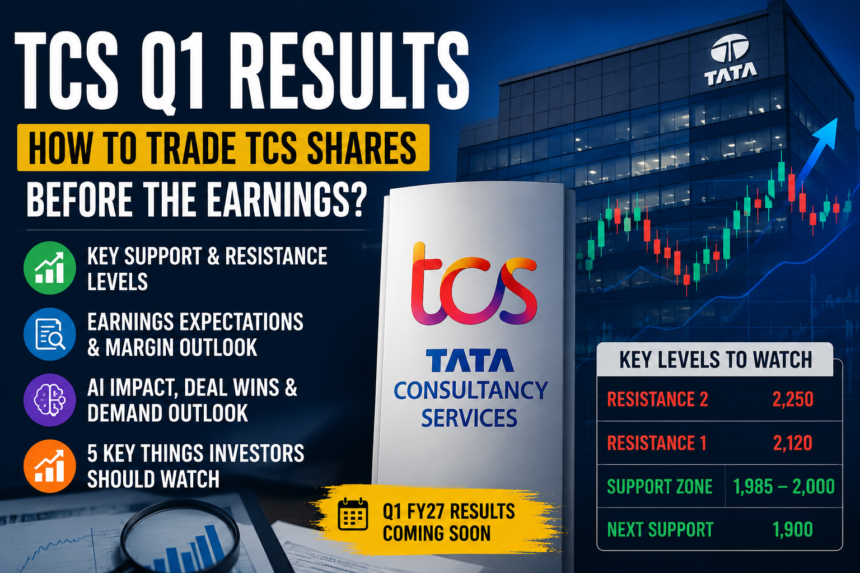
TCS Q1 Results, India’s largest IT services company, Tata Consultancy Services (TCS), is preparing to announce its Q1 FY27 earnings, and investors are paying close attention. While the company has long been considered a blue-chip stock, recent market performance tells a different story. Weak technical indicators, cautious brokerage estimates, and concerns over global IT spending have created uncertainty ahead of the quarterly results.
So, is this the right time to buy TCS shares, hold existing positions, or stay on the sidelines?
The answer isn’t straightforward. The upcoming earnings report could become a major catalyst that determines the TCS Share Price direction in the near term. While analysts expect year-on-year growth in both revenue and profit, sequential performance is likely to remain muted. More importantly, management’s commentary on artificial intelligence (AI), client spending, deal wins, and demand outlook may carry greater weight than the financial numbers themselves, as these factors could significantly influence the TCS Share Price after the Q1 results.
Let’s break down everything investors and traders should know before TCS releases its first-quarter results.
Why TCS Q1 Results Matter More Than Ever
Every earnings season is important, but this quarter carries added significance for TCS.
The global IT services industry continues to face multiple headwinds. Enterprises remain cautious about technology spending due to economic uncertainty, while AI is reshaping how traditional outsourcing contracts are structured. At the same time, pricing pressures, wage hikes, and slower discretionary spending are forcing companies to rethink their growth strategies.
As India’s IT bellwether, TCS often sets the tone for the entire sector. Its earnings frequently influence investor sentiment toward companies like Infosys, Wipro, HCLTech, and Tech Mahindra.
This is why the market isn’t simply looking for better revenue numbers—it wants reassurance about future growth.
Expected Q1 FY27 Earnings: Growth Remains Limited
TCS Q1 Results, Market estimates suggest that TCS will report modest year-on-year growth in the June quarter.
Consensus estimates from multiple brokerage firms indicate:
- Revenue growth of approximately 13% year-on-year
- Net profit growth of around 4% year-on-year
- Sequential revenue growth expected to remain almost flat
Although annual growth appears healthy on paper, quarter-on-quarter performance paints a less encouraging picture. Flat sequential growth indicates that demand recovery across global IT spending remains slow.
Many businesses are delaying digital transformation projects, reducing discretionary technology budgets, and focusing more on cost optimization instead of expansion.
For investors hoping for a strong earnings surprise, expectations remain fairly conservative.
Why TCS Shares Have Underperformed This Year
The stock has struggled throughout the year despite its reputation as one of India’s most dependable technology companies.
Compared with the broader market, TCS has significantly underperformed.
Several factors have contributed to this weakness:
- Slowing demand from international clients
- Weak discretionary technology spending
- Rising employee costs
- Increased competition
- AI-driven pricing pressure
- Global macroeconomic uncertainty
The correction has been far steeper than the broader benchmark indices, making many investors wonder whether the stock has already priced in most of the bad news.
Some analysts believe valuation has become more attractive, while others remain cautious due to the uncertain demand environment.
Technical Analysis: TCS Still Trades in a Weak Trend
TCS Q1 Results, From a technical perspective, TCS hasn’t yet shown convincing signs of a sustained recovery.
The stock has consistently traded below its 20-day Simple Moving Average (SMA) for several months, reflecting continued bearish momentum.
However, there is one encouraging sign.
The pace of decline has slowed considerably over recent weeks. Instead of making fresh sharp lows, the stock has started consolidating closer to its moving averages.
This suggests that selling pressure is gradually easing.
Although the broader trend remains negative, buyers appear willing to accumulate shares at lower levels while waiting for a positive trigger.
That trigger could very well be the upcoming quarterly earnings announcement.
Key Support and Resistance Levels Every Trader Should Watch
Technical traders should keep a close eye on several critical price zones that could determine the stock’s next move.
Major Support Zone: ₹1,985–₹2,000
This is currently the most important support area.
If TCS manages to hold above this range after the earnings announcement, buyers may gain confidence.
However, if this support breaks decisively, selling pressure could intensify quickly.
The next downside target would likely emerge near:
- ₹1,900
This level could become the next major support if bearish momentum strengthens.
Immediate Resistance: ₹2,120
The first challenge for bullish traders lies around ₹2,120.
Crossing this level may indicate that short-term sentiment is improving.
However, simply touching the resistance isn’t enough.
The stock needs sustained buying interest above this level before traders can become optimistic.
Major Breakout Level: ₹2,250
This is perhaps the most important resistance level on the charts.
If TCS successfully moves above ₹2,250 and maintains those gains, technical momentum could improve significantly.
Such a breakout could potentially open the door for a rally toward:
- ₹2,450
Until then, traders should continue treating the stock as being in a corrective phase.
Brokerages Expect Weak Sequential Revenue Growth
Most leading brokerage firms remain cautious regarding near-term revenue growth.
Although expectations differ slightly, almost every major research house predicts either flat or marginal sequential growth.
Forecasts include:
- Constant currency revenue growth around 0.1%
- Some estimates near 0.3%
- Others expect almost no sequential improvement
These numbers highlight a common concern across the industry.
Clients continue delaying large technology investments while focusing primarily on essential spending.
Instead of pursuing aggressive digital transformation initiatives, many companies are emphasizing operational efficiency and cost savings.
That shift directly affects revenue growth for major IT service providers like TCS.
Why Global Demand Remains Soft
TCS Q1 Results, Several global developments continue weighing on the IT sector.
Among the biggest concerns are:
Economic Uncertainty
Businesses across North America and Europe remain cautious about capital allocation.
Higher interest rates and slower economic growth have encouraged companies to postpone non-essential technology projects.
Reduced Discretionary Spending
Many enterprises are limiting investments to only mission-critical technology initiatives.
Projects involving innovation, modernization, and expansion are being delayed until economic conditions improve.
Pressure from Large Deal Renewals
Even when companies renew outsourcing agreements, they’re demanding better productivity and lower pricing.
This creates revenue pressure despite retaining existing clients.
Geopolitical Risks
International conflicts and geopolitical uncertainty continue affecting business confidence.
Several analysts believe ongoing tensions in parts of the Middle East have contributed to delayed enterprise decision-making.
Margins Could Decline Because of Wage Hikes
Revenue isn’t the only concern.
Profit margins are also expected to come under pressure during the quarter.
Most brokerage firms anticipate a sequential decline in EBIT margins.
The primary reason is annual employee wage hikes.
Salary increases improve workforce retention but also increase operating expenses.
Analysts expect margin declines ranging between:
- 100 basis points
- 140 basis points
- Up to 160 basis points
Unless offset by stronger revenue growth or improved operational efficiency, these higher costs are likely to reduce profitability during the quarter.
Artificial Intelligence Is Becoming the Biggest Talking Point
TCS Q1 Results, If there’s one subject investors will focus on during the earnings call, it’s artificial intelligence.
AI is rapidly transforming the IT services industry.
But its impact isn’t entirely positive.
On one hand, AI helps companies automate tasks, improve productivity, and create new service offerings.
On the other hand, increased automation allows clients to demand lower billing rates for traditional outsourcing contracts.
This creates a delicate balancing act.
Investors want management to explain:
- How AI is contributing to new business opportunities
- Whether AI-led projects are generating meaningful revenue
- If AI is affecting pricing power
- How TCS plans to maintain profitability in an AI-driven environment
Management’s answers could significantly influence investor sentiment.
Deal Wins Could Determine Future Revenue Growth
Quarterly earnings only tell part of the story.
Future revenue depends largely on new contracts.
Investors will therefore pay close attention to:
- Total Contract Value (TCV)
- Large enterprise deal wins
- Client additions
- Pipeline strength
Several analysts expect TCS to report deal wins worth between $8 billion and $10 billion.
Large contract announcements provide visibility for future revenue growth, even if current-quarter numbers remain weak.
Strong deal wins would reassure investors that demand hasn’t disappeared—it has merely been delayed.
Five Key Things Investors Should Watch During TCS Q1 Results
TCS Q1 Results, Rather than focusing solely on revenue and profit figures, investors should monitor five critical aspects of the earnings announcement.
1. Constant Currency Revenue Growth
Constant currency performance removes the impact of exchange-rate fluctuations and offers a clearer picture of underlying business performance.
Weak numbers here may indicate continued softness in demand.
2. EBIT Margin Performance
Margins reveal how effectively the company controls costs.
A sharper-than-expected decline could raise concerns about profitability in coming quarters.
3. Deal Wins and Total Contract Value
Large contracts often act as leading indicators of future growth.
Healthy deal wins can offset concerns over weak near-term revenue.
4. Management Commentary on US and BFSI Demand
The United States remains TCS’s largest market.
Similarly, Banking, Financial Services, and Insurance (BFSI) contributes a substantial portion of revenue.
Any improvement—or deterioration—in these segments could influence future earnings expectations.
5. AI Strategy and Monetization
Perhaps the biggest question remains:
Can AI become a meaningful revenue engine instead of simply reducing traditional outsourcing income?
Investors will carefully analyze management’s roadmap.
Trading Strategy Before the Results
Quarterly earnings often trigger sharp price movements.
For short-term traders, discipline becomes essential.
Here are some practical considerations:
Bullish Scenario
If TCS reports stronger-than-expected earnings, healthy deal wins, and positive AI commentary while holding above ₹2,000, momentum could improve quickly.
A move above ₹2,120 would strengthen bullish sentiment.
Crossing ₹2,250 could potentially trigger a broader recovery.
Bearish Scenario
If revenue disappoints, margins decline more than expected, or management issues cautious guidance, sellers may regain control.
Breaking below ₹1,985 could accelerate downside momentum toward ₹1,900.
For Long-Term Investors
Investors with a multi-year investment horizon may focus less on one quarter’s numbers and more on:
- Client pipeline
- Digital transformation demand
- AI execution
- Long-term margin sustainability
- Capital allocation
Short-term volatility often creates opportunities for patient investors, provided the company’s long-term fundamentals remain intact.
Should Investors Buy Before the Earnings?
Buying shares immediately before earnings always carries additional risk.
Quarterly results can trigger significant price swings in either direction.
Aggressive traders may attempt to capitalize on volatility, but conservative investors often prefer waiting until the market digests the results.
Watching how the stock reacts around the crucial ₹1,985 support and ₹2,250 resistance levels may provide greater clarity regarding the next trend.
For long-term investors, the management’s outlook on AI, client demand, and deal momentum could ultimately prove more important than this quarter’s earnings figures.
Can TCS Bounce Back in the Coming Quarters?
Despite near-term challenges, Tata Consultancy Services remains one of India’s strongest technology companies.
Its diversified client base, strong balance sheet, consistent cash generation, and leadership position continue to provide long-term stability.
However, the road ahead isn’t without obstacles.
The company must successfully navigate:
- AI disruption
- Slowing global technology spending
- Margin pressure
- Pricing challenges
- Increased competition
If enterprise technology budgets recover during the second half of the financial year, TCS could benefit significantly.
Until then, investors are likely to remain cautious.
Read More: HCLTech AI Deal Worth $1.14 Billion Signals New Era of Enterprise AI Transformation
Conclusion
TCS Q1 Results, TCS enters the Q1 FY27 earnings season under pressure, with both technical indicators and earnings expectations remaining subdued. While analysts anticipate modest year-on-year growth, the absence of meaningful sequential improvement reflects the cautious spending environment across global enterprises.
For traders, the technical setup is straightforward. The ₹1,985–₹2,000 zone represents a crucial support area, while ₹2,120 and ₹2,250 are the key resistance levels that could determine whether the stock stages a meaningful recovery.
Beyond the headline numbers, investors should pay close attention to management’s commentary on AI adoption, large deal wins, client spending trends, and demand from the US and BFSI sectors. These insights will likely shape market sentiment more than the quarterly financial results alone. As the IT industry navigates a rapidly evolving landscape, TCS’s ability to adapt and capitalize on emerging opportunities will remain the defining factor for its long-term growth story.