
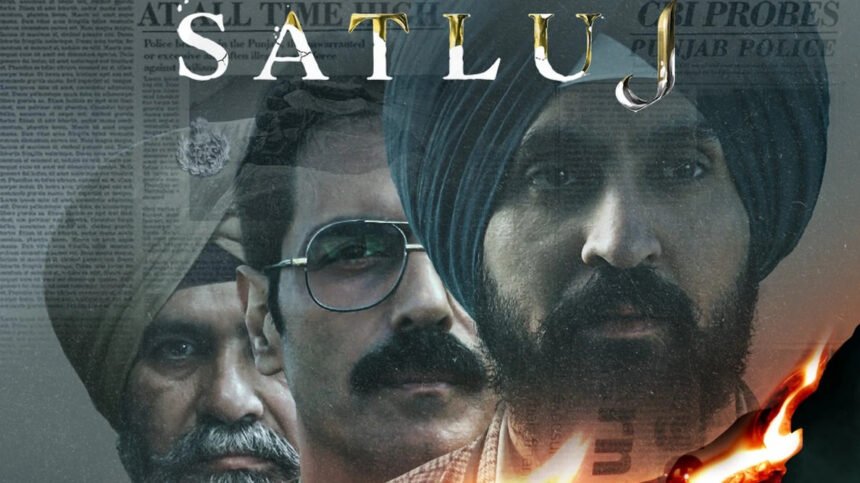
Satluj Movie Review, Directed by Honey Trehan and led by Diljit Dosanjh, Satluj is a deeply unsettling political drama inspired by the life, work, disappearance, and killing of human rights activist Jaswant Singh Khalra. The film explores one of the darkest chapters in Punjab’s recent history, when allegations of extrajudicial killings, secret cremations, enforced disappearances, and unchecked police power raised serious questions about the price paid by ordinary citizens during the fight against militancy.
Previously known as Punjab ’95, the film follows Khalra’s transformation from a bank manager and family man into a determined human rights campaigner who discovers evidence suggesting that thousands of unidentified bodies were cremated by the authorities. This Diljit Dosanjh Satluj review explores how the actor delivers one of the most restrained and emotionally powerful performances of his career while bringing Khalra’s remarkable journey to life.
But Satluj is not simply a biographical drama.
Most importantly, it asks a question that remains relevant far beyond the events depicted on screen: What happens when the institutions responsible for protecting citizens begin operating above the law?
That question gives Satluj its political force, emotional weight, and disturbing contemporary relevance.
Satluj Review: Why This Political Drama Demands Attention
At its core, Satluj tells the story of one man’s decision to investigate something that powerful people would prefer to keep hidden.
Jaswant Singh Khalra is introduced not as a conventional cinematic hero but as an ordinary man with an extraordinary sense of responsibility.
He is a bank employee, husband, father, friend, and member of his community. He does not begin his journey seeking confrontation with the government or police administration.
Instead, circumstances push him toward activism.
The disappearance of people around him leads Khalra toward a horrifying discovery. Records connected to cremation grounds appear to indicate that large numbers of bodies had been cremated after being classified as unidentified or unclaimed.
Where did these people come from?
Who were they?
Were their families informed?
Were proper investigations conducted before they were killed?
The deeper Khalra investigates, the more disturbing the picture becomes.
Satluj builds its narrative around this gradual discovery, allowing viewers to understand why an ordinary citizen would risk his safety, career, and eventually his life to demand answers.
The result is a political drama that works not because it constantly delivers speeches but because it makes the consequences of institutional abuse deeply personal.
The Historical Context Behind Satluj
Satluj Movie Review, Understanding Satluj requires understanding the environment in which its story unfolds.
Punjab experienced an extended period of militancy, political violence, terrorism, and aggressive counterinsurgency operations during the 1980s and early 1990s.
Thousands of civilians, security personnel, political workers, and militants lost their lives.
The state faced a genuine security crisis.
Police forces were under enormous pressure to eliminate armed groups and restore stability.
However, Satluj focuses on the dangerous consequences that can emerge when extraordinary police powers are exercised without sufficient transparency and accountability.
The film presents allegations of illegal detentions, disappearances, extrajudicial executions, and secret cremations.
Its central argument is not that governments should ignore terrorism or violent extremism.
Instead, the film raises a more difficult question.
Can a democratic state defeat terrorism by abandoning the principles of justice and due process that distinguish democracy from authoritarianism?
That is where Satluj becomes more than a historical drama.
It becomes a warning.
Security institutions may require considerable authority during extraordinary situations. But authority without accountability can become something far more dangerous.
Power begins protecting itself.
Records disappear.
Witnesses become afraid.
Victims are transformed into statistics.
And justice becomes increasingly difficult to obtain.
A Chilling Opening Establishes the Film’s Political Message
Satluj opens with one of its most disturbing sequences.
A group of police officers stand in fields at night with several detained individuals.
The atmosphere initially appears strangely casual.
The officers joke with one another. They discuss their careers, relationships, and personal ambitions. One policeman complains that his girlfriend will not marry him until he receives a promotion.
Then the scene suddenly reveals its horrifying purpose.
The detained men are executed.
More people are killed because the officer allegedly needs additional bodies to strengthen his chances of promotion.
The bodies are thrown into the river.
The brilliance of the sequence lies in its disturbing normality.
The officers do not behave like stereotypical cinematic villains. They behave like employees completing a routine assignment.
That is precisely what makes the scene terrifying.
Violence has become administrative.
Human lives have become numbers.
Death has become a professional achievement.
Through this sequence, Honey Trehan immediately establishes the central concern of Satluj: What happens when institutional violence becomes normalized?
The river itself becomes an important metaphor.
Water usually represents life, movement, and renewal. Here, it becomes a silent witness carrying away evidence of crimes that powerful institutions would prefer society to forget.
Combined with Marc Marder’s haunting background score, the opening creates an atmosphere of dread that remains throughout the film.
Diljit Dosanjh as Jaswant Singh Khalra: An Ordinary Man Who Refuses to Stay Silent
Satluj Movie Review, The film then introduces Jaswant Singh Khalra, played with remarkable restraint by Diljit Dosanjh.
Khalra is not presented as someone searching for martyrdom.
He is compassionate, practical, and deeply connected to ordinary people.
An early scene involving an elderly couple establishes his character effectively. Despite their financial difficulties and previous loans, Khalra tries to help them because he understands their suffering.
Their son has disappeared.
That detail becomes important.
Satluj repeatedly reminds viewers that behind every disappearance is a family waiting for answers.
Parents wait for children who never return.
Wives wait for husbands.
Children grow up without knowing what happened to their fathers.
Khalra’s journey begins when he investigates the disappearance of the mother of a close friend who has been killed.
His search leads him toward cremation records suggesting that she may have been among numerous unidentified bodies cremated by the authorities.
But one cremation ground is only the beginning.
As Khalra continues investigating, he discovers similar patterns elsewhere.
The scale of the alleged violations becomes impossible to ignore.
At that moment, Khalra faces a choice.
He can protect himself and remain silent.
Or he can speak.
He chooses to speak.
And that decision changes everything.
Satluj Shows How Activism Begins With Asking Simple Questions
One of the film’s greatest strengths is the way it portrays activism.
Satluj does not present Khalra as a revolutionary figure from the beginning.
He becomes an activist because official explanations fail to answer basic questions.
Where are the missing people?
Who authorized these actions?
Who will investigate the investigators?
These questions become increasingly dangerous because they challenge institutions accustomed to operating without scrutiny.
Khalra begins documenting cases, collecting evidence, speaking with families, approaching courts, and raising awareness about alleged human rights violations.
His campaign gradually attracts national and international attention.
But visibility brings danger.
Officials and political figures become increasingly uncomfortable with his activism.
Threats begin.
Pressure increases.
Khalra is encouraged to stop.
Yet he refuses.
The film makes an important point here.
Power rarely fears noise alone.
What power fears is evidence.
Documents.
Names.
Records.
Witnesses.
Patterns.
When scattered tragedies become organized evidence, they become much harder to dismiss.
Khalra understands this.
That understanding ultimately makes him dangerous to those who want the past buried.
The Controversy Around Satluj and Its Censorship Battle
Satluj Movie Review, Satluj has attracted significant attention not only because of its subject matter but also because of the long controversy surrounding its release.
Originally titled Punjab ’95, the film reportedly faced extensive certification disputes and demands for numerous changes.
The controversy itself has become closely connected to the film’s message.
Why?
Because Satluj is fundamentally about suppression.
It is about powerful institutions attempting to control information.
It is about people struggling to make uncomfortable truths visible.
Therefore, restrictions surrounding the film inevitably invite a broader debate about artistic freedom, political cinema, censorship, and the public’s right to engage with difficult historical subjects.
The controversy also raises an important question.
Should audiences be protected from politically uncomfortable stories, or should they be allowed to watch them and reach their own conclusions?
Political cinema has always been controversial.
Films dealing with state violence, communal conflict, terrorism, nationalism, human rights, and institutional accountability naturally provoke strong reactions.
But controversy should encourage discussion.
It should not automatically become justification for silence.
If a democracy is confident in its institutions, difficult films should be answered with debate, criticism, historical evidence, and competing interpretations.
Suppressing uncomfortable stories often gives them even greater political significance.
In the case of Satluj, the censorship controversy has made the film’s central themes even more relevant.
Honey Trehan Uses a Three-Part Narrative to Build Emotional Momentum
Director Honey Trehan structures Satluj through three broad narrative movements.
The first section focuses on Jaswant Singh Khalra’s discovery of alleged human rights violations and his transformation into an activist.
The second shifts toward the investigation into his disappearance.
The third explores the terrifying consequences of his abduction.
This structure gives the film both emotional depth and procedural urgency.
The first act belongs primarily to Diljit Dosanjh.
Then the narrative changes direction.
After Khalra disappears, the film increasingly becomes an investigation drama.
Arjun Rampal’s character, CBI officer Samudra Singh, assumes greater importance as investigators attempt to understand what happened.
The transition could have weakened the film.
Instead, it expands the story.
Khalra may no longer dominate every scene physically, but his presence continues to shape the entire narrative.
His absence becomes a character in itself.
Every document, witness, interrogation, and confrontation reminds viewers why the investigation matters.
When the Police Become Judge, Jury and Executioner
Satluj Movie Review, The most disturbing aspect of Satluj is its portrayal of unchecked police authority.
The film does not deny the reality of terrorism or the enormous challenges faced by law enforcement agencies during periods of violent insurgency.
Instead, it asks whether fighting terrorism can justify abandoning the law.
That distinction matters.
A democracy grants police institutions the authority to arrest suspects, investigate crimes, and use force under legally defined circumstances.
But what happens when officers begin deciding who deserves to live or die?
Satluj portrays a system in which the machinery of law enforcement gradually becomes detached from legal accountability.
The consequences are catastrophic.
Once police officers believe they are above the law, anyone can become a target.
Political opponents.
Activists.
Witnesses.
Journalists.
Ordinary citizens.
Even fellow police officers.
The film’s warning is simple but powerful: Institutions created to protect society can become dangerous when nobody is allowed to question them.
Suvinder Vicky Delivers a Terrifying Performance as SSP Sugga
Among the film’s strongest performances is Suvinder Vicky as SSP Sugga.
Sugga represents the psychology of institutional violence.
He does not consider himself evil.
He believes he is protecting the state.
In his mind, extraordinary circumstances require extraordinary actions.
Terror must be answered with greater terror.
Fear becomes a weapon.
Violence becomes policy.
Human rights become obstacles.
This mentality makes Sugga particularly frightening.
A villain motivated by personal greed is easy to understand.
A man who believes every atrocity he commits serves a higher purpose is far more dangerous.
One of the film’s most disturbing moments involves the killing of a policeman’s family after the officer assists Khalra.
The victims are subsequently branded as terrorists.
The sequence demonstrates how completely the system has abandoned morality.
Truth no longer matters.
Labels matter.
Control matters.
Protecting the institution matters.
Suvinder Vicky delivers the role with frightening conviction. He avoids exaggerated villainy and instead creates a character whose confidence comes from knowing that the system protects him.
That makes his performance even more unsettling.
Kanwaljit Singh and the Machinery of Institutional Power
Satluj Movie Review, Kanwaljit Singh plays DGP Bitta, a senior official who represents another level of the system.
If Sugga is the weapon, Bitta is the authority allowing the weapon to operate.
His performance demonstrates how institutional abuse rarely depends on one violent individual.
Systems require cooperation.
Senior officials look away.
Subordinates follow orders.
Records are manipulated.
Witnesses are intimidated.
Investigations are delayed.
Responsibility becomes distributed across the bureaucracy until nobody accepts accountability.
That is one of Satluj’s strongest observations.
Large-scale injustice does not always require thousands of openly evil people.
Sometimes it requires a system where enough individuals decide that silence is safer than resistance.
Diljit Dosanjh Gives One of His Most Controlled Performances
Diljit Dosanjh carries the emotional foundation of Satluj.
His performance is intentionally understated.
There are no unnecessary heroic speeches.
No exaggerated displays of courage.
No attempt to transform Jaswant Singh Khalra into a conventional action hero.
Instead, Diljit portrays courage as persistence.
Khalra continues asking questions even when the answers become dangerous.
That quiet determination makes the performance powerful.
One particularly emotional scene involves Khalra explaining his refusal to abandon the struggle through the metaphor of a lamp.
A single lamp may appear small against overwhelming darkness.
But darkness cannot erase the meaning of light.
The metaphor captures the film’s central philosophy.
One person may not defeat an entire system.
But one person can expose it.
And exposure can begin change.
Diljit Dosanjh understands the emotional requirements of the role and avoids turning Khalra into a larger-than-life cinematic figure.
His humanity makes his fate even more devastating.
Geetika Vidya Ohlyan Brings Strength and Dignity to Paramjit Kaur
Satluj Movie Review, Geetika Vidya Ohlyan delivers an equally important performance as Paramjit Kaur.
Political dramas often reduce the wives of male activists to background figures whose primary responsibility is to cry, worry, and wait.
Satluj avoids that mistake.
Paramjit understands the danger surrounding her husband’s work.
She experiences fear, anger, grief, and uncertainty.
But she also demonstrates extraordinary determination.
After Khalra disappears, his fight does not disappear with him.
His family continues demanding answers.
Paramjit becomes part of the larger struggle for justice.
Ohlyan’s restrained performance gives the character emotional credibility.
She does not need dramatic monologues to communicate suffering.
Her expressions, silences, and controlled anger are enough.
Through Paramjit, the film reminds viewers that political violence never affects only the direct victim.
Families inherit the consequences.
Sometimes they also inherit the fight.
Arjun Rampal Adds Gravitas to the Investigation
The second half of Satluj increasingly relies on Arjun Rampal’s performance as CBI officer Samudra Singh.
Rampal brings calm intensity to the role.
His character is not presented as a perfect hero.
Witnesses are frightened.
Evidence is difficult to obtain.
Officials protect one another.
People change statements.
Potential witnesses disappear.
The system creates obstacles at every stage.
Rampal’s restrained performance works because he never tries to overpower the story.
Instead, he becomes the audience’s guide through the investigation.
As Samudra Singh moves closer to the truth, the procedural sections become increasingly tense.
His confrontations with Sugga are particularly effective.
These scenes represent two competing ideas of law enforcement.
One believes authority must operate within the law.
The other believes authority is the law.
That ideological conflict gives the investigation much of its dramatic power.
Satluj Avoids Turning Violence Into Entertainment
Satluj Movie Review, A film dealing with custodial violence, torture, and extrajudicial killings faces an important creative challenge.
How much violence should be shown?
Too little, and the audience may fail to understand the brutality of the events.
Too much, and suffering can become exploitation.
Honey Trehan generally maintains the right balance.
Satluj contains disturbing sequences, particularly during its final act.
But the violence is not presented as spectacle.
The camera does not celebrate brutality.
Instead, it emphasizes humiliation, fear, helplessness, and institutional cruelty.
This restraint makes the film more powerful.
Viewers are not invited to enjoy violence.
They are forced to confront its consequences.
That difference separates serious political cinema from sensationalism.
The Supporting Cast Strengthens the Film’s Realism
Satluj benefits from a strong supporting cast.
Jagjeet Sandhu delivers an impressive performance as rookie policeman Kuljit Singh, particularly during the final section of the film.
His character demonstrates the moral conflicts that can emerge within corrupt institutions.
Not everyone inside a broken system begins as a monster.
And a few attempt to resist.
The film uses these different responses to show how institutional abuse survives.
Saurabh Sachdeva also leaves an impression despite limited screen time.
Vansh Bhardwaj, Vikas Mohla, Amit Dhawan, and other supporting performers contribute to the oppressive atmosphere surrounding the police establishment.
Together, they create a believable institutional ecosystem rather than a collection of one-dimensional villains.
Satluj Is More Than a Jaswant Singh Khalra Biopic
Satluj Movie Review, Comparisons with Diljit Dosanjh’s previous biographical performances are inevitable.
However, Satluj differs from a conventional biopic.
The film does not attempt to document every major event in Khalra’s life.
Instead, it concentrates on the investigation that transformed him into one of India’s most prominent human rights activists.
This approach strengthens the film.
The story remains focused.
Khalra’s personal journey becomes the gateway to a larger examination of democracy, policing, state violence, and accountability.
In that sense, Satluj is not only about one man.
Khalra becomes the moral center of a much larger political story.
Why Satluj Feels Relevant Beyond Punjab and the 1990s
The events depicted in Satluj belong to a particular historical period.
But the questions raised by the film are universal.
How much power should governments have during national security crises?
Can police encounters ever replace due process?
What protections should exist for human rights activists?
How independent should investigative agencies be?
What happens when witnesses fear the authorities more than criminals?
Can governments investigate allegations against their own institutions fairly?
What responsibility does society have toward victims who lack political influence?
These questions are not limited to Punjab.
They are relevant to every democracy.
That is why political films like Satluj can make governments and institutions uncomfortable.
Audiences may watch a story about the past and begin asking questions about the present.
That ability to encourage questioning gives political cinema its power.
The Film’s Greatest Strength Is Its Demand for Accountability
Satluj Movie Review, Satluj does not offer easy answers.
It does not claim that governing during periods of terrorism is simple.
It does not pretend police officers faced no genuine threats.
Instead, it argues that difficult circumstances make accountability more important, not less.
These principles are not anti-state.
They are fundamental to democratic governance.
A government is strongest when citizens trust its institutions.
Trust cannot be demanded.
It must be earned through transparency, accountability, and respect for the law.
Satluj repeatedly returns to that idea.
The Painful Irony at the Heart of Jaswant Singh Khalra’s Story
Perhaps the most tragic aspect of the film is the irony surrounding Khalra’s fight.
He begins investigating disappearances because thousands of families lack answers.
Eventually, he disappears too.
His own family is forced into the same struggle experienced by the families he tried to help.
The activist becomes a victim.
The investigator becomes another case.
The man demanding accountability becomes evidence of why accountability is necessary.
That irony gives Satluj its devastating emotional power.
Yet the film also suggests that sacrifice can produce consequences that institutions cannot permanently suppress.
Public attention grows.
Investigations begin.
Evidence emerges.
Courts become involved.
The demand for justice continues.
Khalra’s voice survives because others refuse to stop speaking.
That may be the film’s most important message.
Systems can silence individuals.
Silencing ideas is much harder.
Satluj Review: Final Verdict
Satluj is a brave, disturbing, and politically significant drama that refuses to treat state violence as an abstract historical subject.
Honey Trehan delivers a controlled and emotionally powerful film that combines biographical drama, political commentary, investigative thriller, and institutional critique.
Diljit Dosanjh gives a deeply sincere performance as Jaswant Singh Khalra, capturing the quiet courage of an ordinary man who chooses to confront extraordinary injustice.
Arjun Rampal brings gravitas and controlled intensity to the investigation.
Suvinder Vicky is terrifying as a police officer whose belief in his own righteousness makes him even more dangerous.
Geetika Vidya Ohlyan, Kanwaljit Singh, Jagjeet Sandhu, and the supporting cast add emotional and dramatic depth to the narrative.
The film’s greatest achievement, however, lies in the questions it leaves behind.
Who protects citizens when the institutions responsible for protecting them become the source of fear?
Can national security justify abandoning due process?
How much power is too much power?
And what responsibility do ordinary people have when they discover injustice?
Satluj does not provide comfortable answers.
It asks viewers to think.
That alone makes it important political cinema.
Read More: Alpha X Review: Alia Bhatt & Sharvari Deliver Stylish Spy Action, but the Story Divides
Conclusion
Satluj Movie Review, Satluj is ultimately a story about memory, courage, institutional power, and the enormous personal cost of demanding accountability.
Through Jaswant Singh Khalra’s journey, the film shows how one ordinary individual can challenge a powerful system simply by documenting evidence, asking questions, and refusing to remain silent.
The film is also a warning.
Democratic institutions do not remain democratic automatically.
They remain democratic only when citizens, courts, journalists, investigators, activists, and public officials continue demanding transparency and accountability.
Sometimes, that is precisely where the real struggle begins.