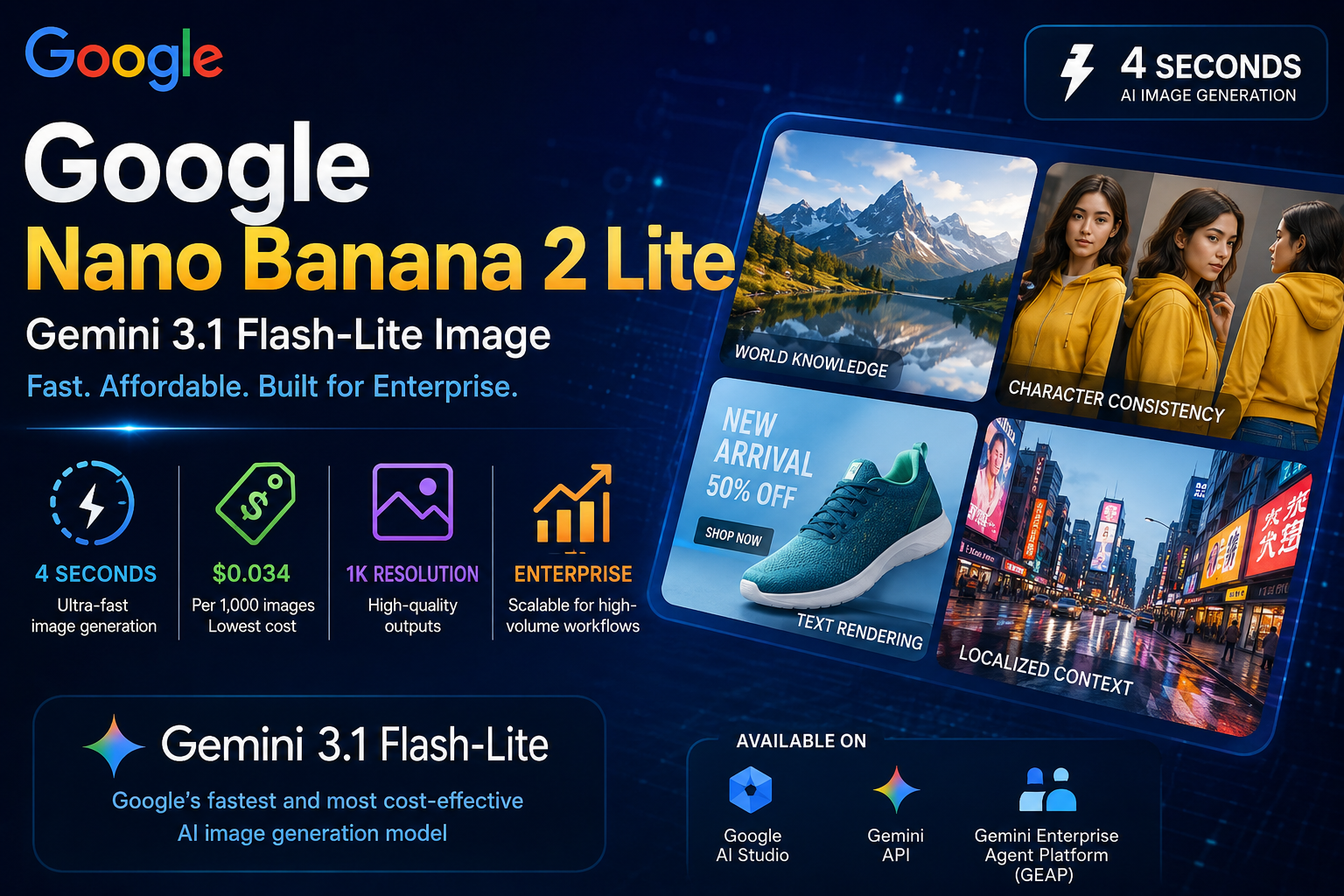
Google Nano Banana 2 Lite, Artificial intelligence is evolving at an incredible pace, and Google has just taken another major leap forward. The tech giant has officially introduced Nano Banana 2 Lite (NB2 Lite), technically known as Gemini 3.1 Flash-Lite Image, a lightweight AI image generation model designed to deliver exceptional speed without driving up costs.
For businesses that depend on producing thousands—or even millions—of AI-generated images every month, this launch could be a game changer. Instead of waiting several seconds or paying premium prices for every image, developers can now generate high-quality visuals in around four seconds using Google AI image generator technology at one of the industry’s lowest costs. This makes the Google AI image generator an attractive solution for enterprises seeking faster, more affordable, and scalable AI-powered visual content creation.
The announcement reflects Google’s growing focus on enterprise AI, where speed, scalability, and affordability often matter more than artistic perfection. Whether it’s creating marketing graphics, localizing advertisements, designing product mockups, or powering automated creative workflows, Nano Banana 2 Lite aims to become the invisible engine behind modern digital content production.
Let’s take a closer look at what Google’s newest AI model offers and why it could reshape enterprise image generation.
What Is Nano Banana 2 Lite?
Nano Banana 2 Lite is Google’s newest lightweight AI image generation model built on the Gemini 3.1 Flash Lite architecture. Unlike larger creative AI models that prioritize maximum image quality and advanced customization, NB2 Lite focuses on delivering rapid results while consuming fewer computing resources.
The model has been engineered specifically for organizations that require high-volume image generation instead of occasional creative projects. It strikes a balance between quality, speed, and operating costs, making it particularly attractive for businesses managing automated visual production pipelines.
Google has made the model immediately available through several enterprise platforms, including:
- Google AI Studio
- Gemini API
- Gemini Enterprise Agent Platform (GEAP)
This broad integration allows developers to begin building AI-powered image generation directly into their applications without waiting for additional releases.
Why Google Built a Lightweight AI Image Model
Google Nano Banana 2 Lite, Large AI image generators often face a common challenge—they’re powerful but expensive.
Generating thousands of images using traditional models requires substantial computing power, leading to higher infrastructure expenses and longer processing times. For enterprises running large marketing campaigns or automated design systems, those delays quickly become costly.
Google developed Nano Banana 2 Lite to solve exactly this problem.
Rather than maximizing artistic complexity, the company optimized the model for efficiency. The result is an AI system capable of producing images rapidly while dramatically reducing operational costs.
Think of it like comparing a sports car with a delivery scooter. While the sports car may offer more horsepower, the scooter is far more practical for making hundreds of quick deliveries every day. Nano Banana 2 Lite plays a similar role in AI image generation.
Lightning-Fast Image Generation in Just Four Seconds
Perhaps the biggest highlight of Nano Banana 2 Lite is its remarkable speed.
According to Google, the model can generate a standard 1K-resolution image in approximately four seconds.
For organizations producing massive quantities of visuals, shaving even a few seconds off every request creates enormous productivity gains over time.
Fast generation speeds enable businesses to:
- Produce marketing assets instantly
- Generate advertising variations in real time
- Create rapid design prototypes
- Accelerate software development workflows
- Improve customer-facing AI applications
In today’s digital economy, speed often translates directly into competitive advantage.
Industry-Leading Low Cost Makes Enterprise AI More Accessible
Google Nano Banana 2 Lite, Cost is another area where Google’s latest model stands out.
Nano Banana 2 Lite costs just $0.034 per 1,000 generated images, making it the most affordable image generation model in Google’s current portfolio.
Here’s how the pricing compares:
| AI Model | Cost Per 1,000 Images |
|---|---|
| Nano Banana 2 Lite | $0.034 |
| Nano Banana (NB1) | $0.039 |
| Nano Banana 2 | $0.067 |
| Nano Banana Pro | $0.134 |
This pricing strategy significantly lowers the financial barrier for startups, software developers, digital agencies, and large enterprises alike.
Instead of limiting AI-generated visuals to premium projects, organizations can now integrate image generation into everyday operations without worrying about excessive costs.
Built for High-Volume Enterprise Workflows
Unlike consumer-focused AI image generators that emphasize artistic creativity, Nano Banana 2 Lite is designed to function quietly behind the scenes.
Google envisions the model powering large-scale automated systems such as:
- Digital commerce platforms
- Marketing automation software
- Advertising technology
- Website localization
- AI content management systems
- Product catalog generation
These environments often require thousands of nearly identical images with slight variations.
Rather than manually designing each visual, businesses can automate the entire process using AI.
Improved World Knowledge Creates More Accurate Visuals
Google Nano Banana 2 Lite, Google has upgraded the model’s contextual understanding, often referred to as “world knowledge.”
This enhancement allows Nano Banana 2 Lite to create scenes that better reflect real-world environments and relationships.
For example, if an application requests a local coffee shop in Tokyo or a Parisian street market, the AI has a stronger understanding of what those environments should realistically resemble.
This capability proves especially valuable for:
- Geographic localization
- Travel marketing
- Educational graphics
- Retail storefront mockups
- Business presentations
More accurate contextual understanding means less manual editing after image generation.
Better Character Consistency Solves a Long-Standing AI Problem
One of AI image generation’s biggest weaknesses has always been maintaining consistent characters across multiple images.
A character created in one image often looks noticeably different in the next.
Google claims Nano Banana 2 Lite significantly improves this issue through enhanced character consistency.
This feature benefits industries including:
Storyboarding
Creative teams can maintain identical characters throughout visual narratives.
Fashion and Retail
Virtual models can remain consistent while showcasing different clothing items.
Gaming
Concept artists can preserve character identity across development stages.
Advertising
Brands can maintain visual consistency throughout entire campaigns.
Consistency may sound like a small improvement, but for professional production environments, it dramatically reduces editing time.
Enhanced Text Rendering Makes AI Images More Useful
Google Nano Banana 2 Lite, Embedding readable text into AI-generated images has historically been difficult.
Letters often appear distorted, misspelled, or unreadable.
Nano Banana 2 Lite introduces improved typography rendering, allowing developers to include clearer text directly within generated visuals.
This enhancement helps businesses rapidly create:
- Promotional banners
- Digital advertisements
- Social media graphics
- Product labels
- Marketing posters
- Localized multilingual campaigns
Instead of correcting text manually, teams can evaluate layouts almost instantly.
Understanding the Trade-Offs of Nano Banana 2 Lite
Every lightweight AI model makes certain compromises, and Google openly acknowledges them.
Unlike Nano Banana 2 and Nano Banana Pro, the Lite version supports only 1K image resolution.
Higher resolutions such as 2K and 4K are unavailable.
For enterprises focused on speed rather than ultra-high-definition artwork, this limitation is relatively minor.
The restricted resolution enables Google to optimize processing speed while reducing infrastructure demands.
It’s a deliberate engineering decision rather than a technical limitation.
Benchmark Performance Shows Impressive Results
Despite being a lightweight model, Nano Banana 2 Lite performs surprisingly well in benchmark testing.
Google reports a Text-to-Image Arena Elo score of 1251.
That score surpasses:
- Nano Banana (NB1): 1151
- Nano Banana Pro: 1245
The model also achieves:
- Single-image editing score: 1308
- Multi-image editing score: 1294
These numbers suggest Google has successfully balanced efficiency with quality.
Instead of sacrificing performance entirely, the company has optimized the model to deliver competitive results while operating faster and at significantly lower costs.
Ideal Use Cases for Nano Banana 2 Lite
Google Nano Banana 2 Lite, Google isn’t positioning NB2 Lite as an artistic masterpiece generator.
Instead, it’s targeting practical business applications where automation matters most.
Some of the strongest use cases include:
Digital Marketing
Generate thousands of personalized advertisements for different audiences.
A/B Testing
Rapidly produce multiple design variations to identify the highest-performing campaigns.
E-Commerce
Automatically create product images, promotional graphics, and storefront assets.
Software Development
Integrate AI-generated visuals directly into applications through APIs.
Rapid Prototyping
Design teams can quickly visualize concepts before investing in detailed artwork.
Localization
Generate region-specific marketing materials with contextual imagery and readable local language text.
For companies operating at scale, these efficiencies translate directly into faster production cycles and reduced operational costs.
Developers Should Know About Image Editing Performance
Although image generation is highly optimized, Google notes that editing existing images may take slightly longer.
Why?
Image editing requires additional processing because the AI must first analyze existing pixels before creating updated versions.
This extra computational step naturally increases response time compared to generating entirely new images.
However, the delay remains relatively minor and is unlikely to affect most enterprise workflows.
Google’s Enterprise-First Licensing Strategy
Google Nano Banana 2 Lite, Unlike many open-source AI image models, Nano Banana 2 Lite isn’t available for local deployment.
Instead, Google distributes it exclusively through its cloud infrastructure and proprietary APIs.
This managed approach offers several benefits:
- No hardware management
- Automatic scaling
- Continuous updates
- Enterprise-grade security
- Simplified deployment
On the flip side, organizations remain dependent on Google’s cloud ecosystem and usage-based pricing.
Businesses seeking complete control over deployment may still prefer open-weight alternatives, but enterprises already invested in Google’s services will likely appreciate the convenience.
Can Nano Banana 2 Lite Compete with Emerging Rivals?
Competition in AI image generation has become increasingly intense.
Several startups are introducing lightweight models that emphasize speed and flexibility, with some even adopting partially open licensing that allows developers to customize and commercially deploy the technology.
Google, however, is taking a different path.
Rather than competing solely on openness, it is leveraging its vast cloud infrastructure, developer ecosystem, and integration with existing enterprise products. Combined with extremely aggressive pricing, Nano Banana 2 Lite offers businesses an attractive solution that minimizes setup complexity while delivering reliable performance.
For organizations already using Google’s AI services, the new model fits naturally into existing workflows and may prove more practical than managing self-hosted alternatives.
How Nano Banana 2 Lite Fits into Google’s Broader AI Vision
Google launched Nano Banana 2 Lite alongside the public preview of Google Gemini Omni Flash, a multimodal AI model capable of conversational video generation and editing.
While Omni Flash represents Google’s long-term ambitions in AI-powered video creation, Nano Banana 2 Lite serves a different purpose.
It’s the practical workhorse.
Instead of dazzling users with advanced multimedia capabilities, it quietly handles the repetitive image generation tasks businesses perform every day.
Together, these products illustrate Google’s strategy of building an entire AI ecosystem capable of supporting everything from quick image creation to sophisticated video production.
Read More: Google Search AI Mode Unveiled at Google I/O 2026: Everything You Need to Know
Conclusion
Google’s launch of Nano Banana 2 Lite (Gemini 3.1 Flash-Lite Image) represents more than just another AI model release—it signals a strategic push toward making enterprise AI image generation faster, cheaper, and easier to scale.
By generating 1K-resolution images in roughly four seconds while costing only $0.034 per 1,000 images, the model delivers an impressive combination of speed and affordability. Its improvements in contextual understanding, character consistency, and text rendering make it well suited for marketing automation, e-commerce, software development, and large-scale creative workflows.
Although it sacrifices higher-resolution output in favor of efficiency, Nano Banana 2 Lite demonstrates that lightweight AI models no longer need to compromise significantly on quality. As businesses continue integrating generative AI into daily operations, Google’s latest offering positions itself as a powerful infrastructure layer designed for the demands of modern enterprise environments.