
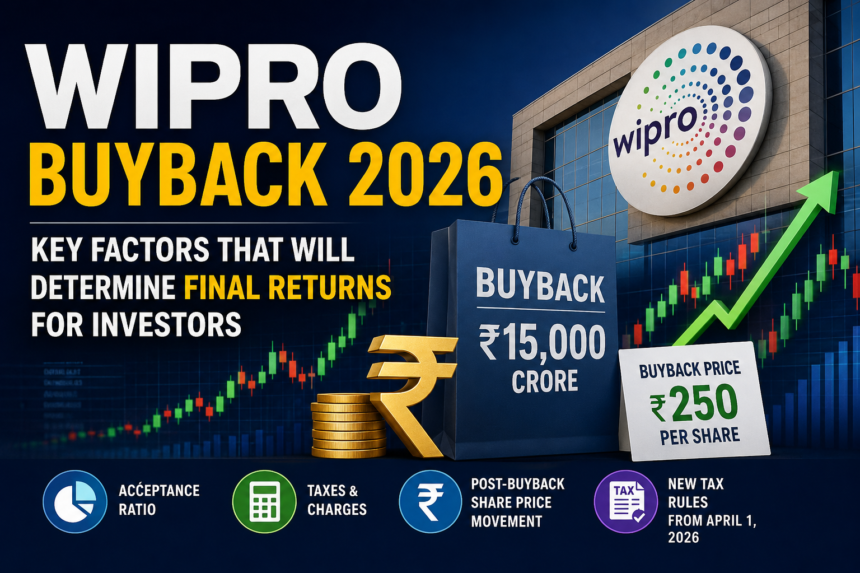
Wipro Buyback 2026, India’s IT giant Wipro has announced a massive ₹15,000 crore buyback plan, instantly grabbing the attention of retail investors across the country. At first glance, the offer sounds almost irresistible. After all, the company is offering a buyback price of ₹250 per share, which appears significantly higher than the prevailing market price.
But here’s the big question — will investors actually earn as much profit as they expect?
That’s where the real story begins.
So before jumping into the Wipro buyback frenzy, let’s break down the factors that could truly decide whether investors make strong gains or end up disappointed.
What Is Wipro’s 2026 Buyback Plan?
Wipro has announced plans to repurchase shares worth ₹15,000 crore through the tender offer route. Under this mechanism, eligible shareholders can tender their shares back to the company at a fixed buyback price.
The company plans to buy back up to 60 crore equity shares from shareholders.
Naturally, such announcements create excitement in the stock market because the buyback price is usually set at a premium compared to the current market value. Investors often rush to buy shares hoping to pocket quick profits.
However, buybacks are not as straightforward as they seem.
Why Buyback Offers Look So Attractive
Wipro Buyback 2026, Think of a buyback like a supermarket offering to repurchase a product from customers at a price higher than what others are willing to pay. Sounds amazing, right?
That’s exactly why buybacks attract attention.
If an investor buys Wipro shares at a lower market price and the company offers ₹250 per share in the buyback, the immediate assumption is simple:
Buyback Price – Purchase Price = Profit
But stock market math rarely stays that simple.
Several hidden elements can quietly eat into those expected profits.
The Biggest Catch: Not All Shares Get Accepted
This is probably the most misunderstood part of any buyback.
In a tender offer buyback, companies do not purchase every share submitted by investors. Instead, they buy only a limited quantity.
That’s where the acceptance ratio becomes extremely important.
Understanding Acceptance Ratio
The acceptance ratio determines how many shares the company will actually buy from each investor.
For example:
- You own 100 shares
- You tender all 100 shares
- But the company accepts only 25 shares
That means only 25 shares are sold at the attractive buyback price. The remaining 75 shares stay in your demat account.
And this changes the entire profit calculation.
Why Wipro’s Acceptance Ratio May Stay Low
Wipro Buyback 2026, Wipro is buying back only around 5.7% of its total outstanding shares. That’s a relatively small portion compared to the total number of shares available in the market.
As a result, competition among investors could become intense.
A large number of retail participants may apply for the buyback, which could reduce the final acceptance ratio substantially.
In simple words, many investors may end up selling only a small portion of their holdings at ₹250.
That can dramatically reduce the expected gains.
The Real Risk: Remaining Shares Could Lose Value
Here’s something many first-time investors fail to consider.
The shares that are not accepted in the buyback remain in the investor’s account. Once the excitement around the buyback fades, the stock price may decline.
This is common in many buyback situations.
Why does it happen?
Because investors who entered only for short-term gains often begin selling their leftover shares after the buyback process ends. That selling pressure can drag the stock price lower.
Imagine getting only 20 shares accepted while the remaining shares fall sharply in value afterward. Suddenly, the attractive buyback doesn’t look so profitable anymore.
Taxes Can Quietly Reduce Final Earnings
Another major factor investors often ignore is taxation.
Even though the taxation system for buybacks changed in 2026, taxes still play a significant role in reducing actual returns.
Investors must account for:
- Capital gains tax
- Brokerage charges
- Securities Transaction Tax (STT)
- GST on brokerage
- Stamp duty
All these deductions can significantly lower the final net profit.
It’s similar to ordering food online. The menu price looks affordable until delivery charges, taxes, and platform fees suddenly inflate the final bill.
New Buyback Tax Rules From April 1, 2026
Wipro Buyback 2026, The taxation structure for buybacks underwent a major shift starting April 1, 2026.
Earlier, buyback proceeds were taxed similarly to dividend income. Investors had to pay tax on the entire amount received without deducting the original purchase cost.
Now, the rules have changed.
Buybacks are treated like regular share sales and taxed under capital gains taxation.
That’s an important improvement because investors can now subtract their purchase cost before calculating taxable profit.
Example of How Capital Gains Tax Works
Let’s understand this with a simple example.
Suppose an investor purchased:
- 1,000 shares at ₹200 each
- Total investment = ₹2 lakh
Now assume Wipro buys back those shares at ₹500 per share.
- Total buyback value = ₹5 lakh
- Capital gains = ₹3 lakh
If these gains qualify as long-term capital gains (LTCG), then:
- Exemption available up to ₹1.25 lakh
- Taxable amount = ₹1.75 lakh
LTCG Tax Calculation
1.75 lakh×12.5%=21,8751.75\text{ lakh} \times 12.5\% = 21,875
So the investor would pay ₹21,875 as long-term capital gains tax.
And that’s before considering brokerage and other transaction charges.
Why Retail Investors Often Miscalculate Buyback Profits
Many investors calculate profits emotionally instead of realistically.
They see a higher buyback price and instantly assume guaranteed returns.
But actual profitability depends on multiple moving parts working together.
Key Elements That Decide Final Returns
- Acceptance ratio
- Market price movement after buyback
- Capital gains tax
- Brokerage charges
- STT
- GST on brokerage
- Stamp duty
Ignoring even one of these factors can distort the entire calculation.
Should Investors Buy Wipro Shares Only for Buyback Gains?
Wipro Buyback 2026, That depends entirely on risk appetite and investment strategy.
Short-term traders looking purely for buyback arbitrage should remain cautious because low acceptance ratios can reduce profitability.
Long-term investors, however, may view the buyback differently.
A buyback often signals that a company believes its shares are undervalued. It can also improve earnings per share (EPS) by reducing the number of outstanding shares.
But relying solely on buyback excitement for quick gains can sometimes backfire.
The market rarely rewards assumptions.
Can Wipro’s Buyback Still Be Profitable?
Yes, it certainly can be profitable — but only if investors understand the complete picture.
Those entering blindly based on the headline buyback price may feel disappointed later.
On the other hand, investors who carefully calculate expected acceptance ratio, post-tax returns, and possible stock price risks can make far more informed decisions.
In the stock market, details matter more than headlines.
And buybacks are no exception.
What Investors Should Watch Before Participating
Before investing in Wipro specifically for the buyback, investors should carefully monitor:
1. Expected Acceptance Ratio
This will likely become the single biggest factor determining profitability.
2. Stock Price Movement
If the market price rises too close to the buyback price, the arbitrage opportunity shrinks.
3. Tax Implications
Different investors may face different tax outcomes depending on holding period and tax slab.
4. Overall Market Sentiment
Weak market conditions can negatively affect leftover shares after the buyback process.
Read More: Union Budget 2026-27 Highlights: AI Push, Tax Relief, and Major Economic Reforms
Conclusion
Wipro Buyback 2026, Wipro’s ₹15,000 crore buyback has undoubtedly generated strong excitement among retail investors. The ₹250 per share offer looks attractive on paper, and many traders are already viewing it as a quick-profit opportunity.
However, the real returns may turn out to be far lower than expected once factors like acceptance ratio, taxation, brokerage charges, and post-buyback stock movement are taken into account.
The biggest mistake investors can make is assuming that every tendered share will be accepted at the buyback price. In reality, only a portion may qualify, while the remaining shares could face market volatility afterward.
That’s why investors should approach the Wipro buyback with realistic expectations rather than blind optimism. Smart investing isn’t about chasing headlines — it’s about understanding the fine print hidden beneath them.