

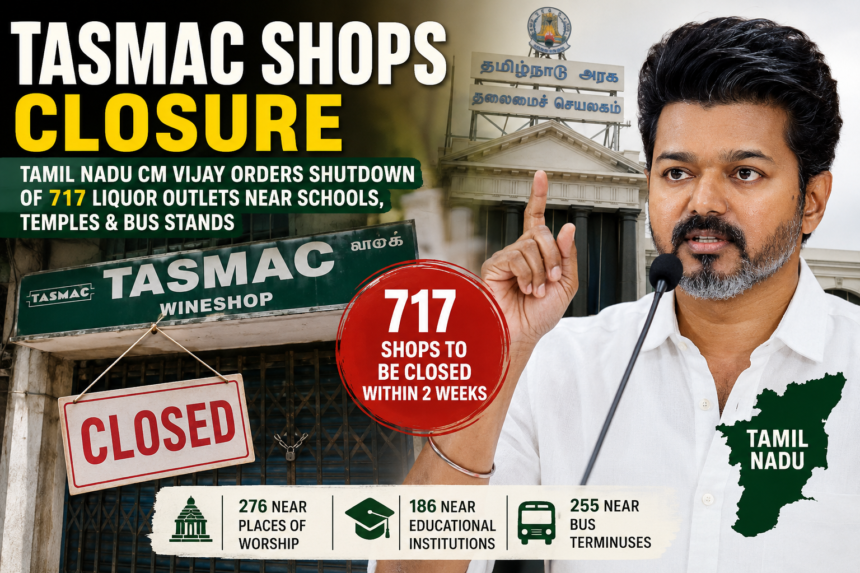
TASMAC Shops Closure, Tamil Nadu Chief Minister C. Joseph Vijay has made a strong political and social statement within days of taking office by ordering the closure of 717 TASMAC liquor shops located near educational institutions, places of worship, and bus terminuses across the State. The move has instantly sparked discussions across Tamil Nadu, with supporters calling it a bold social reform initiative while critics are closely watching how effectively the policy will be implemented.
The announcement also signals the beginning of what many believe could become a more welfare-focused and socially driven administration under Vijay’s leadership.
Massive Crackdown on TASMAC Shops Across Tamil Nadu
According to an official government release, the Tamil Nadu government has directed the closure of 717 TASMAC outlets operating within 500 metres of sensitive public spaces. These include schools, colleges, temples, churches, mosques, and major transport hubs.
Out of the total shops identified:
- 276 TASMAC shops are located near places of worship
- 186 shops operate close to educational institutions
- 255 shops are situated near bus terminuses
The closures are expected to be completed within two weeks.
Tamil Nadu State Marketing Corporation, popularly known as TASMAC, currently operates 4,765 retail liquor outlets across the State. Despite being one of the largest revenue-generating systems for the Tamil Nadu government, TASMAC has long remained controversial due to concerns over alcoholism, public nuisance, and social disruption.
Why TASMAC Shops Have Always Been Controversial
TASMAC Shops Closure, Liquor politics in Tamil Nadu is nothing new. For decades, TASMAC outlets have been at the centre of heated political and social debates. Many citizens argue that liquor shops located near schools and temples negatively influence young people and disturb the cultural atmosphere of neighbourhoods.
Women’s organisations in particular have repeatedly demanded stricter control over liquor sales. In many rural and urban communities, alcohol abuse has been linked to domestic violence, financial distress, and family instability.
That’s why Vijay’s announcement has struck an emotional chord with many sections of society. To them, the move represents more than just shutting shops — it signals an attempt to rebalance public welfare with government revenue generation.
A Key Election Promise Begins Taking Shape
Political observers believe the closure order is also an early indication that the new government intends to deliver visible action quickly. During the election campaign, issues surrounding governance, corruption, cost of living, and social welfare dominated political conversations in Tamil Nadu.
Now, within days of assuming office, Chief Minister Vijay has moved aggressively on one of the State’s most emotionally charged issues.
For many voters, especially women, this could strengthen public confidence in the administration’s willingness to act decisively.
Chief Minister Vijay’s First Major Administrative Move
C. Joseph Vijay was sworn in as the Chief Minister of Tamil Nadu on May 10 along with nine Cabinet Ministers. The ceremony attracted massive public attention, with thousands of supporters and fans gathering at Chennai’s Jawaharlal Nehru Stadium.
Soon after taking oath, Vijay signed three important government files, including a major welfare initiative offering 200 units of free electricity for domestic consumers who use up to 500 units every two months.
The TASMAC closure order has now become one of the defining early decisions of his administration.
Political analysts say the timing is important. New governments often try to create momentum in their first few weeks, and Vijay’s administration appears focused on projecting a strong image of governance and social reform.
Women’s Groups Welcome the Decision
TASMAC Shops Closure, Several women’s organisations and social activists across Tamil Nadu have welcomed the announcement. For years, many of these groups have campaigned against liquor outlets operating near residential areas and educational institutions.
Their argument is simple: easy access to alcohol creates wider social problems.
From household debt to road accidents and domestic violence, critics of TASMAC have consistently linked excessive alcohol consumption with broader social damage. In many districts, protests against liquor shops have become common over the last decade.
The closure of 717 shops may not completely solve the issue, but supporters believe it sends a strong symbolic message.
Economic Questions Still Remain
However, the decision also raises difficult economic questions for the Tamil Nadu government.
TASMAC contributes thousands of crores in annual revenue to the State treasury. Any large-scale reduction in liquor sales can potentially impact government finances, particularly welfare spending and public infrastructure projects.
This creates a delicate balancing act for the new administration.
Can the government maintain social reform measures while protecting State revenues? That question will likely dominate future political debates.
Some economists argue that instead of depending heavily on liquor income, Tamil Nadu should gradually diversify revenue sources through industrial growth, tourism, and technology investments.
Opposition Parties Closely Monitoring the Move
TASMAC Shops Closure, opposition parties have responded cautiously so far. While many cannot openly oppose the closure of liquor shops near schools and temples, some leaders are questioning whether the move is more symbolic than structural.
Critics point out that thousands of TASMAC outlets will still continue operating across the State. Others are waiting to see whether the government will eventually pursue broader alcohol policy reforms.
Still, the immediate public response appears largely favourable, particularly in semi-urban and rural regions where anti-liquor sentiment remains strong.
Tamil Nadu Assembly Begins New Political Chapter
On May 11, Chief Minister Vijay officially took oath as a legislator in the Tamil Nadu Legislative Assembly. Alongside him, Cabinet Ministers and senior political leaders also assumed office as members of the 17th Tamil Nadu Legislative Assembly.
Among those present were:
- Udhayanidhi Stalin
- Edappadi K. Palaniswami
- O. Panneerselvam
The oath-taking ceremony was conducted in the presence of Pro-tem Speaker M.V. Karuppaiah.
The Assembly session marked the formal beginning of a new political phase in Tamil Nadu politics, with Vijay now transitioning from cinema icon to full-time administrator.
Public Expectations Are Extremely High
One thing is already clear — expectations from the new Chief Minister are enormous.
Supporters expect rapid welfare reforms, stricter governance, improved public services, and bold political decisions. Meanwhile, critics are watching closely to see whether the administration can convert announcements into long-term structural changes.
The TASMAC closure order may only be the first test.
If implemented effectively, it could improve Vijay’s political credibility significantly. But if execution falters, opposition parties may use the issue to question the government’s administrative efficiency.
Could This Lead to Wider Liquor Reforms?
Many political observers now wonder whether this move is merely the beginning of broader alcohol regulation policies in Tamil Nadu.
Could more TASMAC shops eventually be relocated or shut down? Could the government introduce stricter licensing rules or limited operating hours?
At the moment, officials have not announced any wider prohibition roadmap. However, the strong public reaction indicates that liquor policy could remain a major issue during Vijay’s tenure.
Much will depend on how the government balances social pressure with economic realities.
The Symbolism Behind the Decision
Politics often runs on symbolism, and this decision carries powerful symbolic value.
By targeting liquor shops near temples, schools, and bus stands, the government is addressing spaces associated with faith, education, and public life. These are emotionally sensitive locations for many citizens.
The move also helps establish Vijay’s image as a leader attempting to prioritise social concerns immediately after taking office.
In politics, first impressions matter enormously — and this decision has certainly ensured that the new administration’s beginning will not go unnoticed.
The Tamil Nadu government’s decision to shut down 717 TASMAC liquor shops near educational institutions, places of worship, and transport hubs marks one of the strongest early policy actions under Chief Minister C. Joseph Vijay’s leadership. The announcement has generated widespread public attention, especially among women’s groups and social reform advocates who have long demanded tighter regulation of liquor sales.
At the same time, the decision opens up larger conversations about public health, government revenue, and the future of alcohol policy in Tamil Nadu. Whether this becomes a one-time administrative action or the beginning of broader reforms remains to be seen.
What is certain, however, is that Vijay’s government has started its tenure with a bold and highly visible message — one designed to resonate deeply with ordinary citizens across the State.
Read More: Railway Jobs 2026 RRB NTPC Group D Vacancy: Latest Notification, Eligibility & Salary
Conclusion
The TASMAC Shops Closure near schools and temples is more than just a governance decision; it reflects the changing expectations of modern Tamil Nadu society. People increasingly want governments to focus not only on economic growth but also on social well-being and community safety.
As the new administration settles into power, every policy move will be scrutinised closely. But for now, this decisive action has given supporters a glimpse of the leadership style Vijay may bring to Tamil Nadu politics — fast, symbolic, and aimed directly at public sentiment.