
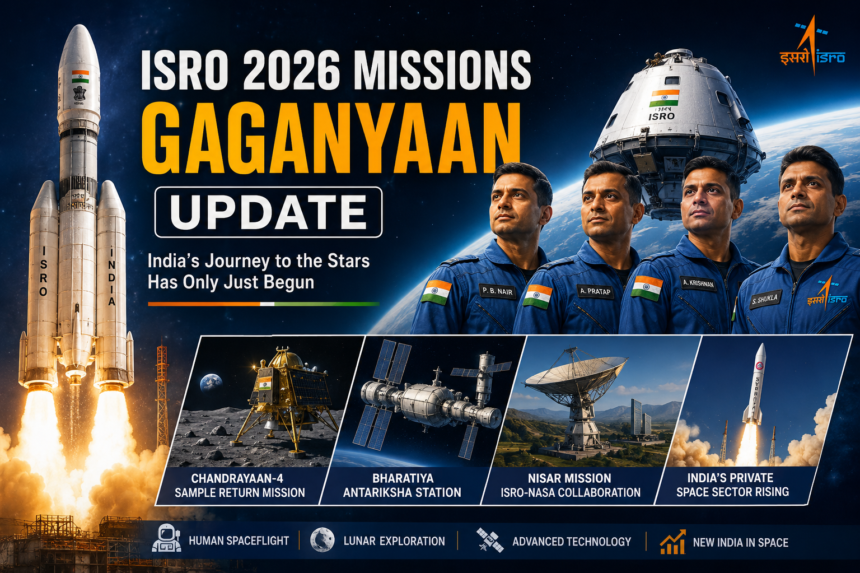
ISRO 2026 Missions Gaganyaan Update, India’s space programme is currently passing through one of the most exciting and transformative phases in its history. After the remarkable success of Chandrayaan-3’s soft landing near the Moon’s south pole in 2023, India established itself as a major global space power. The achievement made India only the fourth country to successfully soft-land on the Moon and the first nation to land near the lunar south pole.
Since then, the Indian Space Research Organisation (ISRO) has accelerated preparations for a new generation of ambitious missions. In 2026, the focus is firmly on Gaganyaan — India’s first human spaceflight mission — along with Chandrayaan-4, India’s planned lunar sample return mission. At the same time, India’s private space industry is expanding rapidly, while long-term projects like the Bharatiya Antariksha Station are shaping the country’s future in space exploration.
This comprehensive guide explains ISRO’s major missions in 2026, the latest Gaganyaan update, India’s expanding private space sector, and the country’s long-term vision for becoming a global leader in space technology.
Gaganyaan: India’s First Human Spaceflight Mission
What Is Gaganyaan?
Gaganyaan is ISRO’s historic mission to send Indian astronauts — known as Vyomanauts — into space aboard an Indian spacecraft launched from Indian soil. Once completed successfully, India will become only the fourth nation in the world to independently launch humans into space after Russia, the United States, and China.
The mission involves sending a crew of three astronauts into low Earth orbit at an altitude of around 400 kilometres. The astronauts are expected to remain in orbit for up to three days before returning safely to Earth. One of the most technically challenging parts of the mission is the re-entry phase, during which the crew module must safely withstand intense heat before splashing down in the Bay of Bengal.
Gaganyaan Mission Status in 2026
ISRO has already completed several important milestones under the Gaganyaan programme. In recent years, the organisation successfully carried out Test Vehicle Demonstration (TV-D) missions to validate the Crew Escape System. This emergency abort mechanism is designed to pull astronauts away from the rocket in case of a launch failure.
These successful tests cleared one of the most critical safety requirements for human spaceflight.
In 2026, ISRO is focusing on the final round of unmanned precursor missions before the first crewed flight. Although the mission timeline remains flexible, the first human spaceflight is expected no earlier than 2026-2027.
Meanwhile, the four astronauts selected for the mission have completed advanced training in Russia and are currently undergoing mission-specific preparation in India.
Meet India’s Vyomanauts
The four Indian Air Force test pilots selected for the Gaganyaan programme are among the most highly trained personnel in India’s aerospace sector.
Group Captain Prashanth Balakrishnan Nair
He is widely considered the most likely mission commander due to his extensive operational and leadership experience.
Group Captain Angad Pratap
An experienced fighter pilot with a strong background in advanced aircraft testing and operational missions.
Group Captain Ajit Krishnan
Known for his technical expertise and engineering-oriented operational experience.
Wing Commander Shubhanshu Shukla
The youngest among the four astronauts and one of the most closely watched members of the programme.
Shubhanshu Shukla has also been selected for the commercial Axiom Space Mission 4 to the International Space Station (ISS). As a result, he is expected to become the first Indian to visit the ISS and the first Indian in space since Rakesh Sharma’s historic mission in 1984.
Chandrayaan-4: India’s Lunar Sample Return Mission
A Major Leap Beyond Chandrayaan-3
ISRO 2026 Missions Gaganyaan Update, After the success of Chandrayaan-3, ISRO has shifted attention toward Chandrayaan-4, an even more ambitious lunar mission. Unlike previous lunar missions, Chandrayaan-4 aims to collect samples from the Moon and return them safely to Earth.
This mission is significantly more complex than a standard lunar landing mission. It involves multiple advanced operations, including:
- Landing on the Moon
- Collecting lunar soil and rock samples
- Launching from the Moon’s surface
- Docking with an orbiter in lunar orbit
- Returning the samples safely to Earth
Only a few countries have successfully demonstrated such capabilities. China achieved a similar milestone with the Chang’e-5 mission in 2020.
Therefore, Chandrayaan-4 represents a major technological leap for India’s space programme.
Chandrayaan-4 Timeline
At present, Chandrayaan-4 is in the advanced design and development stage. ISRO is targeting a launch window sometime between 2028 and 2030.
According to current mission plans, the mission will likely be launched in two separate segments using ISRO’s powerful LVM-3 rocket. One launch will carry the lander and ascent module, while the second launch will carry the orbiter and Earth re-entry module.
Bharatiya Antariksha Station: India’s Future Space Station
India is not limiting its ambitions to short-duration missions. The country is also developing its own space station, officially called the Bharatiya Antariksha Station (BAS).
The Indian government has already approved funding for the project. ISRO aims to launch the first module of the station by 2028, while a fully operational station is targeted for completion by 2035.
The BAS will provide India with an independent and permanent human presence in low Earth orbit. It will support scientific research, technology testing, and long-duration human spaceflight missions. Additionally, the station may serve as a staging platform for future deep-space missions to the Moon and beyond.
With this project, India hopes to join a select group of nations capable of operating independent space stations.
India’s Private Space Sector Is Expanding Rapidly
One of the biggest developments in India’s space ecosystem is the rapid rise of private space startups. Following the Indian Space Policy 2023 reforms and the creation of IN-SPACe (Indian National Space Promotion and Authorisation Centre), private companies are now playing a major role in India’s space future.
This policy shift has opened new opportunities for innovation, investment, and commercial space activities.
Major Indian Space Startups in 2026
Skyroot Aerospace
Skyroot Aerospace became the first Indian private company to launch a rocket with the successful Vikram-S mission in 2022. The company is now working toward full orbital launch capability.
Agnikul Cosmos
Agnikul Cosmos is developing advanced launch systems, including the world’s first single-piece 3D-printed rocket engine.
Pixxel
Pixxel is building a constellation of hyperspectral imaging satellites designed for agriculture, mining, environmental monitoring, and climate analysis.
Dhruva Space
Dhruva Space focuses on satellite services, spacecraft platforms, and integrated space technology solutions.
Bellatrix Aerospace
Bellatrix Aerospace specialises in advanced propulsion systems and electric thrusters for satellites and future spacecraft.
These companies are helping transform India into a global hub for affordable space technology and commercial launch services.
India-US Cooperation and the NISAR Mission
ISRO 2026 Missions Gaganyaan Update, Another major highlight of India’s 2026 space agenda is the NISAR mission — a joint project between NASA and ISRO.
NISAR, which stands for NASA-ISRO Synthetic Aperture Radar, is an advanced Earth observation satellite design to monitor changes across Earth’s surface every 12 days.
The satellite will help scientists track:
- Earthquakes
- Volcanoes
- Landslides
- Ice sheet movements
- Forest changes
- Wetlands and environmental shifts
The mission is expect to launch from India aboard the LVM-3 rocket in 2026. Importantly, it represents one of the largest and most sophisticated collaborations between India and the United States in the space sector.
Why ISRO’s Space Missions Matter for Everyday Indians
Many people often ask how space missions benefit ordinary citizens. However, ISRO‘s work directly impacts millions of Indians every day in ways that are often overlooked.
Weather Forecasting
ISRO’s meteorological satellites improve weather prediction accuracy, which is extremely important for farmers, aviation, shipping, and disaster preparedness.
Communication Services
The GSAT satellite series supports television broadcasting, telemedicine, internet services, and communications across remote parts of India.
Navigation and Positioning
India’s NavIC system provides highly accurate regional navigation services similar to GPS, with better precision over India and neighbouring regions.
Earth Observation
Remote sensing satellites monitor forests, agriculture, water resources, urban development, and environmental changes.
Disaster Management
Satellite imagery plays a critical role in responding to floods, cyclones, droughts, earthquakes, and other natural disasters by enabling faster rescue and relief operations.
Read More: Carries the Hopes of 1.4 Billion: PM Modi Applauds as Shubhanshu Shukla Heads to the ISS
Conclusion
ISRO 2026 Missions Gaganyaan Update, From Gaganyaan’s historic human spaceflight mission to Chandrayaan-4’s lunar sample return ambitions and the development of the Bharatiya Antariksha Station, India’s space programme is entering a completely new era of growth and technological capability.
At the same time, the rapid rise of private space startups is accelerating innovation and creating new economic opportunities in the aerospace sector.
For a country that launched its first satellite in 1975 and is now preparing for human spaceflight and its own space station, the transformation has been extraordinary. More importantly, India’s biggest achievements in space may still lie ahead.
Taza Newsz continues to cover ISRO news, Gaganyaan updates, Chandrayaan missions, and India’s latest science and technology developments with dedication and depth.