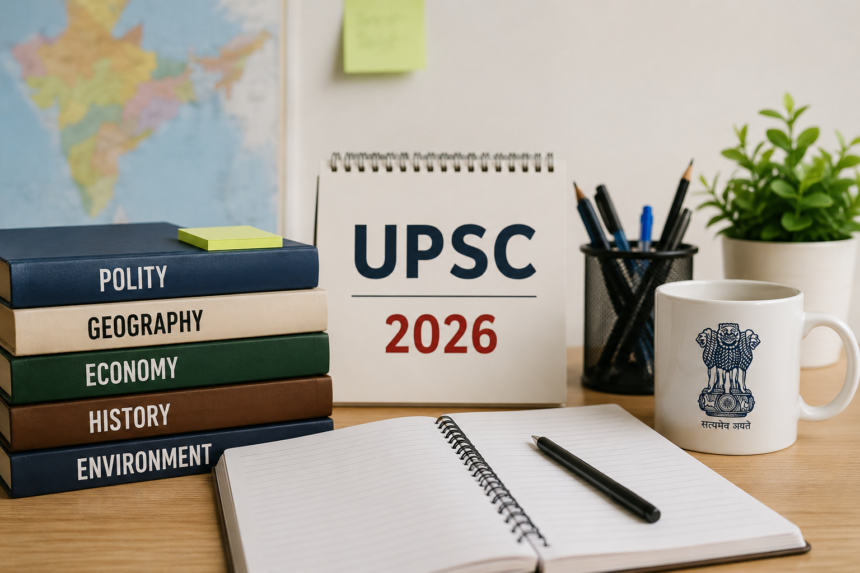
UPSC CSE 2026 Preparation Guide for Beginners, over 10 lakh Indians apply for the UPSC Civil Services Examination — one of the most prestigious and competitive examinations in the world. Only around 1,000 candidates ultimately make it to the Indian Administrative Service, Indian Police Service, Indian Foreign Service, and other elite civil services. The ratio of success is humbling: roughly 0.1% of applicants cross the finish line.
Yet those who clear the UPSC are not mythical geniuses — they are students who understood the syllabus deeply, planned their preparation intelligently, and stayed consistent through doubt, failure, and setbacks. This complete beginner’s guide gives you everything you need to start your UPSC CSE 2026 journey on the right foot — from understanding the exam structure to building a study plan to finding the best free resources available online.
Understanding the UPSC CSE: The Three-Stage Process
Stage 1: Preliminary Examination (Prelims)
The Prelims is a screening test consisting of two papers — General Studies (GS) Paper 1 and the Civil Services Aptitude Test (CSAT). Only Paper 1 marks are counted for merit; CSAT is qualifying at 33%. Paper 1 covers History, Geography, Polity, Economics, Environment, Science, and Current Affairs. It consists of 100 multiple-choice questions with negative marking.
Stage 2: Main Examination (Mains)
Candidates who clear Prelims face the nine-paper Mains examination — a written test that evaluates analytical ability, knowledge depth, and communication skills. The papers include Essay, General Studies Papers 1-4, Optional Subject (2 papers), and two qualifying language papers. The total marks for Mains that count toward the final merit list are 1,750.
Stage 3: Personality Test (Interview)
Candidates who qualify Mains face a 275-mark personality test conducted by the UPSC board. The interview is not a knowledge test — it evaluates judgement, leadership potential, curiosity, communication, and the overall personality of the candidate.
UPSC CSE 2026: Key Dates to Remember
- UPSC CSE Notification 2026 — typically released in February/March
- Last date for application — usually 21 days after notification
- UPSC Prelims 2026 — typically held in June
- UPSC Mains 2026 — typically held in September/October
- Personality Test — February/March of following year
- Final result — April/May of following year
Complete UPSC Prelims Syllabus 2026
General Studies Paper 1 Topics
- History: Ancient, Medieval, Modern India; Indian National Movement
- Geography: Physical, economic, social; world geography; Indian geography
- Polity: Indian Constitution, governance, political system, panchayati raj
- Economy: Planning, economic development, growth, inflation, banking
- Environment: Ecology, biodiversity, climate change, conservation
- Science & Technology: Everyday science, space, defence, IT, biotech
- Current Affairs: Last 12 months; India and world events
12-Month UPSC Study Plan for Beginners
Months 1-3: Foundation Building
Start with NCERTs — the textbooks used in CBSE schools from Class 6 to Class 12 in History, Geography, Economics, and Science. These form the absolute foundation of UPSC preparation. Read them once, make brief notes, and don’t skip anything. Also begin a quality newspaper (The Hindu or Indian Express) from day one — current affairs is a year-round activity.
Months 4-6: Standard References
Move from NCERTs to standard references: Laxmikanth for Polity, Ramesh Singh for Economy, G.C. Leong for Geography, Spectrum for Modern History. Spend focused time on each subject rather than reading everything simultaneously. Begin attempting previous years’ UPSC Prelims question papers to understand the pattern and difficulty level.
Months 7-9: Consolidation and Test Series
Join a reputed UPSC Prelims test series — available both online (Insights on India, Unacademy, Drishti IAS) and offline. Regular test practice is non-negotiable. Analyse every test paper — understand why you got a question wrong. Simultaneously begin Mains answer writing practice by attempting 2-3 essay-type answers every week.
Months 10-12: Revision and Full Tests
The final three months before Prelims should be heavily revision-focused. Take full-length mock tests under exam conditions every week. Revise your notes repeatedly. Focus on weak areas identified from test analysis. Keep current affairs revision daily and compile a summary document of the most important events and topics from the past year.
Best Free Resources for UPSC Preparation 2026
Government Websites — Primary Sources
- Ministry of Education website — for official education policy documents
- PIB (Press Information Bureau) — for government scheme and policy news
- NITI Aayog website — for economic data and policy documents
- RBI Annual Report — essential for economy preparation
Online Platforms
- Insights on India (insightsonindia.com) — arguably the best free UPSC resource; daily current affairs, answer writing
- ForumIAS (forumias.com) — active community, free study materials, test series
- Drishti IAS (drishtiias.com) — Hindi and English; excellent current affairs compilation
- Unacademy free tier — many UPSC educators offer free lectures on YouTube
YouTube Channels
- StudyIQ — comprehensive coverage of all UPSC topics in Hindi and English
- Unacademy UPSC — free lectures from top educators
- UPSC Wallah — by Physics Wallah; growing rapidly with high quality
Common Mistakes UPSC Beginners Make
- Starting too many books simultaneously — stick to 1-2 books per subject, read them thoroughly
- Ignoring current affairs — UPSC increasingly tests news-based questions; read newspapers daily
- Not attempting previous year papers — PYQs are the best guide to what UPSC actually asks
- Neglecting answer writing — Mains success depends on how you write, not just what you know
- Taking too many coaching classes without independent study — coaching is supplementary, not primary
Choosing Your Optional Subject
UPSC CSE 2026 Preparation Guide for Beginners, The UPSC Mains Optional Subject (Paper 6 and 7) contributes 500 marks to your total. Choosing wisely can be the difference between selection and failure. The most popular optional subjects for Indian candidates in 2026 are:
- Public Administration — large number of candidates, good coaching availability
- Sociology — relatively shorter syllabus, good scoring if answered well
- Geography — high overlap with GS papers; beneficial for those with geography background
- History — traditional popular choice; long syllabus but excellent overlap with GS Paper 1
- PSIR (Political Science and International Relations) — strong for those with social science background
Read More: Study Abroad from India 2026: Best Countries for Indian Students Guide
Conclusion
UPSC CSE 2026 Preparation Guide for Beginners — it requires 12-16 months of intense, focused study and the resilience to handle rejection and keep going. But for those who stay the course, the rewards are extraordinary: a career of service, impact, and privilege that few other professions can match.
Start today. Pick up an NCERT. Read the newspaper. And take the first step on a journey that could define your entire life. Taza Newsz covers UPSC news, exam date announcements, and preparation resources regularly. Follow us to stay informed.