
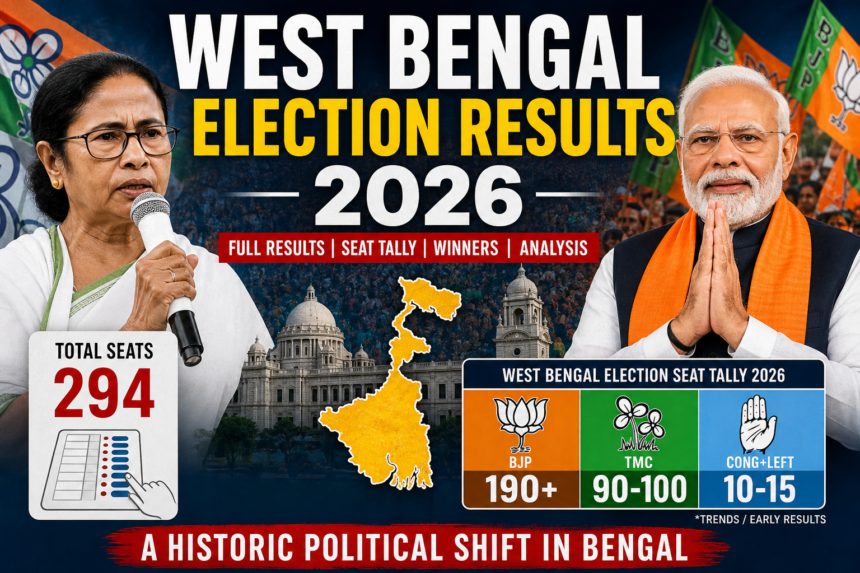
West Bengal Election Results 2026, The Bengal Election have delivered one of the most dramatic political transformations in the state’s history. After years of dominance by the Trinamool Congress (TMC), early trends and emerging results indicate a major power shift, with the Bharatiya Janata Party (BJP) making unprecedented gains and positioning itself to form the government for the first time in the state. According to the latest West Bengal election seat tally 2026, the BJP has surged ahead of the majority mark, reflecting a decisive mandate from voters across the state.
The results are not just significant for West Bengal but also carry national implications, as they reflect evolving voter sentiment and the growing influence of national parties in traditionally regional strongholds.
Overview of West Bengal Elections 2026
The West Bengal Legislative Assembly consists of 294 seats, and a party or alliance needs 148 seats to secure a majority and form the government.
The elections were conducted in multiple phases, with a high voter turnout exceeding 80% in several constituencies, indicating strong public engagement and a highly competitive political environment.
A total of 2,926 candidates contested the elections, making it one of the most competitive electoral battles in recent years.
Latest Results and Seat Trends (2026)
As per the latest available data from counting trends and early results:
- BJP: Leading with over 190+ seats (projected/early results)
- TMC: Around 90–100 seats
- Congress & Left: Limited presence with marginal gains
Early counting trends also showed BJP taking a strong lead:
- BJP leading in 80+ seats early in counting
- TMC trailing significantly in comparison
These numbers indicate that the BJP has not only crossed the majority mark but may achieve a comfortable majority, signaling a decisive mandate.
A Historic Political Shift
The 2026 election marks a historic turning point in West Bengal politics. The state has been governed by:
- Left Front (1977–2011)
- TMC under Mamata Banerjee (2011–2026)
Now, for the first time, BJP appears set to take control of the state government.
According to multiple reports, this shift is being described as a “political tsunami”, reflecting widespread anti-incumbency and changing voter preferences.
Key Constituencies and Battles
West Bengal Election Results 2026, Several high-profile constituencies shaped the narrative of the election:
Bhabanipur (Mamata Banerjee vs Suvendu Adhikari)
- One of the most closely watched battles
- Early trends showed a tight contest between the two leaders
Nandigram
- Symbolic battleground from 2021 elections
- BJP continued to show strength here
Bolpur
- TMC candidate leading by over 15,000 votes in early counting
These constituencies highlighted the intense rivalry between BJP and TMC, which dominated the election.
Factors Behind BJP’s Victory
Several critical factors contributed to BJP’s strong performance:
1. Anti-Incumbency Against TMC
After 15 years in power, voter fatigue and dissatisfaction with governance played a major role.
2. Strong Grassroots Campaign
BJP’s focus on booth-level management and organizational expansion helped it penetrate deeper into rural Bengal.
3. Targeted Welfare Promises
Promises aimed at women voters and financial assistance schemes significantly influenced voting patterns.
4. Cultural and Political Narrative
The campaign emphasized identity, governance issues, and economic concerns, resonating with a broad voter base.
5. Fragmented Opposition
Congress and Left parties failed to present a united challenge, allowing BJP to consolidate anti-TMC votes.
TMC’s Performance and Challenges
West Bengal Election Results 2026, The Trinamool Congress, led by Mamata Banerjee, faced a tough election:
- Loss of traditional strongholds in several regions
- Erosion of minority and rural vote banks in some areas
- Strong challenge from BJP even in South Bengal
Despite setbacks, TMC retained influence in select regions and remained a significant opposition force.
Role of Other Parties
Congress
- Attempted a comeback but struggled to regain relevance
- Managed to lead in a few constituencies early on
Left Front
- Continued decline in electoral performance
- Limited impact compared to previous decades
Smaller Parties
- Played spoiler roles in select constituencies
- Marginal impact on overall results
Voter Turnout and Public Mood
The 2026 elections witnessed exceptionally high voter turnout, reflecting:
- Strong political engagement
- Desire for change among voters
- High-stakes perception of the election
Reports indicated turnout figures above 85% in several constituencies, signaling a highly energized electorate.
Market and Economic Impact
Interestingly, the election results also influenced financial markets:
- Stock markets showed positive movement
- Investor confidence increased due to political stability expectations
This highlights how political outcomes can directly affect economic sentiment.
National Implications
The West Bengal election results have broader political consequences:
Strengthening BJP Nationally
The victory reinforces BJP’s position as a dominant national force and expands its footprint in eastern India.
Setback for Opposition Alliance
The results are seen as a major blow to opposition unity ahead of future national elections.
Impact on Future Elections
The outcome is likely to influence:
- 2029 Lok Sabha elections
- Political strategies in other states
Read More: West Bengal Exit Poll 2026: What Early Trends Reveal About BJP vs Trinamool
Conclusion
The West Bengal Election Results 2026 represent a watershed moment in Indian politics. The apparent rise of the BJP in a state long dominated by regional forces signals a significant shift in voter behavior and political dynamics.
While final numbers may still evolve as counting concludes, the broader trend is clear: West Bengal is witnessing a new political era. The outcome reflects not just a change in government but also a transformation in the state’s political identity.
As the dust settles, all eyes will now be on how the new leadership governs and whether it can meet the high expectations set by voters.